

aSERP
See how six AI engines describe your brand from one place: prompt-level and topic-level tracking covers OpenAI, Anthropic, Gemini, Perplexity, Grok, and DeepSeek, with per-engine visibility metrics for each.
Listing not yet reviewed by our editors · How we check
Overview
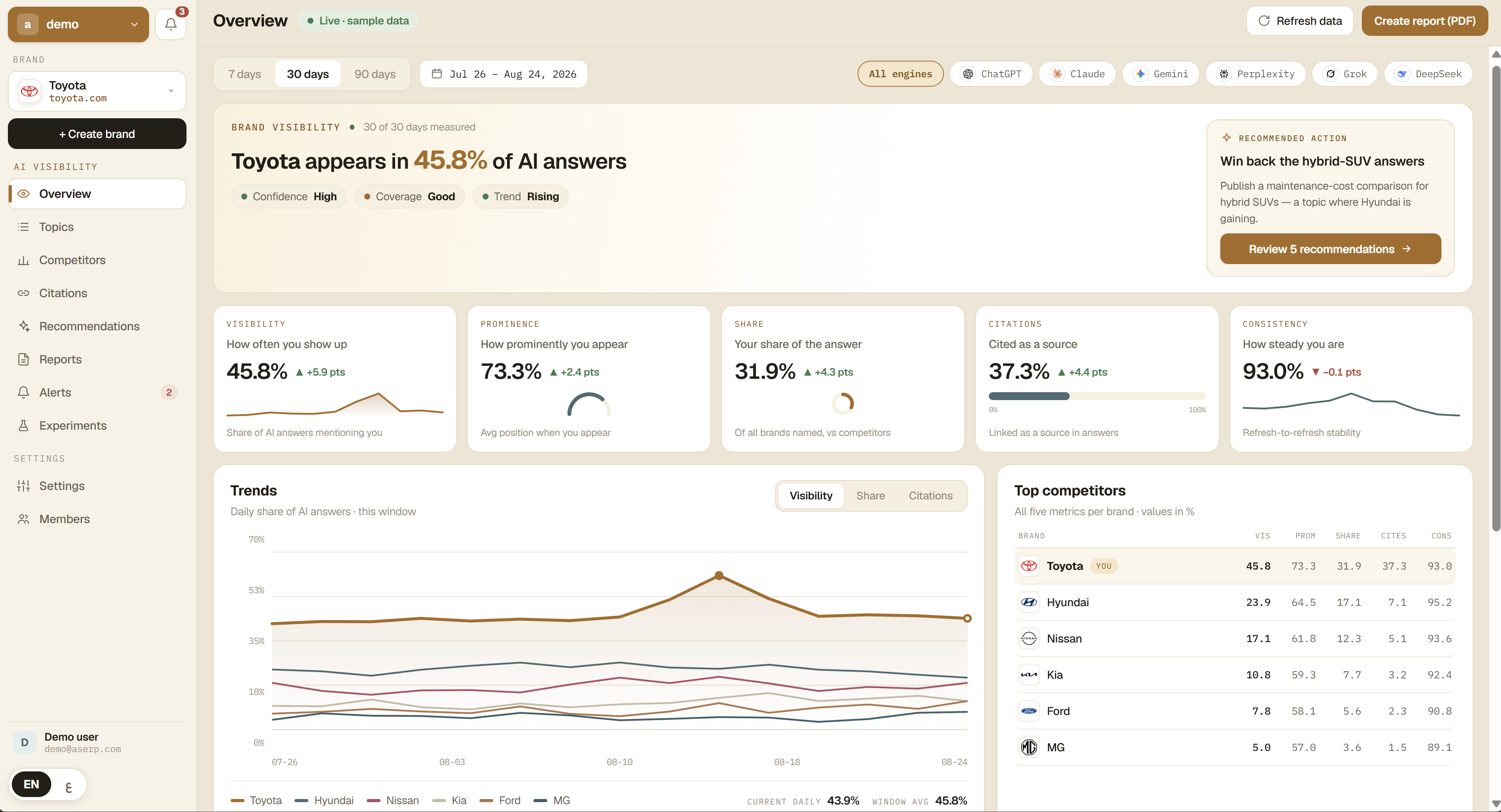
- See how six AI engines describe your brand from one place: prompt-level and topic-level tracking covers OpenAI, Anthropic, Gemini, Perplexity, Grok, and DeepSeek, with per-engine visibility metrics for each.
- Find out exactly where competitors outrank you in AI answers: brand and competitor benchmarking measures share of answer and share of voice side by side.
- Learn which websites AI models trust to describe your market: citation and source analysis shows the sources behind each answer and how often your own site gets cited.
- Back every AI visibility metric with proof: daily answer captures store the actual responses, so stakeholders see the evidence behind each number.
- Move past simple mention counts: brand presence, prominence, citation rate, and consistency show how strongly and how reliably AI answers position your brand.
- React quickly when AI answers change: alerts flag sudden shifts in monitored prompts, and historical trends show what moved and when.
- Know which content changes improve your AI search visibility: recommendations and content experiments measure the share-of-voice lift from each change over time.
- Cut client reporting time for agencies and SEO teams: PDF and Excel exports with scheduled delivery send AI visibility reports to clients and stakeholders automatically.
- Track the questions buyers actually ask in each region: market-specific and language-specific prompt tracking reads each answer in the language it was given.
- Measure your generative engine visibility before you pay: a 7-day free trial with no credit card required, and prompt and market limits set by your plan.
Pros & Cons
From the listing; not yet checked by our editors.
Pros
- Daily answer captures
- Metrics tracking
- Visibility tracking
- Prominence tracking
- Brand share tracking
- Citation analytics
- Generates client-ready reports
- Brand mentions monitoring
- Competitor tracking
- Prompts-level diagnostics
- Alert system for answer shifts
- Content experiments for voice share
- Realistic tracking of customer prompts
- Tracking evolution of answers
- Parsing in native language
- Trust source analytics
- NLP functionalities
- Brand representation improvement strategies
- Brand growth insights
- Customer interaction understanding
- Market insights
- Chatbot performance tracking
- Six answer engine monitoring
- Scheduled reports in PDF & Excel
- Customizable tracking prompts
- Alerts for answer shifts
- Market-true prompts tracking
- Actionable recommendations
- Metrics per answer engine
- Allows content experiments
- White-label reports
Cons
- No mobile application
- Monitoring capacity and advanced features depend on the plan
- Monitoring capacity and advanced features depend on the plan
- A paid subscription is required after the trial
Alternatives to aSERP
Tools that share the most tags with aSERP.
- Lucid Engine
Get your brand recommended by AI search engines instead of your competitors with the Competitor Radar feature that identifies who AI prefers.
Paid · from $99/month
$99/month
Not yet checked
- Skillaeo
Ensure your brand is accurately cited in AI-generated answers on ChatGPT, Claude, and Perplexity with real-time AEO analysis that queries multiple AI engines.
Freemium · from $19.90/month
$19.90/month
Not yet checked
- Scrunch
Gain a competitive edge by tracking your brand's presence and ranking for any prompt against competitors, powered by real-time prompt analytics.
Free trial · from $250/month
$250/month
Not yet checked
- AI Mention You
Discover your website's visibility across AI assistants and chatbots with a single domain scan, revealing mentions traditional SEO tools miss.
Freemium · from $19/month
$19/month
Not yet checked
- Egaki
See exactly how often your brand appears in AI search results and LLMs with continuous visibility tracking, turning unknown performance into a clear feedback loop.
Not listed
Not listed
Not yet checked
- Arobis | AI Visibility Checker
Know exactly how discoverable your site is to ChatGPT, Gemini, Claude, and Perplexity with a single domain entry and zero sign-up friction
Free
Not listed
Not yet checked
Reviews
Rate this tool
Loading reviews...
Frequently asked questions
What is the purpose of aSERP?
The purpose of aSERP is to measure how different AI systems interpret and describe brands, their products, and even their competitors. Its goal is to offer valuable insights into the representation of brands across various AI platforms and provide actionable conclusions for brand growth and representation improvement.
How does aSERP interpret and describe brands?
aSERP interprets and describes brands by tracking how different AI platforms, including models like ChatGPT, Claude, Gemini, Perplexity, Grok, and DeepSeek, respond to specific prompts. Based on this tracking, it can provide specific insights into how these AI systems interpret and describe brands, products, and competitors.
What data does aSERP gather and how is it presented?
aSERP gathers data on how often a brand appears in AI answers (visibility), how strongly a brand is positioned in answers (prominence), brand share, and citations (how often a brand's website is included in answers), and consistency. This data is then presented in a comprehensible manner to provide actionable insights for brand growth and representation improvement.
What are the key features of aSERP?
Key features of aSERP include daily answer captures, metrics tracking (visibility, prominence, brand share, citations, and consistency), client-ready report generation, brand mention and competitor tracking, diagnostics at prompt level, alert systems for sudden answer shifts, and the ability to run content experiments to measure voice share.
What metrics does aSERP track and why?
aSERP tracks important metrics like visibility, prominence, brand share, citations and consistency. Tracking these metrics is crucial as they enable brands to see how often and prominently they appear in AI responses, their standing in relation to competitors, how often their website gets included in answers, and the consistency of these occurrences.
Can aSERP monitor both brand mentions and competitor tracking?
Yes, aSERP has features that enable it to monitor both brand mentions and competitor tracking. This gives brands the ability to understand their brand positioning and performance in the market in comparison to their competitors.
What does the aSERP's alert system do?
The alert system in aSERP is designed to notify users of sudden shifts in answers. This can help brands be adaptable and respond swiftly to changes in customer needs and market trends.
What are content experiments in aSERP?
Content experiments in aSERP allow brands to modify or test different strategies to measure their share of voice. This could include testing changes to their website content or implementing new marketing strategies and observing how they impact the brand's appearance in AI answers.