

Overview
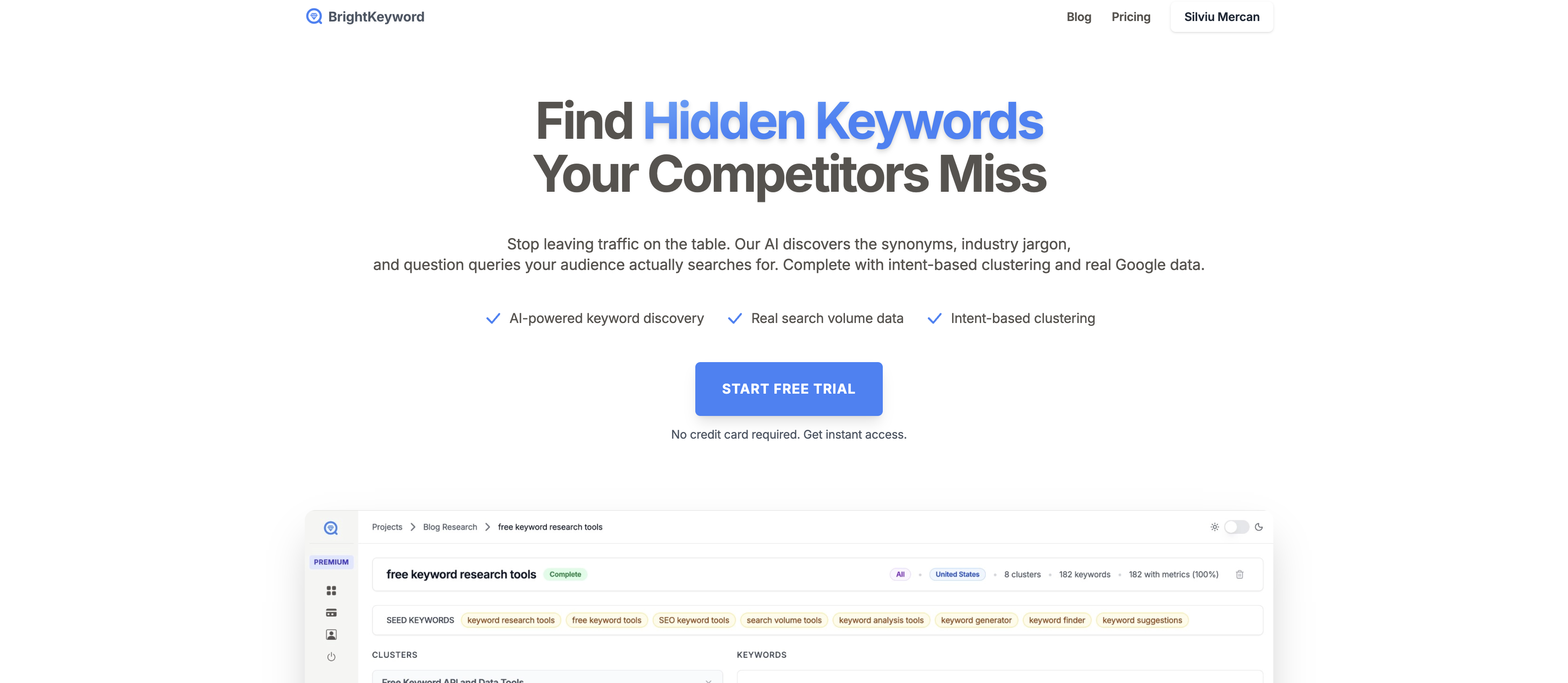
- Discover hidden keywords competitors overlook by using AI that generates terms in your specific audience's exact language and search patterns, not generic phrases.
- Structure your content effectively with keywords automatically organized into intent-based clusters, each mapped to a recommended page type like blog posts or product pages.
- Prioritize high-opportunity keywords using real search volume data, CPC, competition level, and 12-month trend history attached to every term.
- Capitalize on emerging trends before competitors by spotting keywords with sudden spikes or steady growth via detailed 12-month search history charts.
- Target any global market with confidence using localized keyword data and metrics tailored to your selected geographic region.
- Export your complete keyword strategy seamlessly by downloading all research, clusters, and metrics to CSV for integration with your content calendar.
Pros & Cons
Pros
- Identifies hidden keywords
- Discover industry-specific terminology
- Uncover long-tail variants
- Identify question-based queries
- Finds LSI keywords
- Generates audience-specific language
- Organizes keywords into clusters
- Maps clusters to page types
- Recommends search intent
- Enriches keywords with data
- Offers keyword volume data
- Shows CPC for keywords
- Reveals keyword competition level
- Provides 12-month search trend
- Filtering and sorting options
- Discover trending keywords feature
- Localized keyword data
- Secure, private research
- Recommends content structuring
- Aids in SEO Rankings
- Offers insights on targeting
- Target any global market
- Uncover obscured keywords
- Real search volume data
- Support customization of audience
- Automatic intent-based clustering
- Analysis and prioritization aid
- Detailed change in trend volume
- Specific industry or niche targeting
- Real advertiser data metrics
- Transparent pricing model
- Hidden terminology discovery
- Supports question keywords
- Verifies Google data
- Semantic terms discovery
- Supports international SEO campaigns
- Private keyword research
- Organizes research into projects
- Useful for SEO professionals
- Useful for content marketers
- Beneficial for indie founders
- Tools for agencies
- Supports niche markets
- Local storage for preferences
- Essential cookies always active
- Performance and functionality cookies
Cons
- No free plan available
- Limited topics per month
- Extra cost for additional topics
- No API for integration
- No real-time customer support
- Data source not specified
- No mobile app version
- Limited keyword quantity per topic
- No multi-language support
- No integration with other SEO tools
Reviews
Rate this tool
Loading reviews...
❓ Frequently Asked Questions
BrightKeyword is an AI-powered keyword discovery tool. Its design revolves around the identification of hidden keywords that competitors may overlook. This includes industry-specific terminology, long-tail variants, synonyms, question-based queries, and Latent Semantic Indexing (LSI) keywords. BrightKeyword generates these keywords based on language, terminology, and search patterns specific to a user's target audience, not generic phrases. The tool groups these keywords into intent-based clusters and enriches each keyword with real search data, volume, Cost Per Click (CPC), competition level, and 12-month trend history.
BrightKeyword involves a simple four-step process: defining the market by entering a subject and selecting the target demographic and geographic market; AI-based discovery and clustering of six types of keywords (synonyms, industry-specific terminology, long-tail variants, question queries, and LSI keywords) into intent-based clusters; analyzing and prioritizing using various filters and metrics; and spotting rising trends with the help of 12 months of search history. Every keyword is enriched with real search data: volume, CPC, competition level, and 12-month trend history.
BrightKeyword differentiates itself from other keyword tools by utilizing AI to discover a range of keyword types, including frequently overlooked synonyms, industry jargon, and question queries. Rather than generating keywords based on seed terms, BrightKeyword discovers how the user's actual audience communicates. It also uniquely organizes every keyword into intent-based clusters, each mapping to a suggested page type and search intent.
BrightKeyword uses AI to generate keyword data. The user provides a topic, chooses their target demographic (B2B or B2C), and selects a geographic market. Using the exact language, terminology, and search patterns of this specific audience, the AI generates relevant keywords instead of relying on generic phrases.
BrightKeyword can discover numerous types of keywords, including industry-specific terminology, long-tail variants, synonyms, question-based queries, and Latent Semantic Indexing (LSI) keywords.
BrightKeyword utilizes AI to identify hidden and overlooked keywords. It generates these keywords based on the specific language, terminology, and search patterns of the user's target audience instead of generic phrases. This strategy allows it to uncover terminology, synonyms, and question queries that would typically be missed.
'Intent-based clusters' in BrightKeyword groups related keywords together based on the search intent they reflect. Each of these clusters then maps to a suggested page type (such as blog post, product page, or comparison page), making it easier for content creators to understand which keywords belong together and how to structure their content.
BrightKeyword enriches each keyword with real search data including volume, Cost Per Click (CPC), competition level, and 12-month trend history. This data offers valuable insights into keyword performance and potential.
Yes, BrightKeyword allows users to filter and sort keywords by various parameters, enabling them to discover the highest opportunity keywords most efficiently.
BrightKeyword helps identify trending keywords by providing 12 months of search history for every keyword. This feature enables users to identify sudden spikes or steady growth, allowing them to capitalize on emerging topics before their competitors.
Yes, BrightKeyword provides localized keyword data. Users can select their target geographic market when setting the context for keyword generation, ensuring the generated keywords and their metrics are relevant for their specific market.
Yes, keyword research conducted via BrightKeyword is secure and private. User data is kept confidential; topics, keywords, and research are securely stored and accessible only to the individual user.
BrightKeyword aids in structuring content by organizing keywords into intent-based clusters that each map to a recommended page type. This helps users understand which keywords belong together and how to structure their content effectively. It takes away the guesswork in determining which keys correspond to which type of content.
BrightKeyword provides multiple page type recommendations for different keywords, including blog posts, product pages, comparison pages, and more. These recommendations stem from the intent-based clusters that the tool forms, helping users understand where each keyword is best placed.
BrightKeyword generates keywords in line with the specific language and search patterns of a user's target audience. Users define their market by entering a topic and choosing their target demographic and geographic market. The AI then generates keywords using the language, terminology, and search patterns of this specific audience, making the discovered keywords more precise and relevant to the audience.
'Search intent' in BrightKeyword refers to the purpose behind a web user's specific search query. The tool organizes keywords into clusters based on their corresponding search intent, which maps to a recommended page type. This feature helps users to structure their content more effectively and target their audience's needs more precisely.
BrightKeyword utilizes AI to generate industry-specific terminology. The tool discovers keywords that reflect the specific language, terminology, and search patterns of the user's target audience, hence being able to surface industry-specific language that might be overlooked by traditional keyword discovery tools.
In BrightKeyword, long-tail variants and LSI keywords are key elements in keyword discovery. Long-tail variants are typically less competitive and can capture more specific search intent, while LSIs help in building topical authority, signaling expertise to search engines, and aiding content to rank for broader topics.
Yes, BrightKeyword aids users in taking advantage of high-opportunity keywords. It offers filtering and sorting by various parameters, thereby making it easier to uncover the most profitable keyword opportunities. Real search data, including volume, CPC, competition level, and 12-month trend history, also assist in capitalizing on these opportunities.
Yes, BrightKeyword offers several features to outperform competitors in SEO. Identifying hidden keywords your competitors may miss, generating industry-specific terminology, long-tail variants, synonyms, question-based queries, and Latent Semantic Indexing (LSI) keywords specific to your audience language, and pinpointing trending keywords before competitors are some of the competitive advantages offered by BrightKeyword.
BrightKeyword is suited for freelancers, founders, digital marketing agencies, and teams that aspire to optimize their keyword strategies. It helps uncover hidden keywords that could be missed by more traditional tools, hence maintaining competitive edge in the marketplace.
BrightKeyword employs AI technology to identify hidden keywords. It generates keyword ideas in the specific language, terminology, and search patterns that the target audience uses. The tool reveals a broad range of hidden keywords, including industry-specific terminology, long-tail variants, synonyms, question-based queries, and LSI keywords that are commonly overlooked by other conventional tools.
The intent-based clusters in BrightKeyword are groups of keywords that are automatically organized according to the intended meaning behind each search query. The AI system assigns them to these clusters, which are each associated with a recommended page type and search intent. In other words, these clusters help users see which keywords relate to which content and this guides them on how to construct their webpage content.
BrightKeyword organizes keywords into intent-based clusters. Each cluster maps to a specific recommended page type, such as a blog post, product page, or comparison page, and also aligns with the relevant search intent. This way, users can readily identify the kind of content they need to create and which keywords should be grouped together.
Yes, BrightKeyword does provide real search volume data. Each keyword that the AI tool identifies is equipped with a wealth of real search data, such as volume, cost per click (CPC), competition level, and a 12-month trend history. This data provides insights into the popularity and competitiveness of each keyword.
BrightKeyword guides on content structure by mapping eaxh keyword to a recommended page type (for example, a blog post, product page, comparison page) and search intent. This mapping allows users to understand which keywords belong together and how to organize their content effectively for optimal SEO results.
Within the context of BrightKeyword, 'industry-specific terminology' refers to the unique jargon or phrases used within specific industries, trades, or fields. The AI tool uncovers these terminologies that the target audience may be using in search queries. This involves identifying these niche terminologies to ensure that the uncovered keywords are relevant and effective within the specific industry.
BrightKeyword uncovers different types of keywords including industry-specific terminologies, long-tail variants, synonyms, question-based queries, and LSI keywords. In addition to these, the AI-powered tool also emphasizes on finding keywords that users' competitors are prone to missing.
BrightKeyword helps find trending keywords by providing each keyword with a 12-month trend history. Users can see detailed charts showing changes in search volume over time by hovering over the trend indicator. This feature allows for the quick identification of keywords experiencing sudden increases or steady growth.
Yes, BrightKeyword supports local markets. It provides localized keyword data for any country, allowing users to target their SEO efforts effectively in any given market around the globe.
BrightKeyword ensures privacy of your keyword research by securely storing your topics, keywords, and research and making them accessible only to you. It guarantees that it does not share your data with third parties or use it for model training.
BrightKeyword guides on which keywords belong together using its intent-based clustering feature. The AI system groups similar keywords into clusters, each of which maps to a specific recommended page type and search intent. This way, users can understand which keywords are relevant to which page type and how to structure the content accordingly.
Yes, BrightKeyword does offer a strategy for SEO rankings. It uncovers hidden, high-performing keywords, provides insights on keyword trends and competition, offers localized keyword data, and organizes keywords into clusters that map to page types and search intent. This information can be used to implement effective SEO strategies that can improve website rankings.
BrightKeyword generates keywords in the language, terminology, and search patterns that are specific to an indicated target audience. Instead of delivering generic phrases that may not be as effective, the AI tool uses the exact dialect and terms that the audience uses in their search queries.
In BrightKeyword, Latent Semantic Indexing (LSI) keywords are terms related to the primary keyword. These are words frequently found together because they share the same context. LSI keywords help build topical authority, signal expertise to search engines, and make content rank for broader topics. BrightKeyword uncovers these terms, helping users create content that's rich in context and relevance.
Yes, with BrightKeyword, users can analyze and prioritize their keywords. They can toggle between a split view (with clusters on one side and keywords on the other) and a unified table view, filter keywords by search intent, page type, and keyword category or sort keywords by any metric to surface the highest opportunity keywords. These capabilities allow for effective keyword analysis and prioritization.
Yes, users can export data from BrightKeyword. When they are ready, they can export everything to CSV. This allows for seamless integration with users' content calendars or other SEO tools.
With the question queries feature of BrightKeyword, users can find 'how to', 'what is', and 'why' queries frequently used by their target audience. These question keywords drive informational traffic and are perfect for blog posts, FAQs section and opportunities for featured snippets.
Yes, BrightKeyword does help with content targeting and strategizing. The AI tool uncovers a broad range of keywords and organizes them into intent-based clusters that map to different types of pages and search intent. By identifying the exact language and search patterns an audience uses, BrightKeyword helps users create targeted content and formulate effective strategies for SEO.
Pricing
Pricing model
Free Trial
Paid options from
$29/month
Billing frequency
Monthly
Refund policy
Refunds are available within 30 days of your initial purchase.