

Cogny
Run marketing experiments in 1-6 hours instead of 6-12 weeks: auto-monitoring, AI-generated tickets, code execution against your data, and auto-tracked outcomes remove analyst queues, meetings, and agency turnaround.
Listing not yet reviewed by our editors · How we check
Overview
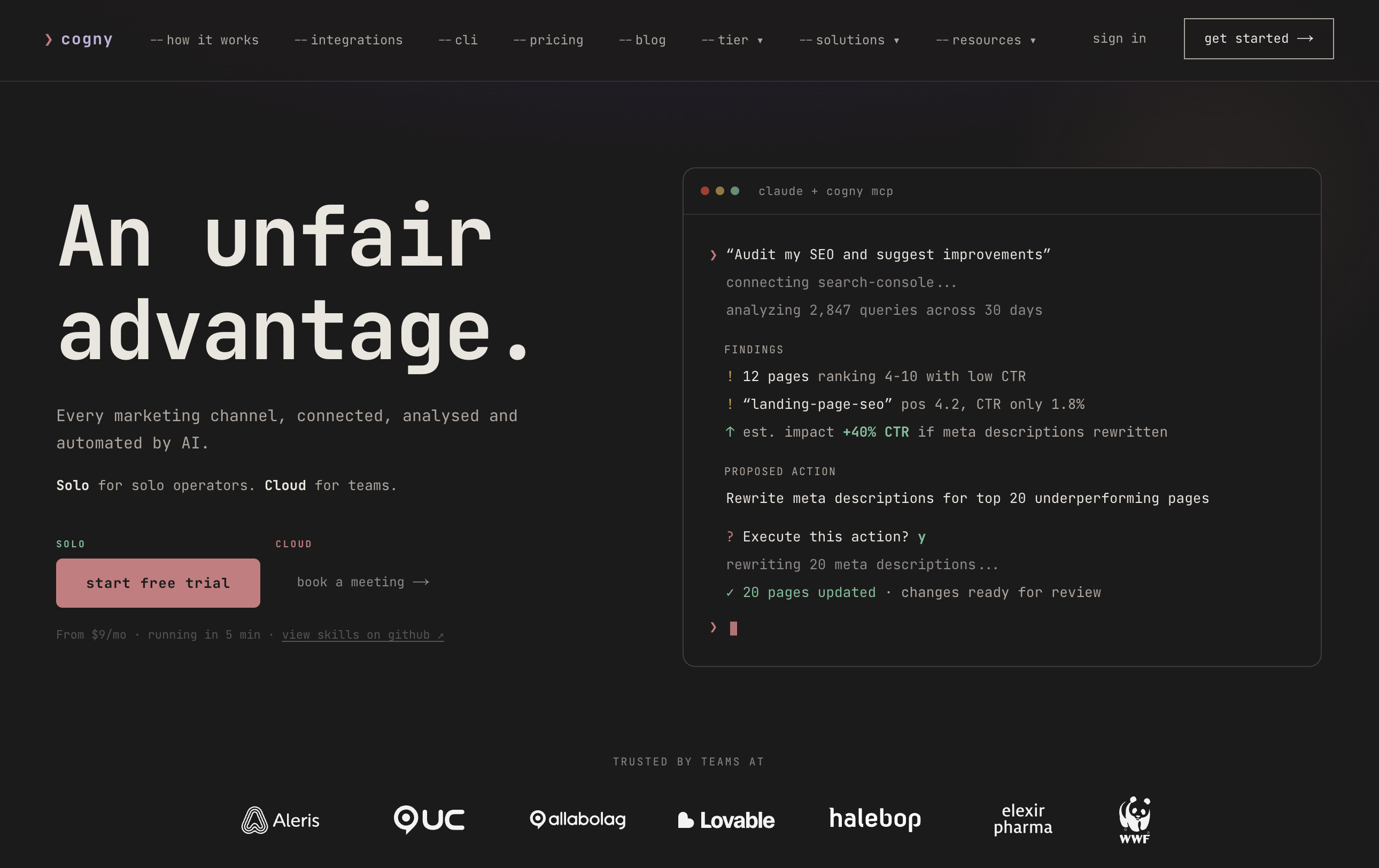
- Run marketing experiments in 1-6 hours instead of 6-12 weeks: auto-monitoring, AI-generated tickets, code execution against your data, and auto-tracked outcomes remove analyst queues, meetings, and agency turnaround.
- Manage every paid channel from one connected workspace: link Google Ads, LinkedIn Ads, TikTok Ads, and Google Analytics to analyze campaign data, build ad strategy, and execute changes without switching dashboards.
- Recover clicks from underperforming pages: Cogny detects low-CTR pages and rewrites their meta descriptions to lift organic search performance.
- Fix the technical SEO issues holding back rankings: automated SEO audits and landing page analysis pinpoint problems across content, keyword usage, and page experience.
- Publish content that matches what searchers want: search intent mapping and content gap detection reveal relevant topics and keywords your site is missing or covers too thinly.
- Stay ahead of rival campaigns and rankings: competitor intelligence and ongoing keyword monitoring track search positions and competitive moves so you adjust strategy early.
- Get your pages cited by AI search engines: GEO optimization and AI citation tracking built on Bing Webmaster data show how AI engines reference your content.
- Reach audiences inside ChatGPT: the OpenAI integration extends your advertising to ads inside ChatGPT.
- Scale from solo marketer to full team without rebuilding workflows: the solo tier covers individual use, while the cloud tier adds shared context, parallel execution, and scheduled tasks for teams.
- Build marketing automation around your own stack: the developer API lets you create custom solutions on top of Cogny's analysis and execution engine.
Pros & Cons
From the listing; not yet checked by our editors.
Pros
- Streamlines digital advertising tasks
- Automates SEO tasks
- Analyzes advertising strategies
- Executes marketing strategies
- Google Analytics integration
- Google Ads integration
- LinkedIn Ads integration
- TikTok Ads integration
- Provides SEO audits
- Keyword monitoring capabilities
- Landing page analysis feature
- Search intent mapping function
- Content gap detection
- Offers competitor intelligence
- Suggests website optimization
- Rewrites underperforming pages' meta
- Built for individuals and teams
- Provides API for developers
- Positions as end-to-end solution
- Designed to improve efficiency
- Integrates various ad accounts
- Offers multichannel connection
- Bing Ads integration
- Meta Ads (Facebook & Instagram) integration
- Google Analytics 4 integration
- Google Tag Manager integration
- Mailchimp integration
- HubSpot integration
- Discord integration
- Built to serve teams
- Supports daily automation
- Allows prompt data query
- Supports variety of integrations
- Fast setup via OAuth
- Real-time SEO queries and rankings
- Performs health audits for tags
- Privacy-first analytics with Plausible and Fathom
- Supports GEO optimization
- Structured data audits
- Provides services for local SEO
- Speedy marketing experiments
- Monitoring and validation of automated experiments
- Connects major email and SMS marketing tools
- Performs LinkedIn campaign audits
- Offers B2B audience analysis
- Optimizes lead generation on LinkedIn
- Flexible pricing options
- Extensive documentation and resources for usage
- Tiers of service for different needs
- Growing list of integrations
Cons
- No custom GPT
- Limited social media integration
- Channel addition rate unpredictable
- Potential privacy issues
- No Pinterest Ads integration
- No Facebook Ads integration
- No Instagram Ads integration
- Restricted SEO tools list
- Limited competitor intelligence options
Alternatives to Cogny
Tools that share the most tags with Cogny.
- SEObot
Eliminate manual keyword research with automated analysis that identifies the most relevant Google search terms for maximum impact
Paid · from $19/month
$19/month
Not yet checked
- Lovarank
Attract qualified traffic with hidden, low-competition keywords discovered automatically by AI analysis of your niche
Free trial · from $99/month
$99/month
Not yet checked
- Nichely
Uncover expert-level subtopics competitors miss through AI-powered Topic Discovery that maps millions of niche relationships
Freemium
Not listed
Not yet checked
- ContentEdge
Generate complete, ready-to-publish content in 15 seconds with AI-powered writing that mimics human language patterns
Free trial · from $24/month
$24/month
Not yet checked
- BlogSEO
Analyzes a website URL, finds keyword opportunities and competitors, then writes blog articles and publishes them to your CMS on a schedule.
Free trial · from $97/month
$97/month
Nov 23, 2026
- Wellows
Understand exactly how AI models interpret your brand with a unified dashboard tracking citations, sentiment, and visibility trends across ChatGPT, Perplexity, and Gemini
Free trial · from $39.99/month
$39.99/month
Not yet checked
Reviews
Rate this tool
Loading reviews...
Frequently asked questions
What is Cogny?
Cogny is an AI-powered marketing tool designed to automate digital advertising and search engine optimization tasks. It works by connecting to ad accounts and performing a range of tasks from analysis to strategy formulation and execution. The platform can be integrated with numerous channels such as Google Analytics, Google Ads, LinkedIn Ads, TikTok Ads, etc.
How does Cogny automate digital advertising tasks?
Cogny automates digital advertising tasks by linking to ad accounts and executing a series of mechanisms, including analysis of the advertising data, forming strategies based on the analysis, and executing those strategies. It operates across different channels for a more extensive reach.
How does Cogny integrate with Google Analytics and Google Ads?
Cogny integrates with Google Analytics and Google Ads by connecting to users' accounts on these platforms. It can then analyze the data from these platforms, formulate strategies, and execute tasks related to digital advertising and SEO, such as keyword monitoring, content gap detection, and more.
What specific tasks can it perform on LinkedIn Ads and TikTok Ads?
On LinkedIn Ads and TikTok Ads, Cogny can analyse the ad campaign data for LinkedIn and track short-form ad metrics for TikTok. The precise tasks it performs on these platforms may include but are not limited to data analysis, strategy formulation for ad campaigns, and their execution.
What kind of SEO services does Cogny provide?
Cogny provides a suite of SEO services including SEO audits, keyword monitoring, landing page analysis, search intent mapping, content gap detection, and competitor intelligence. It also suggests optimization tasks like rewriting meta descriptions for underperforming pages.
How does Cogny perform SEO audits?
Based on the information on their website, details about the specifics of the SEO audit process aren't clear, but it's inferred that Cogny uses its AI capabilities to analyze the SEO elements of a website, identify issues and areas for improvement, and implement corrective actions.
What exactly does keyword monitoring mean in Cogny?
In Cogny's context, keyword monitoring likely refers to tracking of specific keywords in terms of their performance, position in search results and their impact on the website's SEO. This enables ongoing optimization and adjustments to the SEO strategy.
How does Cogny analyse landing pages?
Cogny's landing page analysis probably entails an AI-driven assessment of the landing pages identified from connected ad accounts. Parameters like content, keyword usage, UX, and other SEO factors might be analyzed. However, details of the exact process are not provided.