

Continual
Build predictive models without complex engineering using familiar SQL and dbt declarations
Listing not yet reviewed by our editors · How we check
Overview
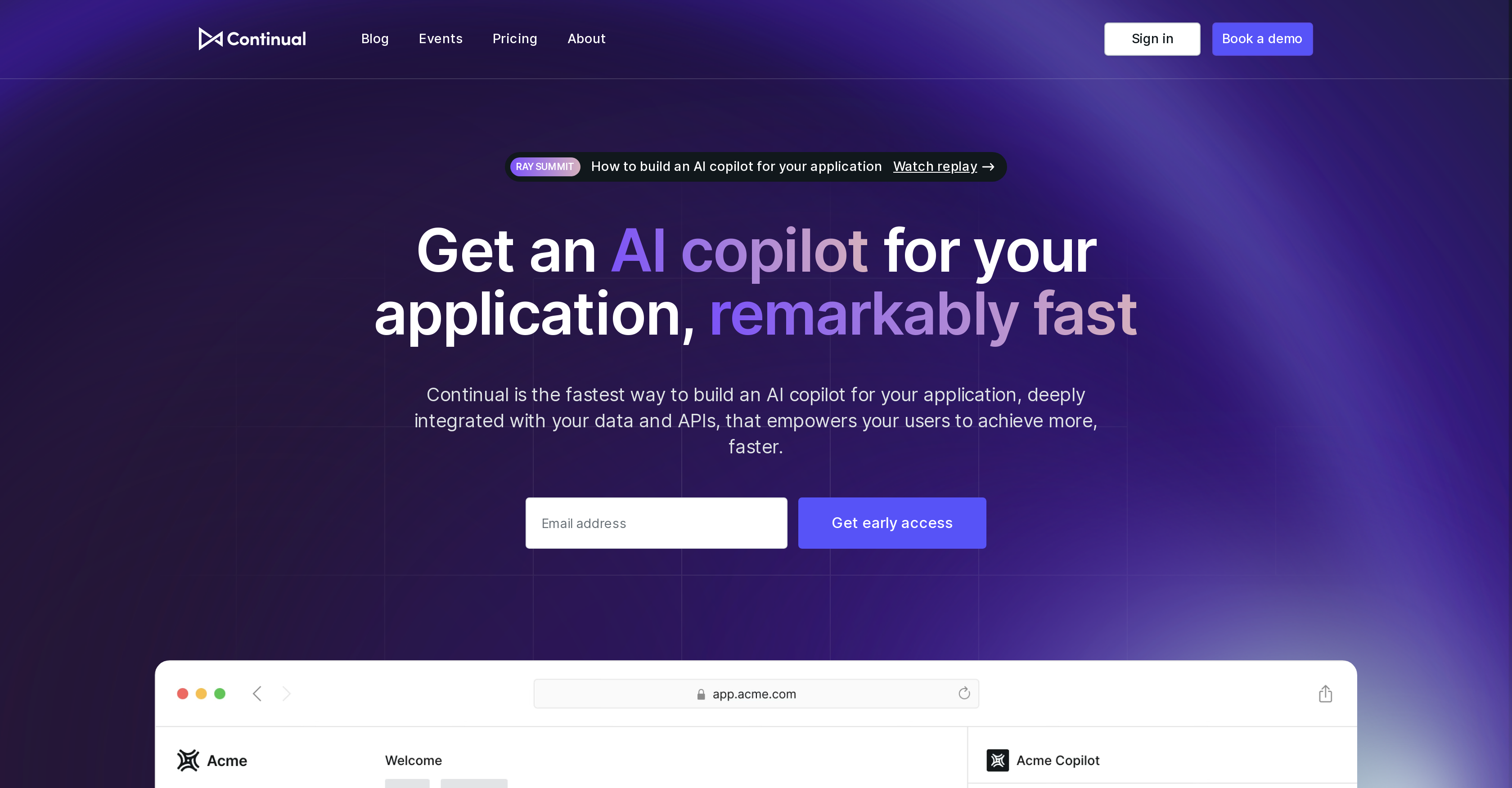
- Build predictive models without complex engineering using familiar SQL and dbt declarations
- Forecast customer churn and inventory demand with models that automatically improve accuracy over time
- Deploy state-of-the-art machine learning directly on your data warehouse without building new pipelines
- Share feature definitions and models across teams through a centralized feature store for faster development
- Extend predictive capabilities with Python integration while maintaining declarative AI engine simplicity
- Keep all data and models stored directly in your existing cloud data platform for easy accessibility
Pros & Cons
From the listing; not yet checked by our editors.
Pros
- Cloud-based predictive modeling
- Uses SQL for app creation
- Works with BigQuery, Snowflake, Redshift, and Databricks
- No need for complex infrastructure
- Models improve continually
- Data and models stored on warehouse
- Easily accessible to operational and BI tools
- Suitable for customer churn, inventory demand, and customer lifetime value predictions
- Equally accessible to data scientists
- Facilitates Python integration
- Shared features accelerate model development
- Simplifies process of building and maintaining predictive models
- Models are up-to-date
- Centralized feature store
- Extensible with Python
- CI/CD friendly
- GitOps workflow support
- Zero infrastructure requirement
- Works natively with modern cloud data platforms
- Declarative model and feature definition
- dbt integration
Cons
- SQL-centric
- Limited to cloud data platforms
- Dependency on modern data stacks
- No MLOPS infrastructure
- Limited extensibility (Python only)
- Dependent on dbt compatibility
- Not suitable for traditional data management systems
- Data must be on the same warehouse
- No mention of multilingual support
- Dependent on continuous access to data warehouse
Alternatives to Continual
Tools that share the most tags with Continual.
- Stack AI
Build custom AI applications in minutes without writing code using an intuitive drag-and-drop interface and pre-built workflow templates
Freemium · from $139/month
$139/month
Not yet checked
- LaunchLemonade
Build custom AI assistants for your business without writing any code using our intuitive visual platform
Free trial · from $25/month
$25/month
Not yet checked
- Origin AI
Create custom enterprise software without hiring developers through AI-driven development that replaces traditional coding requirements
Paid · from $25/month
$25/month
Not yet checked
- Solid
Generate production-ready Tailwind and React code instantly from a simple text prompt, URL, or image upload, eliminating manual front-end coding
Freemium · from $20/month
$20/month
Not yet checked
- Floot
Launch your web app idea without writing code by describing it in chat or visually with our AI-powered platform
Freemium · from $25/month
$25/month
Not yet checked
- Chef by Convex
Launch production-ready full-stack apps with built-in database, authentication, and file uploads through automated backend configuration
Freemium · from $25/month
$25/month
Not yet checked
Reviews
Rate this tool
Loading reviews...
Frequently asked questions
What is Continual?
Continual is an operational AI platform created to assist in building predictive models on data stacks. It eliminates complex engineering requirements, simplifying the predictive models' building and maintenance process through SQL or dbt declarations.
What can I do with Continual?
With Continual, you can create and enhance predictive models on data stored on various popular cloud data platforms such as BigQuery, Snowflake, Redshift, and Databricks. It enables you to easily predict customer churn, inventory demand, and customer lifetime value.
What types of predictive models can I build with Continual?
Continual allows you to build diverse predictive models. Businesses can predict parameters like customer churn, inventory demand, and customer lifetime value. These predictive models can be enhanced and are always up-to-date, continually improving their accuracy.
Which cloud platforms is Continual compatible with?
Continual is compatible with popular cloud data platforms like BigQuery, Snowflake, Redshift, and Databricks. It sits on top of these platforms to build, deploy, and enhance predictive models.
How do I create predictive models in Continual?
To create predictive models in Continual, you can utilize SQL or dbt declarations. Users can define features and models declaratively and employ SQL or dbt or extend with Python. This declarative approach simplifies the process, allowing the best use of your data without needing to write code or pipelines.
Is Continual user-friendly for people who know SQL and dbt?
Absolutely, Continual is designed to be user-friendly for individuals knowledgeable in SQL and dbt. Its declarative approach and the ability to connect to your existing cloud data warehouse streamline the process, making it an ideal tool for modern data teams who prefer SQL or dbt.
Is there a need for complex engineering to use Continual?
No, there is no need for complex engineering to use Continual. It enables the building of predictive models that never stop improving without any complex engineering due to its declarative approach to AI.
How can I integrate Python into Continual?
In Continual, data scientists can extend the platform by integrating Python. This provides versatility, uniting analytics and AI teams with full extensibility of Continual's declarative AI engine.