

DeepAstro
See your full astrocartography map in minutes, free and without signing up: enter birth date, time, and birthplace to get all ten planetary lines across ASC, DSC, MC, and IC angles, with no account or payment details required.
Listing not yet reviewed by our editors · How we check
Overview
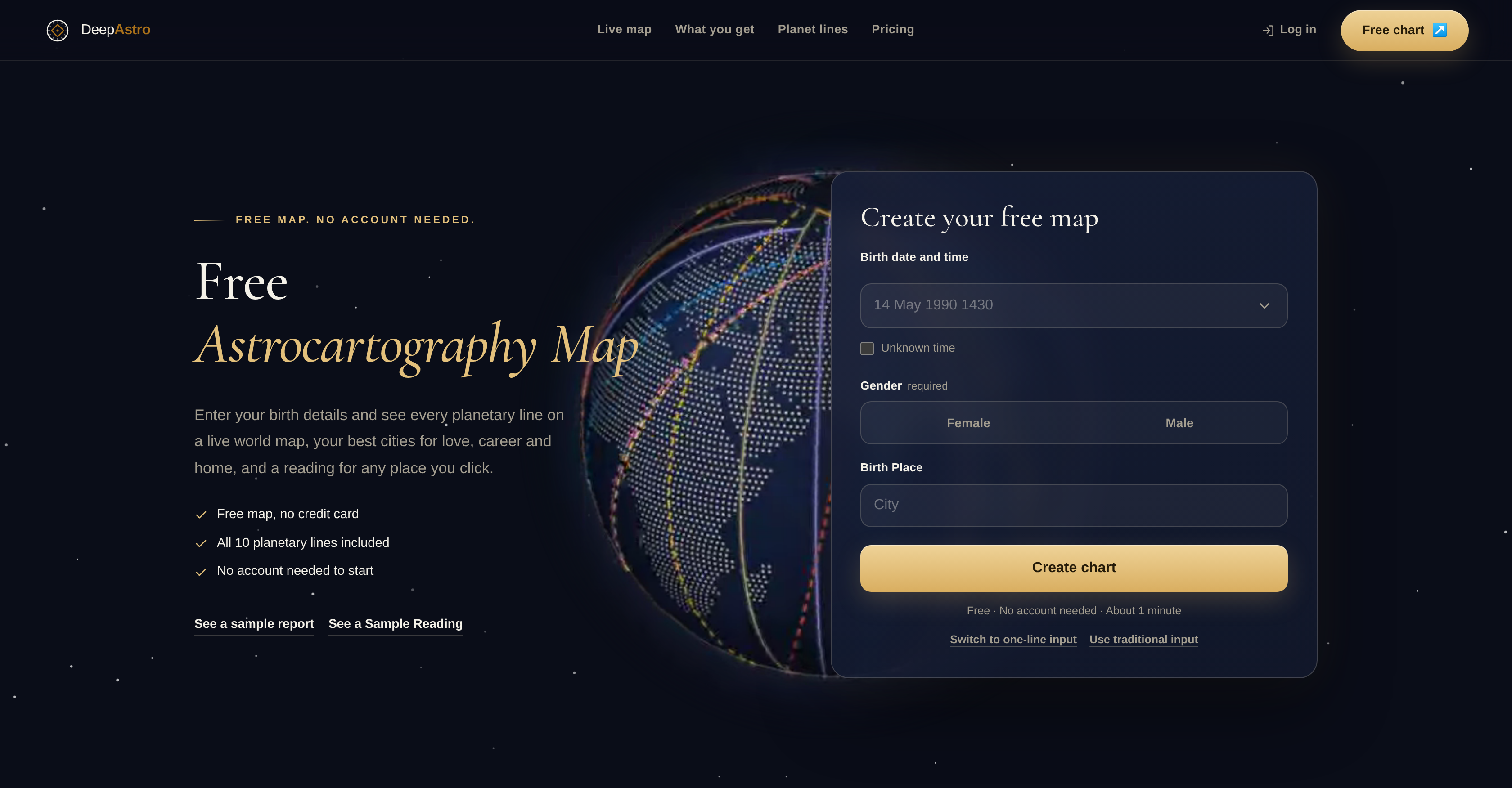
- See your full astrocartography map in minutes, free and without signing up: enter birth date, time, and birthplace to get all ten planetary lines across ASC, DSC, MC, and IC angles, with no account or payment details required.
- Shortlist relocation destinations by life goal: city rankings for love, career, home, and personal growth are driven by the proximity of relevant planetary lines like Venus/DSC, Sun or Jupiter/MC, and Moon/IC.
- Decide between real-world moving options with confidence: side-by-side city comparison applies practical filters for budget, language, and family requirements alongside your planetary lines.
- Get a location-specific reading tied to your own birth chart, not generic horoscope copy: click any city to see the nearby planet, angle, approximate distance in kilometers to the line, local context, and supportive versus difficult themes.
- Ask direct questions about any place or line and get answers grounded in your calculated chart: chart-aware AI follows a fixed sequence of planet function, angle meaning, distance, local circumstances, and opportunities versus friction.
- Walk away with a clear action plan for a single city: personal city reports organize what the location supports, likely tensions, and the questions to investigate next.
- Still map your planetary geography when your birth time is uncertain: unknown-time mode keeps the planetary lines, drops unsupported claims about ASC, DSC, MC, and IC, and states the limits plainly.
- Explore your planetary lines spatially and spot clusters across continents: interactive 2D and 3D world maps let you rotate, zoom, and click through every line.
- See how one specific place re-houses your natal chart: the relocation chart recalculates houses and angles for a selected city while keeping your birth moment fixed.
- Pick up your relocation research on any device: saved charts, selected cities, and AI readings are stored under a free account and reopen after login.
- Pay once and keep what you buy, with no recurring charges: City Brief, Pro, and Ultimate options add structured city reports, extra AI readings, and unlimited city checks as one-time Stripe purchases with no subscription or auto-renewal.
- Preview the reading format before entering any personal data: a sample reading shows a highlighted planet and angle, a sample city's line distance, an interpretive paragraph, and a reflective prompt.
Pros & Cons
From the listing; not yet checked by our editors.
Pros
- No account required initially
- All ten planetary lines free
- Interactive 2D world map
- Interactive 3D globe visualization
- Clickable city details overlay
- Approximate line distance displayed
- Goal-specific city rankings
- Love, career, home filters
- Sidebyside city comparison
- Budget, language, family filters
- Chartaware contextual Q&A
- Saved charts sync across devices
- Free account preserves data
- Handles unknown birth time
- Conservative uncertainty messaging
- Precise birthtime emphasis
- Accurate timezone conversion
- Historical timezone support
- Onetime purchase, no subscription
- Secure Stripe payment processing
- Sample reading before chart
- Consistent interpretation sequence
- Structured personal city reports
- Unlimited city checks (paid)
- Multiple contextual readings per plan
- No hidden subscription fees
- No creditcard needed for free
- Live map updates instantly
- Visual line proximity cues
- Supports both latitude/longitude inputs
- Automatic coordinate normalization
- Realtime planetary position calculation
- Angle (ASC, DSC, MC, IC) mapping
- Detailed planet function descriptions
- Contextual city cultural notes
- Exportable report options
- Mobilefriendly responsive design
- Multidevice accessibility
- No ads on free version
- Transparent calculation methodology
- Supports gender input for interpretations
- Fast chart generation (<1 minute)
- Clicktocopy city coordinates
- Customizable distance thresholds
- Integrated language filter for cities
- Clear uncertainty indicators
Cons
- Requires precise birth time
- No API for integration
- Limited offline functionality
- City database capped
- 3D map performance lag
- Cannot export PDF reports
- Only western astrology supported
- Filters lack demographic depth
- Payment via Stripe only
Alternatives to DeepAstro
Tools that share the most tags with DeepAstro.
- AstroCarto
See exactly how moving to a new city shifts your astrological outlook by generating a full astrocartography chart for any location
Free trial · from $19.90
$19.90
Not yet checked
- Astrocartography Calculator
Identify the exact cities and countries that amplify your career visibility by projecting your natal Sun and Jupiter lines onto a precise world map.
Freemium · from $9.90/unit
$9.90/unit
Not yet checked
- Astrocartography Chart
Choose where to move or travel with confidence: enter your birth date, exact birth time, and birthplace to get a personalized astrocartography map showing where your planetary lines cross major world cities.
Freemium · from $9.90
$9.90
Not yet checked
Reviews
Rate this tool
Loading reviews...
Frequently asked questions
How does DeepAstro calculate my planetary lines from my birth data?
DeepAstro first normalizes the birth data by resolving the place name to geographic coordinates, applying the local timezone and converting the local time to UTC. It then calculates the precise planetary positions for that instant, identifies where each planet crosses the four chart angles (ASC, DSC, MC, IC), and projects those angular crossings as continuous lines onto a world map.
Can I use DeepAstro if I don’t know my exact birth time?
Yes, you can use DeepAstro without an exact birth time. The platform switches to an unknown‑time mode that still shows planetary geography but removes any unsupported certainty about the ASC, DSC, MC, or IC angles and explicitly notes the resulting limitations.
What’s the difference between the ASC, DSC, MC, and IC lines on DeepAstro’s map?
ASC lines mark where a planet was rising at birth and highlight identity‑related themes. DSC lines mark where a planet was setting and emphasize relationships and how you interact with others. MC (Midheaven) lines mark where a planet was culminating and point to public direction, career, and reputation. IC lines mark where a planet was on the lower meridian and relate to home, roots, and family matters.
How accurate are the city rankings for love, career, home, and personal growth on DeepAstro?
The city rankings are derived from the proximity of the relevant planetary lines (e.g., Venus/DSC for love, Sun or Jupiter/MC for career, Moon/IC for home, Jupiter/ASC for growth) combined with optional practical filters. On their website the rankings are presented as directional context, not guarantees, and their reliability depends on the accuracy of your natal data and external factors such as culture, language, and opportunity.
Do I need to create an account to see the free astrocartography map on DeepAstro?
No account is required to view the free astrocartography map. The live map with all ten planetary lines, top‑city rankings, and the first city checks are accessible without signing in or providing payment details.
How many planetary lines does the free DeepAstro chart include?
The free chart includes every one of the ten planetary lines—Sun, Moon, Mercury, Venus, Mars, Jupiter, Saturn, Uranus, Neptune, and Pluto—plus the four angular lines (ASC, DSC, MC, IC).
Can I compare two cities side‑by‑side on DeepAstro and filter by budget or language?
Yes. DeepAstro provides a side‑by‑side city comparison tool that allows you to apply practical filters such as budget, language, and family requirements.
What does the distance measurement next to a planetary line on DeepAstro actually mean?
The distance shown next to a planetary line is the approximate linear distance (usually in kilometers) from the city center to the nearest point of that line. A shorter distance indicates a stronger thematic concentration, but DeepAstro treats it as a gradient rather than a binary cutoff.