

Fabi.ai
Answer ad-hoc data questions in minutes without building new models using AI-powered code suggestions
Listing not yet reviewed by our editors · How we check
Overview
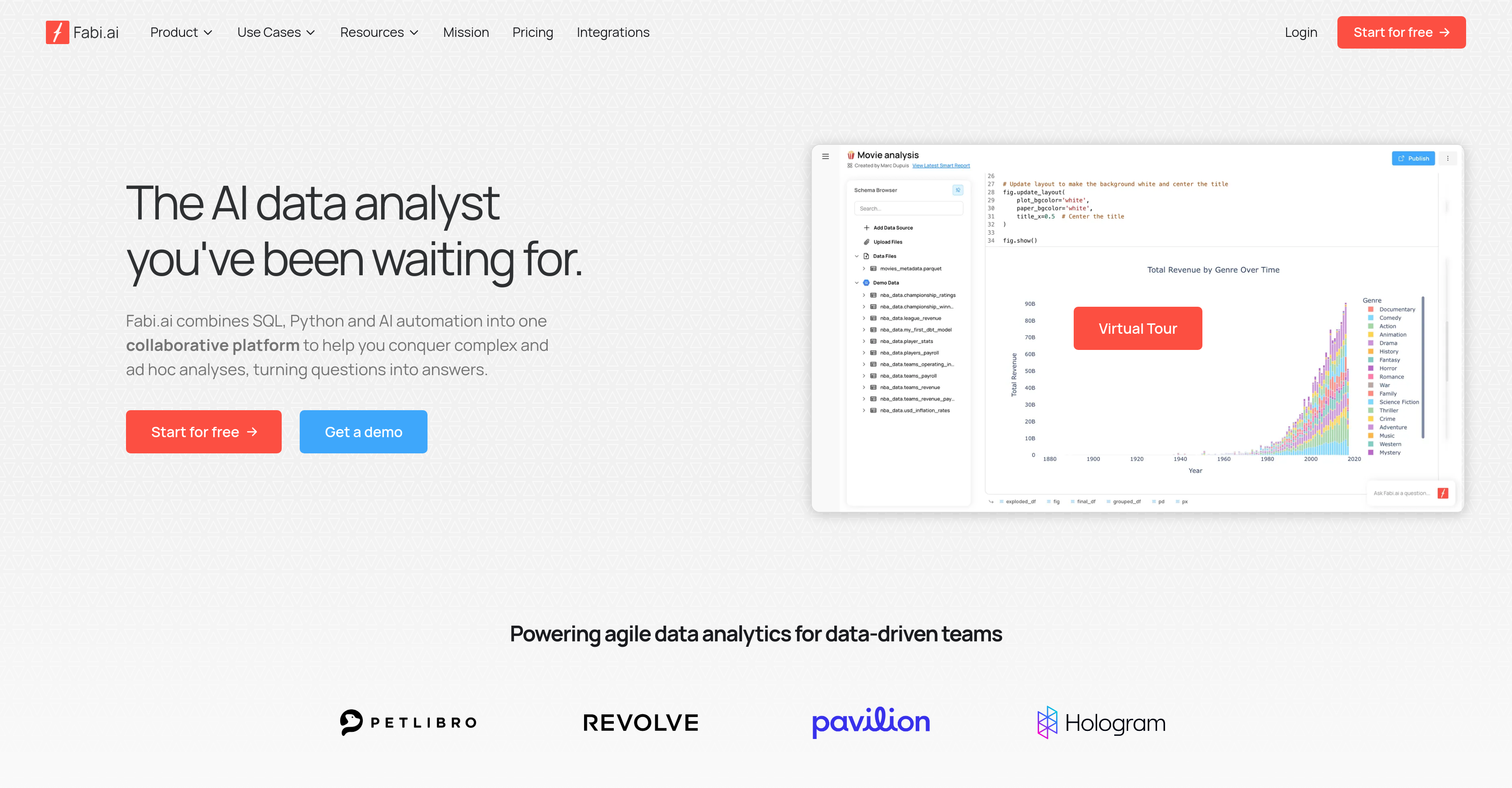
- Answer ad-hoc data questions in minutes without building new models using AI-powered code suggestions
- Automatically update all downstream analyses when source data changes through reactive cells that eliminate manual updates
- Publish interactive reports with custom filters on your schedule, keeping stakeholders informed with current insights
- Build advanced statistical models and machine learning for A/B testing, churn prediction, and sales forecasting directly in Python
- Maintain portable, reproducible analytics with full version control that tracks every code change automatically
- Connect seamlessly to existing data stacks including PostgreSQL, MySQL, BigQuery, Snowflake, and MongoDB
Pros & Cons
From the listing; not yet checked by our editors.
Pros
- SQL and Python integration
- Collaborative data analysis
- Speedy exploration, coding, debugging
- Python backend:portability, reproducibility, version-controlled
- Quick ad hoc analytics
- Reactive cells for automatic updates
- Automatic reporting
- Customizable report filters
- Advanced statistical modeling
- Tailored business decision tools
- Easy data stack integration
- Interactive reports creation
- Real-time data handling
- Centralized data source
- CSV data uploads
- Ad hoc strategic analysis
- Revenue-generating advanced analysis
- Automatic report publishing
- Shareable reports and apps
- In-memory joins for data
- One-click report publishing
- Workflow retained in platform
- Strategic business decision facilitation
- SQL-to-Python seamless workflow
- A/B testing analysis
- Churn prediction analysis
- Pricing optimization tool
- Sales forecasting capabilities
- Existing data stack compatibility
- SOC2 Compliant
- GDPR Ready
- CCPA Ready
- Environment-friendly workflow
- Reduces iteration cycles
- Multiple data source compatibility
- User-friendly interface
- Time efficient
- Better coding experience
- Improved exploratory analysis
- Automated report schedules
- Eliminates manual export/import processes
- Streamlined workflow management
- User-defined customization
- Automatic reactive cell changes
- Efficient ad hoc reporting
- High-level productivity boost
Cons
- Limited language support (SQL, Python only)
- Reactive cells might create dependency
- Non-intuitive for non-coding users
- Lack of detailed customization options
- No offline functionality
- Potential integration issues
- Lack of real-time collaboration features
- Only offers user-defined report schedules
- Automatic updates may disrupt current analysis
- Features may be overwhelming for beginners
Alternatives to Fabi.ai
Tools that share the most tags with Fabi.ai.
- Yorph AI
Transform raw data into strategic decisions automatically with intelligent automation that processes and analyzes information
Freemium · from $29.99/month
$29.99/month
Not yet checked
- GigaSpaces eRAG GenAI
Get instant, accurate answers from all your operational data by asking questions in plain English, powered by advanced semantic reasoning that translates your intent into precise SQL queries.
Not listed
Not listed
Not yet checked
- Arria
Automatically generate enterprise reports and financial analysis from raw data using patented NLG technology that mimics expert analysts
Free trial · from $15/month
$15/month
Not yet checked
- Trend Hunter
Receive detailed trend insights 20 times faster than traditional research methods with AI-powered trend reports
Paid · from $199/month
$199/month
Not yet checked
- One AI
Transform unstructured text, audio, and video into structured analytics with advanced NLP capabilities
Freemium
Not listed
Not yet checked
- Eilla
Automate routine deal tasks like report generation and due diligence with AI-powered workflow automation
Not listed
Not listed
Not yet checked
Reviews
Rate this tool
Loading reviews...
Frequently asked questions
What is Fabi.ai?
Fabi.ai is an AI-powered data analysis platform that brings together SQL, Python, and AI automation into one collaborative environment. It is designed to aid in complex and ad hoc data analyses, transforming questions into answers with near immediacy. The platform maintains the entire Python code base in the backend, ensuring portability, reproducibility, and version control. It also features reactive cells that automatically update downstream analyses when upstream data changes. Fabi.ai offers automatic reporting, advanced statistical modeling, A/B testing analysis, churn prediction, pricing optimization, and sales forecasting.
How does Fabi.ai combine SQL, Python, and AI automation in data analysis?
Fabi.ai merges SQL, Python, and AI automation by providing a collaborative environment where SQL and Python's analytical abilities are brought together to carry out various data analyses. SQL is utilized for data querying and Python for more advanced analyses. AI automation comes in by speeding up exploration, coding, and debugging processes, reducing time spent on routine tasks through AI-powered code suggestions and ensuring that reactive cells automatically update downstream analyses whenever there's an upstream data change.
What is the role of the AI analyst assistant in Fabi.ai?
The AI analyst assistant in Fabi.ai plays a crucial role in speeding up data exploration, coding, and debugging processes. It reduces time spent on routine tasks through AI-powered code suggestions and ensures that downstream analyses are automatically updated whenever there are changes in upstream data. The AI assistant enables users to answer ad hoc questions in minutes without having to build new models from scratch.
How does Fabi.ai keep the entire Python code base in the backend?
Fabi.ai maintains the total Python code base in the backend as part of its 'Analytics as code' strategy. Through this strategy, coding is both portable and reproducible, allowing for consistency in work. A version-controlled environment is also maintained which ensures that each code revision can be tracked individually, preserving the work's history and providing a mechanism for collaboration among different users.
How does Fabi.ai enable quick ad hoc analytics?
Fabi.ai enables quick ad hoc analytics by having the user ask questions directly, which are then answered in minutes without having to build new models. The AI data analyst assistant reduces the time spent on repetitive tasks by providing AI-powered code suggestions, leading to faster derivation of insights from data.
How do Fabi.ai's reactive cells work?
The reactive cells in Fabi.ai automatically update downstream analyses when upstream data changes. This reduces the overhead of manually updating data or analyses whenever there's a change or new data, significantly cutting down on unnecessary routine tasks in the data analysis process, which in return saves time and thereby increases productivity.
What kind of AI-powered code suggestions does Fabi.ai offer?
Fabi.ai offers AI-powered code suggestions to reduce time spent on repetitive tasks. These code suggestions are generated by an AI analyst assistant, which provides relevant, automated code snippets to speed up the coding process. This results in faster derivation of insights from data.
How does Fabi.ai offer automatic reporting?
Fabi.ai offers automatic reporting by publishing interactive reports with customizable filters, adhering to a user-defined schedule. This allows for continual and up-to-date reports, empowering stakeholders with the latest insights.