
LigandAI
Move from target to ranked binder candidates in a single sitting rather than waiting on sequential design cycles, since the LigandForge Peptide Discovery Engine produces peptide binders at a rate measured in the thousands per second through single-pass discrete diffusion.
Listing not yet reviewed by our editors · How we check
Overview
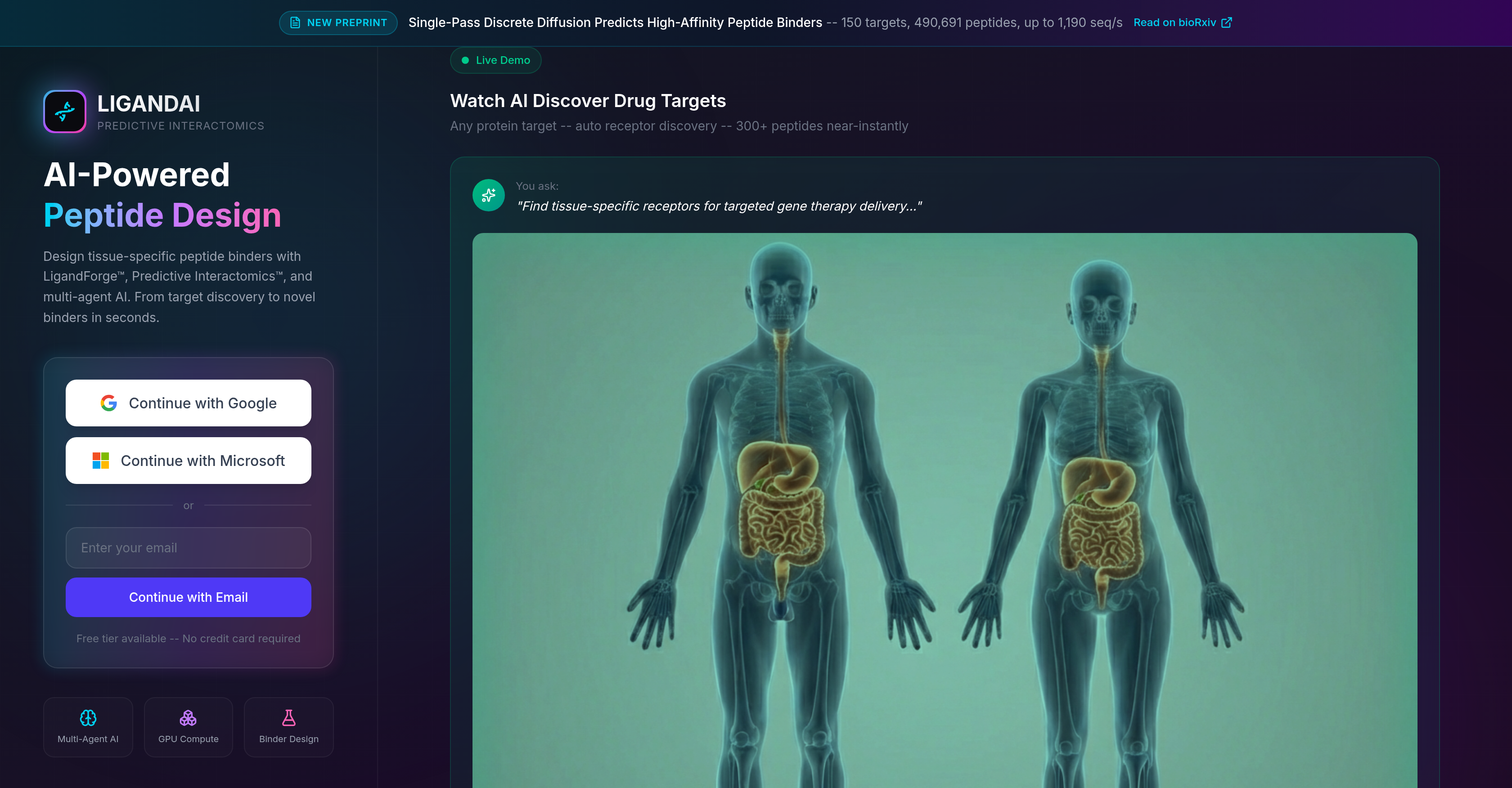
- Move from target to ranked binder candidates in a single sitting rather than waiting on sequential design cycles, since the LigandForge Peptide Discovery Engine produces peptide binders at a rate measured in the thousands per second through single-pass discrete diffusion.
- Decide which candidates deserve bench time before spending reagents, because DeltaForge thermodynamic scoring attaches a correlation metric to each binder so ranking is quantitative instead of intuitive.
- Open programs against targets that lack an established chemical starting point, as Predictive Interactomics performs target discovery across any protein or cell type and widens the therapeutic ground a team can cover.
- Carry results forward with documented confidence, since Boltz-2 multi-GPU validation re-checks generated peptide binders before they reach a synthesis or assay queue.
- Match spend to the size of the program, with a free tier for exploration, academia pricing at $299/mo, basic at $799/mo, pro at $5,000/mo, and enterprise terms on request.
- Build on protected, long-tested AI drug discovery methods rather than untried tooling, backed by 89 worldwide patent filings, 22 granted, and work by Ligandal dating to 2014.
Pros & Cons
From the listing; not yet checked by our editors.
Pros
- Precision targeting for drugs
- Uses LigandForge Peptide Discovery
- Generates peptide binders quickly
- Applies single-pass discrete diffusion
- Offers DeltaForge thermodynamic scoring
- Employs Predictive Interactomics methodology
- Target discovery against any protein
- Works with any cell type
- Widens therapeutic reach
- Incorporates Boltz-2 multi-GPU validation
- Offers several service tiers
- Suitable for academic institutions
- Optimized for professional enterprises
- Has numerous patent filings/grants
- In operation since 2014
- Wealth of experience/knowledge
- Produces reliable correlation metrics
- Assures output accuracy/reliability
- Supports diverse user categories
- Demonstrates innovation in biotechnology
Cons
- Need multi-GPU for validation
- Expensive Pro and Enterprise tiers
- Patent restrictions on technology
- Requires knowledge of bioinformatics
- Limited to peptide binders
- Dependent on DeltaForge scoring
- Specific to Ligandal products
- Requires single-pass discrete diffusion
- No price transparency for Enterprise
- Only supports protein/cell discovery
Reviews
Rate this tool
Loading reviews...
Frequently asked questions
What is LigandAI?
LigandAI is a product developed by Ligandal that is designed to provide AI-guided precision targeting for drug discovery. It leverages efficiency to generate many peptide binders per second and offers a reliable correlation metric. It is integrated with the LigandForge Peptide Discovery Engine and uses single-pass discrete diffusion, DeltaForge thermodynamic scoring, and Predictive Interactomics. It has several service tiers for different categories of users, including academic institutions and professional enterprises.
How does LigandAI work?
LigandAI works by generating peptide binders for any protein using a process called single-pass discrete diffusion. It makes use of DeltaForge thermodynamic scoring for decision making and Predictive Interactomics for target discovery against any protein or cell type. The accuracy and reliability of LigandAI's outputs are ensured through its Boltz-2 multi-GPU validation.
What does LigandAI mean by 'AI-guided precision targeting'?
'AI-guided precision targeting' in LigandAI refers to the tool's ability to use artificial intelligence to precisely identify and target proteins for drug discovery. It allows for the generation of peptide binders for any protein, broadening its therapeutic reach.
What makes LigandAI different from other AI tools for drug discovery?
What makes LigandAI different from other AI tools for drug discovery is its use of single-pass discrete diffusion and DeltaForge thermodynamic scoring. It also has Predictive Interactomics for target discovery against any protein or cell type. This, along with its Boltz-2 multi-GPU validation for accuracy and reliability, demonstrates its unique approach to AI-assisted drug discovery.
Could you explain 'single-pass discrete diffusion' as used in LigandAI?
'Single-pass discrete diffusion' is a process used by LigandAI to generate many peptide binders per second. This allows for high-efficiency peptide design and speeds up the process of drug discovery.
What is DeltaForge thermodynamic scoring, and how does LigandAI use it?
DeltaForge thermodynamic scoring is a feature offered by LigandAI that provides a reliable correlation metric. This is used for decision making, by correlating the thermodynamics of a peptide's binding with its likelihood for successful drug discovery.
Can you provide more detail on LigandAI's Predictive Interactomics and its capabilities?
LigandAI's Predictive Interactomics is a sophisticated target discovery mechanism that works against any protein or cell type. This allows it to extend its therapeutic reach to a wide variety of potential drugs and treatments.
What is the purpose of Boltz-2 multi-GPU validation in LigandAI?
Boltz-2 multi-GPU validation in LigandAI is used to ensure the accuracy and reliability of its outputs. It leverages multiple graphics processing units (GPUs) to verify the results produced by the AI, ensuring that the peptide binders generated are accurate and viable for drug discovery.