

Metabot AI
Get instant answers from your data warehouse by asking questions in plain English, powered by natural language query understanding
Listing not yet reviewed by our editors · How we check
Overview
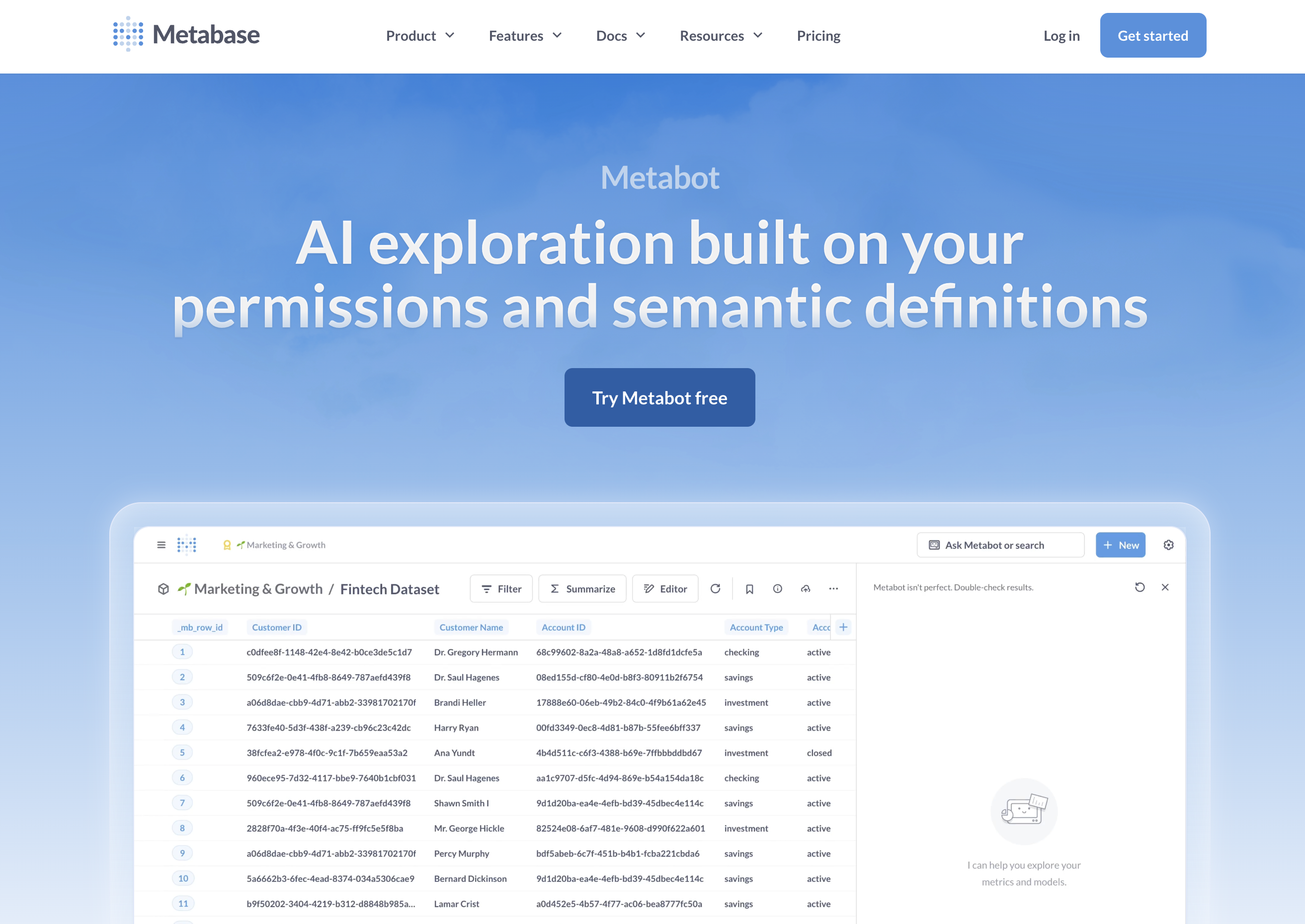
- Get instant answers from your data warehouse by asking questions in plain English, powered by natural language query understanding
- Transform complex charts into clear, written summaries in one click, eliminating manual copy-paste to external systems
- Generate and debug SQL queries automatically, letting you focus on insights instead of syntax
- Maintain strict data security and compliance, as the AI automatically enforces each user's existing permissions and access layers
- Operate within your established data governance, using your predefined business models, metrics, and definitions for accurate responses
- Avoid redundant work by having the AI first search for existing dashboards and questions before running a new query
- Embed a conversational AI analytics interface directly into your own product for your customers to use
Pros & Cons
From the listing; not yet checked by our editors.
Pros
- Integrated into Metabase platform
- Facilitates data exploration
- Generates SQL
- Summarises results
- Understands natural language queries
- Generates or debugs SQL queries
- Transforms charts into summaries
- Ensures data security
- Ensures data compliance
- Operates within existing data governance
- Supports strict data boundaries
- Uses semantic layer
- Efficient execution strategy
- Can be embedded into products
- Constant development updates
- Eliminates need for copying
- Data interaction in conversational language
- Customer data segregation support
- Searches for existing dashboards
- Integrated assistant for data works
- Works within existing setups
- Ideal for teams with strict boundaries
- Eliminates data movement
- Surfaces existing answers
- Assists data exploration
- Helps generate SQL
- Provides result summaries
- Transparent functioning
Cons
- Limited to Metabase platform
- Strongly reliant on permissions
- Queries tied to existing models
- Limited query execution efficiency
- Cannot operate outside existing data governance
- Potential lag from constant updates
- Strict data boundaries limit flexibility
- No explicit multilingual support
- Absence of offline functionality
- No explicitly detailed error handling
Alternatives to Metabot AI
Tools that share the most tags with Metabot AI.
- Yorph AI
Transform raw data into strategic decisions automatically with intelligent automation that processes and analyzes information
Freemium · from $29.99/month
$29.99/month
Not yet checked
- Arria
Automatically generate enterprise reports and financial analysis from raw data using patented NLG technology that mimics expert analysts
Free trial · from $15/month
$15/month
Not yet checked
- GigaSpaces eRAG GenAI
Get instant, accurate answers from all your operational data by asking questions in plain English, powered by advanced semantic reasoning that translates your intent into precise SQL queries.
Not listed
Not listed
Not yet checked
- Trend Hunter
Receive detailed trend insights 20 times faster than traditional research methods with AI-powered trend reports
Paid · from $199/month
$199/month
Not yet checked
- One AI
Transform unstructured text, audio, and video into structured analytics with advanced NLP capabilities
Freemium
Not listed
Not yet checked
- Eilla
Automate routine deal tasks like report generation and due diligence with AI-powered workflow automation
Not listed
Not listed
Not yet checked
Related Videos
New in Metabase 58: Metabot AI is out of beta
Metabase · Jan 15, 2026

Metabot AI: Cara Termudah Bikin Bisnis Kamu Data-Driven di 2025
Toba Consulting Services · Aug 21, 2025


Metabot AI: Data jadi jawaban instan 🚀#shorts #Metabase #MetabotAI
Toba Consulting Services · Aug 22, 2025
Reviews
Rate this tool
Loading reviews...
Frequently asked questions
What is Metabot AI?
Metabot AI is an artificial intelligence tool integrated into the Metabase platform, offering functionalities for data exploration, SQL generation, and summarization of results. It is designed to understand natural language queries, provide relevant answers, and generate or debug SQL queries.
How does Metabot AI facilitate data exploration?
Metabot AI facilitates data exploration by understanding natural language queries. It generates relevant answers and transforms them into SQL queries, allowing you to interact with your data in a conversational language.
How does Metabot AI generate SQL?
Metabot AI generates SQL by interpreting natural language queries. It understands the question asked in natural language and then converts that question into a SQL query that can produce the requested data.
Can Metabot AI debug SQL queries?
Yes, Metabot AI can debug SQL queries. It is designed to troubleshoot and resolve issues with broken or failing SQL queries.
In what ways can Metabot AI interpret natural language queries?
Metabot AI interprets natural language queries by understanding the question asked and transforming it into actionable insights. It breaks down the natural language query into recognizable patterns and transforms those patterns into a structured format that can be used to generate SQL queries.
How can Metabot AI summarize my data results?
Metabot AI summarizes your data results by transforming charts into concise summaries. With a single click, it can convert complex visual data representations into textual summaries.
How does Metabot AI ensure data security and compliance?
Metabot AI ensures data security and compliance by emulating the permissions of the logged-in user. Therefore, access to data is governed by existing permissions set for the user.
What does it mean that Metabot AI operates within existing data governance and context layer?
Operating within the existing data governance and context layer means that Metabot AI uses the structural guidelines set by your data architectures and rules. It leverages the predefined business definitions, models, and metrics to answer queries, without the need for copying data or moving it to external systems.