

ModelRed
Overview
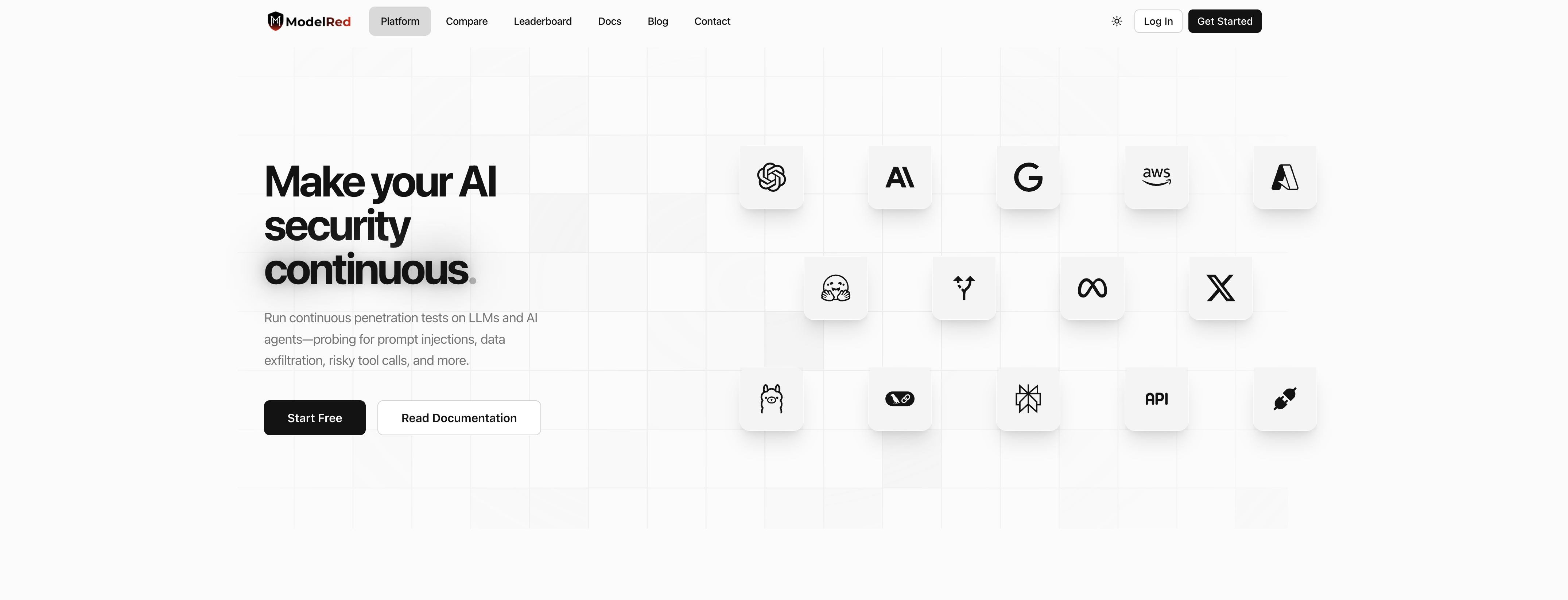
- Catch security vulnerabilities before production deployment with continuous penetration testing that simulates real-world attacks
- Pinpoint specific threats like prompt injections and data exfiltration using versioned probe packs locked to your model versions
- Block unsafe deployments automatically by integrating AI security checks as unit tests in your CI/CD pipeline
- Track security improvements over time with a simple 0-10 scoring system that compares models and releases
- Share reproducible security verdicts with stakeholders using detector-based assessments across multiple threat categories
- Maintain audit compliance with clear ownership tracking and change history for all security testing activities
- Test against thousands of evolving attack vectors from community marketplace and custom probe packs
- Secure any LLM provider including OpenAI, Anthropic and Azure with flexible custom endpoint support
Pros & Cons
Pros
- Continuous Red Teaming
- Automatic Deployment Blocking
- CI/CD Pipeline Integration
- Versioned Probe Packs
- Response Judgment Across Categories
- Simple Security Scoring
- Multiple LLM Providers Compatibility
- Shared Attack Vectors Library
- Python SDK
- Future TypeScript, Go, Rust Support
- Adaptive Penetration Testing
- Prompt Injections Detection
- Data Exfiltration Identification
- Risky Tool Calls Identification
- Detector-Based Verdicts
- Ownership and Audit Trails
- Easy Review, Export, and Shareability
- Model Robustness Assurance
- Versioned Attack Pattern Locking
- Reproducible Verdicts
- Comparative Results Access
- Security Thresholds Enforcement
- External Testing Environment
- Governance Features
- Easy Integration Developer SDK
- Reliable Insights Generation
- Continuous Penetration Tests
- Community Marketplace for Probes
- Model Safety Tracking
- Dedicated LLM Detector
- Pin Versions to Environments
- Probe Results Comparison
- Enhances Collaboration on Security
- Easy SDKs Integration
- Support for Custom Endpoints
- Private, Team, Workspace Sharing
- Compliance Acknowledgement
- Security Test Integration in Minutes
- Curated Suites Sharing with Teams
- Compatible with OpenRouter, HuggingFace
Cons
- Limited SDK language support
- Delayed TypeScript, Go, Rust support
- Limited community probe contribution
- No live support
- No free 24/7 support
- No mobile app
- Unclear scalability of platform
- Data privacy concerns
- Not open-source
- Hard to understand scoring system
Reviews
Rate this tool
Loading reviews...
❓ Frequently Asked Questions
ModelRed is an AI security platform designed to bolster the robustness of AI models. It hunts for vulnerabilities through a set of evolving attack vectors, enables continuous penetration tests on Language Models (LLMs), and AI agents to pinpoint threats like risky tool calls, prompt injections, and data exfiltration.
ModelRed offers several unique features including 'Versioned Probe Packs' which lock attack patterns to specific model versions and 'Detector-based Verdicts' that assess responses across various categories. It also integrates well with CI/CD pipelines, provides team governance features, and a Developer SDK currently available in Python. Moreover, it assigns a score ranging from 0-10 to the findings, facilitating easy tracking over time and model comparison.
'Versioned Probe Packs' in ModelRed are a feature that locks specific attack patterns to specific model versions, allowing for focused security assessments. 'Detector-based Verdicts' are another feature which judges responses across various categories, facilitating multi-pronged threat detection.
ModelRed uses a simple, comprehensive scoring system that ranks its findings on a scale from 0 to 10. This feature allows for easy tracking over time, comparing models, and assigning scores to different releases or environments. This system helps users to understand the level of risks associated with different AI models.
ModelRed integrates with CI/CD pipelines by treating AI safety checks like unit tests. The platform has the ability to fail Pull Requests based on high-risk findings, which ensures security vulnerabilities are caught during the CI/CD process before deployment.
The Developer SDK offered by ModelRed allows developers to integrate AI security into their development workflow quickly. This eases the process of ensuring their AI models and systems stay secure.
Yes, ModelRed is compatible with Python. Its Developer SDK, provided for seamless integration of AI security into the development process, is currently available in Python.
While the Developer SDK offered by ModelRed currently supports Python, the roadmap shows support for TypeScript/JavaScript, Go, and Rust in the near future.
Yes, ModelRed works with all major providers including OpenAI, AWS, Azure along with several others like Anthropic, Bedrock, OpenRouter, and HuggingFace.
API security with ModelRed involves continuous penetration tests on AI systems, threat identification including risky tool calls, prompt injections, and data exfiltration, and integrating team governance features with clear ownership and change history. It also actively involves scoring AI robustness and integrating AI security checks as unit tests in CI/CD pipelines.
ModelRed aids in identifying a variety of threats in Language Models (LLMs) and AI agents including risky tool calls, prompt injections, and data exfiltration among others.
ModelRed facilitates model comparisons and tracking over time through its scoring system. The platform assigns a score from 0 to 10 to the findings, which helps users track their AI model's progress, robustness, and security over time and also allows users to compare different models or different versions of the same model.
Yes, ModelRed offers features for team governance. These features allow for pack privacy, team sharing, or workspace publishing, and come with clear ownership and change history included with audit trails. This assists in fostering accountability, privacy, and efficient collaboration within teams.
ModelRed helps prevent data exfiltration and prompt injections by performing regular penetration tests on LLMs and AI agents. By constantly probing for such threats, it can help detect and mitigate them before they can be exploited.
Yes, ModelRed can be used for vulnerability detection and penetration testing in AI models. Through continuous penetration tests and the hunting of vulnerabilities via a comprehensive set of evolving attack vectors, ModelRed can detect and help users counter potential threats in their AI models.
Yes, ModelRed provides audit trails. This feature is included in their Team Governance tool, providing clear ownership and change history for better accountability and transparency.
'Versioned Probe Packs,' a feature of ModelRed, allows for attack patterns to be locked to specific model versions. This enables precise security assessment for particular versions of models, allowing users to track historical security performance and maintain or improve security as updates are made.
Yes, ModelRed can score models based on the different releases or environments. This functionality facilitates easy tracking over time, enables comparing different models, and allows scores to be assigned to different releases or environments.
'Detector-based Verdicts,' a feature in ModelRed, judges model responses across various categories. This works by implementing special detectors that analyse the responses generated by AI models during security assessments to identify any potential vulnerabilities across a wide range of security categories. This functionality helps deliver reproducible verdicts that are easy to review, export, and share with stakeholders.
ModelRed hunts for various types of vulnerabilities in AI models, searching for risky tool calls, prompt injections, and data exfiltration. These potential threats are identified through continuous penetration tests, ensuring that any weaknesses in AI models are swiftly located and can be adequately addressed.
ModelRed operates by conducting continuous red teaming, which involves simulating potential attacks to identify vulnerabilities in the AI models. These simulated attacks span thousands of possible vectors to ensure a comprehensive audit of the AI's security. The platform uses versioned probe packs for specific test environments and AI-powered detectors for assessing responses across security categories. ModelRed then generates a 0-10 security score to indicate model safety over time.
Key features of ModelRed include its versioned probe packs, which can be pinned to specific environments for testing, as well as its AI-powered detectors, which assess responses across different security categories. Another crucial feature is ModelRed's simple 0-10 security scoring system that allows users to track the safety of their models over time. It also offers integration with CI/CD pipelines, governance and audit trails, and a community marketplace for attack vectors.
ModelRed works with all major large language model providers, including OpenAI, Anthropic, AWS, Azure, and Google. It is also compatible with custom endpoints, which provides a level of flexibility for diverse development environments.
Users and teams can contribute to ModelRed's community marketplace of attack vectors by developing and sharing new security probes. This allows for the amplification of a collective intelligence, building a shared library of security tests to maximize the robustness of AI systems.
Although having coding skills could be beneficial for using ModelRed, especially for tasks like probe creation and deep API integration, the tool does offer a Python SDK for simplicity. The platform also plans to add support for more programming languages like TypeScript, Go, and Rust, allowing users with varied coding skill levels to integrate AI security more easily.
ModelRed enhances the security of AI models through continuous red teaming, mimicking potential real-world attacks to identify vulnerabilities. It offers comprehensive tools such as versioned probe packs, detector-based verdicts, and AI safety checks. By testing AI models against thousands of attack vectors, vulnerabilities can be identified and corrected before they reach production.
ModelRed tests against thousands of attack vectors that include potential threats like prompt injections, data exfiltration, hazardous tool calls, and jailbreaks. The continuous nature of this testing ensures the evolving threat landscape is adequately covered.
Adaptive red teaming in the context of ModelRed refers to the process of continuously testing AI models with evolving attack vectors. It simulates potential attacks in an adaptive manner, evolving the test scenarios as landscapes change, enabling the identification of vulnerabilities dynamically.
The versioned probe pack feature in ModelRed enables attack patterns to be locked to specific versions. This permits the pinning of different versions to respective environments like production or staging. The feature also allows for results comparison across different releases and the sharing of curated suites with your team.
Probe packs in ModelRed have significant importance as they contain the attack vectors used to conduct security tests on AI models. These can be versioned and targeted toward specific environments, enhancing the relevancy and effectiveness of the tests conducted. Probe packs can also be shared across the user's team or contributed to the platform's community marketplace, fostering a collaborative approach to AI security.
Yes, ModelRed offers the ability to track model safety over time. It rolls up its findings into a simple 0-10 score that can be tracked over time, compared between models, and attached to releases or environments. This allows for a straightforward, quantifiable measure of the model's security status.
ModelRed uses detector-based verdicts to judge responses across security categories. These AI-powered detectors enable reproducible verdicts that are easy to review, export, and share with stakeholders. By judging responses across various security categories, a comprehensive security profile is established for the tested AI models.
Yes, with ModelRed's integration into the CI/CD pipelines, you can block deployments when the security thresholds, which are identified through the platform's testing and scoring mechanisms, are not met. This automation helps ensure that any identified security risks are addressed before model deployment.
Yes, ModelRed does support custom endpoints. This indicates that the platform can work with a wide range of LLM providers, whether they are major ones like OpenAI, Anthropic, AWS, Azure, Google, or user-customized endpoints.
The Developer SDK in ModelRed enables users to easily and quickly incorporate AI security into their systems. Starting with Python and planning to include more languages, this SDK provides easy integration for developers, minimizing the time spent integrating security testing into their development processes.
The score system in ModelRed generates a simple 0-10 security score to track the safety of a model over time. This score can be attached to specific releases or environments further providing meaningful insights about the model's security at various points within its lifecycle.
Yes, ModelRed generates detector-based verdicts that are easy to review, export, and share with stakeholders. These verdicts provide reliable insights into the tested AI model's security strengths and vulnerabilities, enabling constructive discussion and actions for improvement.
Yes, ModelRed is compatible with all major AI providers. It works with major LLM providers such as OpenAI, Anthropic, AWS, Azure, and Google, among others. This demonstrates ModelRed's adaptability and capacity to work in diverse development environments.
Pricing
Pricing model
Freemium
Paid options from
$49/month
Billing frequency
Monthly
Refund policy
No Refunds