

Nyckel
Ship AI features in days instead of months by leveraging automated deep learning models that train in seconds
Listing not yet reviewed by our editors · How we check
Overview
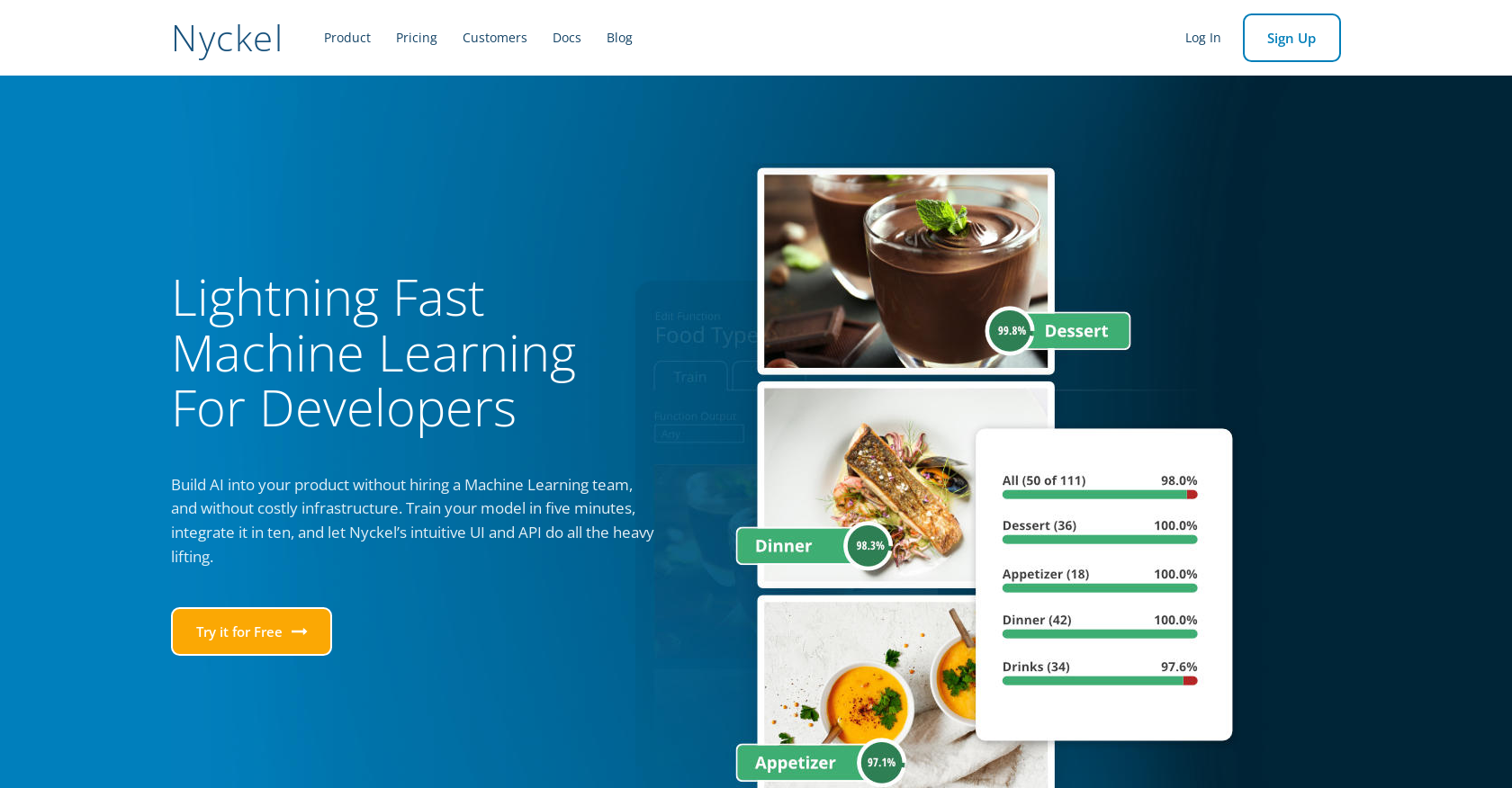
- Ship AI features in days instead of months by leveraging automated deep learning models that train in seconds
- Eliminate ML infrastructure costs and specialized hiring with a complete API that handles model training, deployment, and scaling
- Process images, text, and tabular data through a single unified API for classification, object detection, OCR, and search
- Maintain 99.99% uptime with 300ms response latency while scaling to millions of API calls from day one
- Accelerate model iteration with integrated data tools for annotation, inspection, and mining within your workflow
- Deploy production-ready models immediately after training with enterprise-grade reliability and no infrastructure management
- Start building immediately with free development tier and no data lock-in constraints
Pros & Cons
From the listing; not yet checked by our editors.
Pros
- Lightning-fast machine learning
- Multiple input data types
- Multiple output data functions
- Object detection in images
- OCR capabilities
- API-first design
- Integrated data engine
- Deep learning capacity
- Fast model training and deployment
- High uptime and low latency
- Free evaluation options
- No data lock-in
- Variety of function types
- Image, text, tabular data handling
- Classify, tag, search output options
- Data annotation, inspection, mining
- Seamless application integration
- UI for model training
- Advanced API functionality
- Model ready in seconds
- Scales to millions of invocations
- Automated and parallelized AutoML
- Data focus
- Text classification and tagging
- Image classification and tagging
- Tabular classification and tagging
- Image detection and localization
- Tabular data handling
- Model evaluative options
- Immediate model deployment
- Latency of 300ms
- Integrated annotation, inspection, mining
- Lightning Fast Machine Learning
- Model training in minutes
- Faster moderation time
- Better auto moderation coverage
- Integrated Machine Learning service
- Quicker content release
- Increase in Ad revenue
- Allows cross-modal semantic search
- Intuitive UI and API
- Free model training
- Single Sign-On for Enterprise
- Supports billions of invocations
- Can scale to Thousands of labels
- Supports millions of samples
- Functionality for Computer Vision
- Natural Language Processing function
- Tabular data processing function
- Automated model integration
- Flexibility through API
- Developer friendly
Cons
- Limited function types
- Undefined accuracy parameters
- Minimum spend for production
- Latency in specific scenarios
- Possibly costly for heavy usage
- Complex for non-technical users
- Limited model export options
- Requires hefty data for training
- Potential constraints on scale
- Limited enterprise-level support
Alternatives to Nyckel
Tools that share the most tags with Nyckel.
- Yorph AI
Transform raw data into strategic decisions automatically with intelligent automation that processes and analyzes information
Freemium · from $29.99/month
$29.99/month
Not yet checked
- Arria
Automatically generate enterprise reports and financial analysis from raw data using patented NLG technology that mimics expert analysts
Free trial · from $15/month
$15/month
Not yet checked
- GigaSpaces eRAG GenAI
Get instant, accurate answers from all your operational data by asking questions in plain English, powered by advanced semantic reasoning that translates your intent into precise SQL queries.
Not listed
Not listed
Not yet checked
- Trend Hunter
Receive detailed trend insights 20 times faster than traditional research methods with AI-powered trend reports
Paid · from $199/month
$199/month
Not yet checked
- One AI
Transform unstructured text, audio, and video into structured analytics with advanced NLP capabilities
Freemium
Not listed
Not yet checked
- Eilla
Automate routine deal tasks like report generation and due diligence with AI-powered workflow automation
Not listed
Not listed
Not yet checked
Reviews
Rate this tool
Loading reviews...
Frequently asked questions
What is Nyckel?
Nyckel is a Machine Learning API designed to provide developers with swift machine learning capabilities for computer vision, natural language processing, and tabular data. It abstracts away the complexity of machine learning, allowing its users to focus on their data and problem-solving.
What kind of data can I use as input with Nyckel?
With Nyckel, developers can use image, text, or tabular data as input data.
What types of output options do I have in Nyckel?
For output data, Nyckel provides several options such as classifying, tagging, searching, detecting objects, performing optical character recognition (OCR), or localizing and detecting objects in images.
What types of processing can Nyckel perform on input data?
Nyckel can perform various types of processing on input data, including classifying, tagging, and detecting objects in images, search, and optical character recognition (OCR). It can handle and process text, images, and tabular data.
What are the primary features of Nyckel's API-first design?
The primary features of Nyckel's API-first design revolve around enabling seamless integration into applications and ensuring fast and secure communication for machine learning services.
What is the integrated data engine in Nyckel?
The integrated data engine in Nyckel facilitates data annotation, inspection, and mining within the machine learning workflow, making it easier for developers to process and manage their data.
How is deep learning implemented in Nyckel?
Nyckel's deep learning implementation automatically trains and evaluates deep learning models on user data in seconds. These models can be deployed immediately with high uptime and low latency, allowing developers to scale to millions of invokes from the first day.
What unique benefits does Nyckel offer for developers?
Nyckel offers developers the ability to integrate powerful machine learning capabilities into their products without the need for a dedicated machine learning team or expensive infrastructure. It also provides options for model training, evaluation, and immediate deployment of trained models.