

Openlayer
Ship AI changes with confidence instead of discovering problems in production: pre-deployment AI evaluation measures quality, safety, performance, cost, and compliance before any update goes live.
Listing not yet reviewed by our editors · How we check
Overview
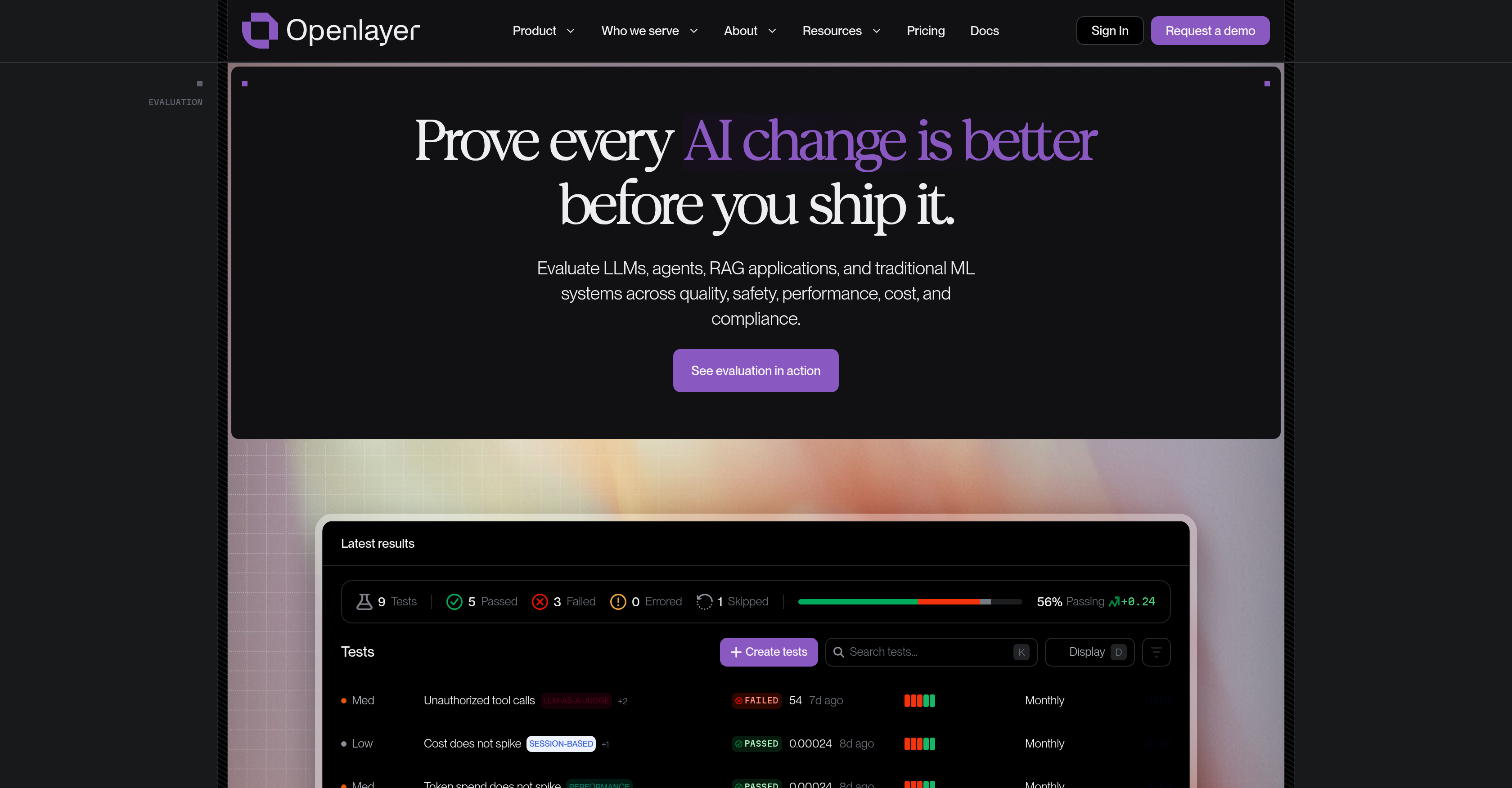
- Ship AI changes with confidence instead of discovering problems in production: pre-deployment AI evaluation measures quality, safety, performance, cost, and compliance before any update goes live.
- Cut weeks of test-writing out of your LLM evaluation workflow: a library of 175+ pre-built tests covers quality checks, performance metrics, and compliance verification, with custom metrics configurable for your own requirements.
- Stop hallucinated answers from reaching your users: LLM-as-judge evaluations score every output for relevance, faithfulness to source material, and hallucination detection.
- Walk into audits and customer reviews with evidence already assembled: every evaluation result stays linked to its system version, configuration, policy, and approval, building a complete AI governance record per release.
- Expose unfair model behavior before it becomes a reputational or regulatory issue: Fairness and Bias Testing surfaces performance gaps across demographic, geographic, and other subpopulation cohorts.
- Know the price of an AI change before you commit to it: cost is measured side by side with quality and compliance, so trade-offs are clear at decision time.
- Run one evaluation standard across your entire AI stack: LLMs, AI agents, Retrieval Augmented Generation (RAG) applications, and traditional machine learning models are all tested in the same workflow.
- Pinpoint exactly where a new version underperforms: AI model testing tracks results across multiple datasets and cohorts, making version-to-version comparisons precise.
- Give engineering and governance teams a shared source of truth: test results, policies, and approvals live in one place, so AI compliance sign-off no longer depends on scattered spreadsheets and handoffs.
Pros & Cons
From the listing; not yet checked by our editors.
Pros
- 175+ pre-built tests
- Custom metrics configuration
- Performance across datasets
- Performance across cohorts
- System version tracking
- Quality, safety, performance metrics
- Cost, compliance evaluation
- Fairness and Bias Testing
- Hallucination detection
- Linking results to configurations
- Policy and approval tracking
- Governance record keeping
- Useful for customer reviews
- Useful for audits
- Supports LLMs evaluations
- Supports agents evaluations
- Supports RAG applications evaluations
- Supports traditional ML systems evaluations
- Systematic performance tracking
- Performance discrepancies identification
- Measure outputs relevance
- Measure outputs faithfulness to source
- Measure demographic cohort performance
- Measure geographic cohort performance
- Track performance changes effectively
- Designed for engineering teams
- Designed for governance teams
Cons
- No offline functionality
- Complex interface
- Possible steep learning curve
- No mobile app
- Limited customizability
- Heavy resource usage
- Lacks integration with some APIs
- No free version available
- Strict governance could restrict performance
- Potentially time-consuming setup
Alternatives to Openlayer
Tools that share the most tags with Openlayer.
- LangSmith Evaluations
Stop shipping broken agent updates by catching regressions before end users notice them, using offline evaluations that benchmark AI agent versions against curated datasets.
Freemium · from $39/month
$39/month
Not yet checked
- Confident AI
Know exactly what improved and what broke after every change: run side-by-side LLM experiments on any AI app after swapping a model, editing a prompt, or adjusting a pipeline step.
Freemium · from $200/month
$200/month
Not yet checked
Reviews
Rate this tool
Loading reviews...
Frequently asked questions
What is Openlayer Evaluation?
Openlayer Evaluation is a comprehensive evaluation tool dedicated to measuring and determining the performance and potential impacts of AI modifications prior to their implementation. This tool is not only designed for evaluating Large Language Models (LLMs), agents, and Retrieval Augmented Generation (RAG) applications but also traditional Machine Learning systems. It precisely measures key elements like quality, safety, performance, cost, and compliance of the AI systems while also keeping a track of the version, configuration, policy, and approval of every single result. Furthermore, Openlayer Evaluation provides a library consisting of over 175 pre-built tests. This tool aims to simplify the process of AI evolution while assisting the engineering and governance teams to handle AI changes effectively and responsibly.
What types of AI systems does Openlayer Evaluation support?
Openlayer Evaluation supports a wide variety of AI systems. This includes Large Language Models (LLMs), agents, Retrieval Augmented Generation (RAG) applications, and traditional Machine Learning systems.
How does Openlayer Evaluation measure AI performance?
The Openlayer Evaluation tool has a multifaceted approach to measure AI performance. It can track performance across various datasets and cohorts. A detailed record is kept for each version regarding its system version, configuration, policy, and approval. This record is then utilized for governance, customer reviews, and audits. Furthermore, Openlayer Evaluation features functions like LLM-as-judge evaluations that score AI outputs based on their relevance, faithfulness to the source material, and hallucination detection.
How can Openlayer Evaluation aid in assessing the potential cost of an AI change?
Openlayer Evaluation assists in assessing the potential cost of an AI change by continuously tracking and recording the performance of the AI system. It quantifies imperative elements such as quality, cost, and compliance of the AI system to reveal a comprehensive cost estimate of any potential changes.
What is the purpose of the pre-built tests provided by Openlayer Evaluation?
The purpose of the pre-built tests provided by Openlayer Evaluation is to offer a simplified and reliable means for users to evaluate their AI systems. With over 175 tests available, they cut across different categories, providing users with a broad selection to accurately measure key components of their AI system. These categories range from quality checks to performance metrics and compliance verifications.
Can I customize the metrics on Openlayer Evaluation to suit my specific requirements?
Yes, Openlayer Evaluation allows users to configure custom metrics based on their specific needs. This means that, while the tool comes equipped with over 175 pre-built tests, you have the flexibility to adjust the metrics to better suit the specific requirements and objectives of your AI system.
How can Openlayer Evaluation assist in AI governance?
Openlayer Evaluation assists in AI governance by ensuring that every result stays linked to its system version, configuration, policy, and approval. This creates a systematic record for each version, which can be used for governance purposes. Furthermore, its 'Fairness and Bias Testing' feature allows users to identify performance discrepancies across different subpopulation cohorts, thus providing insights into potential bias within the AI system.
What does 'LLM-as-judge evaluations' refer to in Openlayer Evaluation?
'LLM-as-judge evaluations' in Openlayer Evaluation is a feature that scores AI outputs according to their relevance, faithfulness to the source material, and hallucination detection. This function imitates a human-like judgment process to assess, score, and validate AI outputs.