

SEO Utils
Know exactly how ChatGPT and other AI search engines present your brand: AI visibility scores and sentiment analysis run alongside Google and Bing rank tracking, covering traditional SEO, local SEO, and AI search optimization in one place.
Listing not yet reviewed by our editors · How we check
Overview
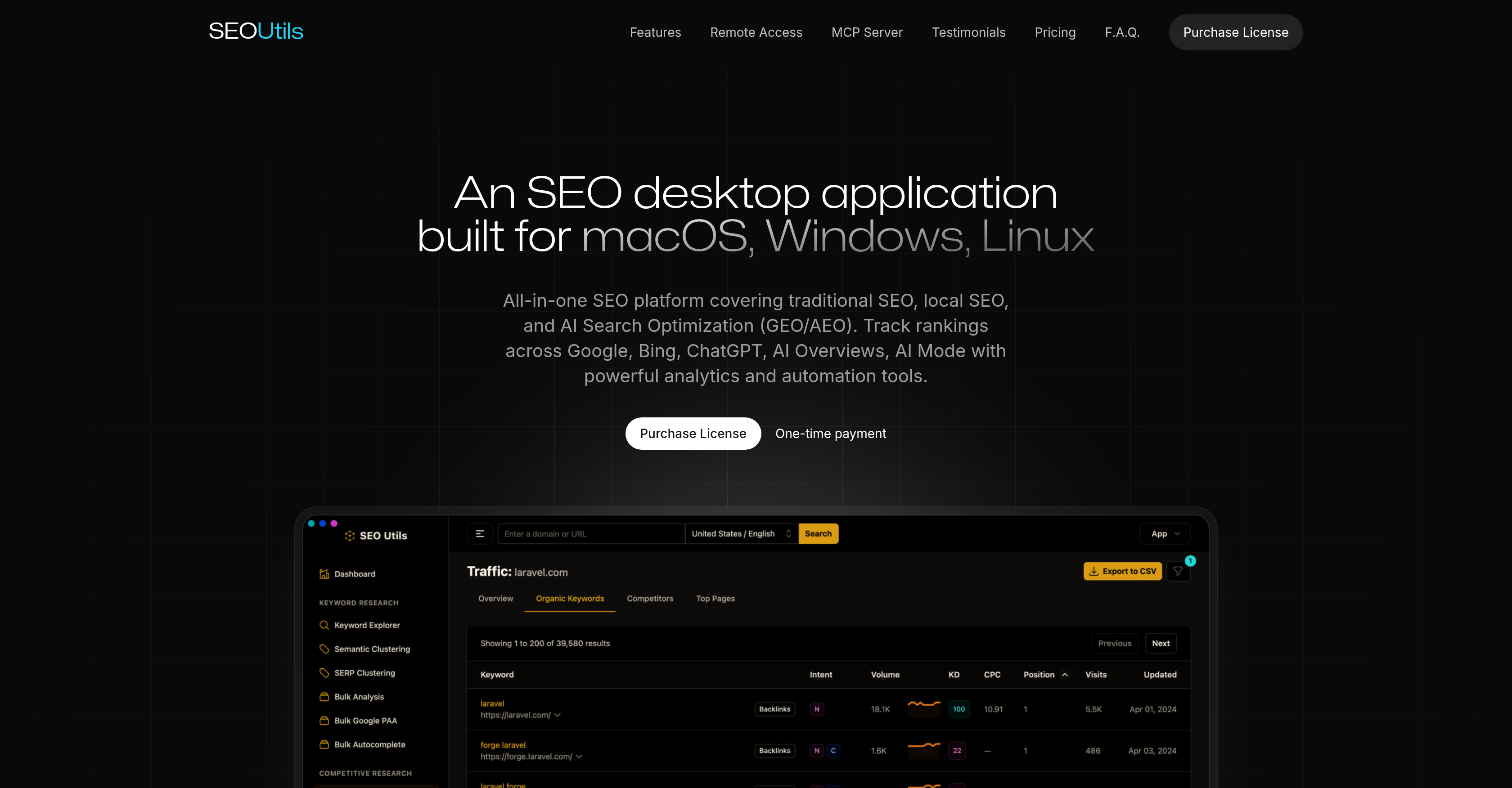
- Know exactly how ChatGPT and other AI search engines present your brand: AI visibility scores and sentiment analysis run alongside Google and Bing rank tracking, covering traditional SEO, local SEO, and AI search optimization in one place.
- See which AI crawlers reach your pages and what they do there: log file analysis shows how AI search engines treat your site, page by page.
- Prove the value of answer engine optimization with real numbers: the AEO dashboard puts AI referral traffic and organic search traffic side by side.
- Connect ranking changes directly to revenue: the Google Analytics 4 integration pulls daily organic sessions, key events, and revenue by landing page and cross-references them with rank tracker positions.
- Get backlink, traffic, and keyword metrics without building a single report: ask questions of your SEO data in plain English, powered by DataForSEO data.
- Close topical gaps before competitors do: NLP-based on-page content analysis surfaces the themes and topical relevance of every page using multiple NLP systems.
- Build keyword clusters around search intent rather than exact-match phrasing: content is converted into semantic vectors that group queries by meaning for sharper content strategy.
- Add internal links without hand-editing pages: the link-building engine proposes specific anchor sentences on related pages and publishes them to your site once you approve.
- Run multiple clients or sites without crossed data: dedicated workspaces keep trackers, properties, and content separate for every project.
- Send agency-ready reporting under your own brand: white-label SEO reports and branded client dashboards stay synced with live tracking data.
- Check rankings and reports away from your desk while keeping data private: a one-time pairing gives you a private seoutils.app address that opens your full desktop workspace from a phone or any other device.
Pros & Cons
From the listing; not yet checked by our editors.
Pros
- Comprehensive SEO platform
- Tracks multiple search engines
- Visibility scores monitoring
- Sentiment analysis feature
- Integration of automation tools
- Logging file analysis
- AEO dashboard integration
- Enables plain English queries
- Supports backlinks analysis
- Traffic and keyword metrics
- On-page text analysis
- Use of different NLP systems
- Converts content into semantic vectors
- Enables effective content strategy
- Supports keyword strategy
- Queries clustering by meaning
- Link-building feature
- Integrated links on approved pages
- Supports workspaces functionality
- White-labeled reports availability
- Syncs with tracking data
- Brands client dashboards
- Supports SEO automation and scaling
- Comprehensive data access through queries
- Identifies and analyses content themes
- Helpful for link-building proposals
- Automated tracking capabilities
- Auto-import logs over SFTP
- Competitive gap analysis
- Spot cannibalization issues
- Detailed entity and topic scoring
- Content transformed into semantic vectors
- Internal linking suggestions
- Workspace for separate projects
- Customizable, live, and white-labeled reports
- Automated report delivery
- Google Maps ranking tracking
- Automated task and reports generation
- Integration with Google Analytics 4
- Unlimited historical data from Google Search Console
- SEO split tests capability
- Settings for remote access
- Runs checks and reports remotely
- Real-time data on your computer
- Competitor content reverse-engineering
- Backlink profile analysis
- Local citations auditing
- Bulk volume keywords analysis
Cons
- Desktop-only platform
- No mobile app version
- Complex interface
- Limited free tier resources
- Single-seat remote access
- Requires extensive setup
- No native integration with GA4
- Limited automation options
- White-labeling may require extra payment
- Clustering uses local only models
Alternatives to SEO Utils
Tools that share the most tags with SEO Utils.
- SEObot
Eliminate manual keyword research with automated analysis that identifies the most relevant Google search terms for maximum impact
Paid · from $19/month
$19/month
Not yet checked
- Lovarank
Attract qualified traffic with hidden, low-competition keywords discovered automatically by AI analysis of your niche
Free trial · from $99/month
$99/month
Not yet checked
- Nichely
Uncover expert-level subtopics competitors miss through AI-powered Topic Discovery that maps millions of niche relationships
Freemium
Not listed
Not yet checked
- ContentEdge
Generate complete, ready-to-publish content in 15 seconds with AI-powered writing that mimics human language patterns
Free trial · from $24/month
$24/month
Not yet checked
- BlogSEO
Analyzes a website URL, finds keyword opportunities and competitors, then writes blog articles and publishes them to your CMS on a schedule.
Free trial · from $97/month
$97/month
Nov 23, 2026
- Wellows
Understand exactly how AI models interpret your brand with a unified dashboard tracking citations, sentiment, and visibility trends across ChatGPT, Perplexity, and Gemini
Free trial · from $39.99/month
$39.99/month
Not yet checked
Reviews
Rate this tool
Loading reviews...
Frequently asked questions
What is SEO Utils?
SEO Utils is a comprehensive desktop platform that offers an assortment of tools for traditional SEO, local SEO, and AI search optimization using AI-powered SEO.
What key functionalities does SEO Utils offer?
SEO Utils offers various key functionalities such as visibility score monitoring, sentiment analysis, strategic insight through automation tools, logging file analysis, AI vs Search traffic comparisons via an AEO dashboard and easy access to SEO data using plain English. It also provides on-page text analysis using different NLP systems and supports link-building.
Is SEO Utils equipped to handle local SEO?
Yes, SEO Utils is fully configured to handle local SEO. This is achieved through its comprehensive set of tools that are designed specifically for local SEO practices with a range of necessary utilities for the tasks involved in local SEO.
How does SEO Utils use AI for SEO optimization?
SEO Utils uses an AI mechanism to monitor AI search engine interactions with your brand and analyse on-page text for understanding themes and topical relevance. It also turns content into semantic vectors to enable more effective content and keyword strategies by clustering queries by meaning.
What are the unique features of SEO Utils?
Unique features of SEO Utils include AI-powered SEO, a feature to query SEO data in plain English, on-page text analysis using NLP systems, turning content into semantic vectors for better content and keyword strategy, workspace functionality that allows for separation of different projects and the provision of white-labeled reports synced with tracking data.
How does SEO Utils help in tracking across different search engines?
SEO Utils provides wide-ranging tracking capabilities across various search engines including Google, Bing, and also AI platforms like ChatGPT. It keeps a track of how AI search engines interact with your site and how they treat your site using logging file analysis.
What is the role of an AEO dashboard in SEO Utils?
The AEO dashboard in SEO Utils plays a key role in allowing users to examine and compare AI vs Search traffic. This dashboard is instrumental in tracking how AI search engines interact with your site.
How does SEO Utils facilitate keyword strategies?
SEO Utils enables more effective keyword strategies by utilising semantic vectors, turning content into these vectors which then allows queries to be clustered by meaning. This results in more strategic use of keywords, focusing more on their semantic significance than simply their frequency.