

Shakespeare
Create professional websites instantly by describing what you want, eliminating the need for coding expertise while maintaining full code access
Listing not yet reviewed by our editors · How we check
Overview
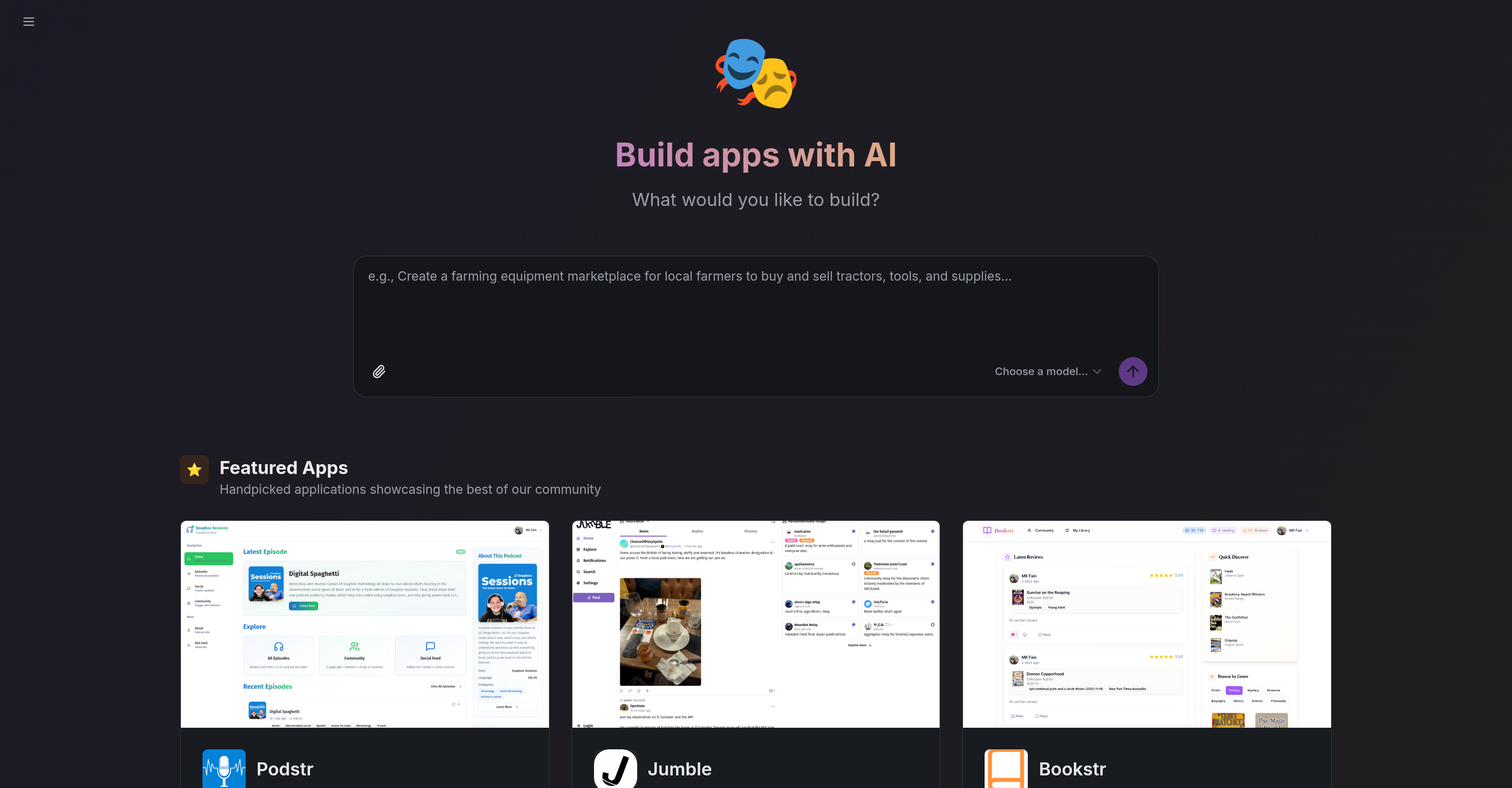
- Create professional websites instantly by describing what you want, eliminating the need for coding expertise while maintaining full code access
- Break free from vendor lock-in by choosing from dozens of AI providers including OpenRouter, OpenAI, Anthropic, and local models
- Keep complete control over your data with local file storage on your computer, ensuring true data sovereignty and instant access
- Track changes and roll back to previous states seamlessly with built-in Git integration for professional version control
- Import projects directly from Git repositories and encourage community contributions with the 'Edit with Shakespeare' badge
- Edit every file manually with the built-in code editor and upload custom images, logos, and assets directly into your project
Pros & Cons
From the listing; not yet checked by our editors.
Pros
- Open source
- Runs in the web: any browser, any device
- Decentralized (Nostr-native)
- Runs locally (no data shared)
- No coding required
- Full code access
- No vendor lock-in
- Built-in version control with git
- Use any AI provider
- Use any AI model, including local LLMs
- Build open source applications
- Build on decentralized protocol, Nostr
- Build web applications
- Deploy for free
- Made for different skill levels
- Choose what you want to pay based on LLM
- Actively being developed and improved
Cons
- Only builds certain projects (must run in web)
- Complex projects may require coding knowledge
- High-quality LLMs like Claude Sonnet can be expensive
- Front-end applications only (no building back-ends)
- Does not support LLM image processing
Alternatives to Shakespeare
Tools that share the most tags with Shakespeare.
- Stack AI
Build custom AI applications in minutes without writing code using an intuitive drag-and-drop interface and pre-built workflow templates
Freemium · from $139/month
$139/month
Not yet checked
- LaunchLemonade
Build custom AI assistants for your business without writing any code using our intuitive visual platform
Free trial · from $25/month
$25/month
Not yet checked
- Origin AI
Create custom enterprise software without hiring developers through AI-driven development that replaces traditional coding requirements
Paid · from $25/month
$25/month
Not yet checked
- Solid
Generate production-ready Tailwind and React code instantly from a simple text prompt, URL, or image upload, eliminating manual front-end coding
Freemium · from $20/month
$20/month
Not yet checked
- Floot
Launch your web app idea without writing code by describing it in chat or visually with our AI-powered platform
Freemium · from $25/month
$25/month
Not yet checked
- Chef by Convex
Launch production-ready full-stack apps with built-in database, authentication, and file uploads through automated backend configuration
Freemium · from $25/month
$25/month
Not yet checked
Reviews
Rate this tool
Loading reviews...
Frequently asked questions
What is Shakespeare - Open Source AI Builder?
Shakespeare is an open source AI builder providing a development environment designed to assist in creating custom applications. It's based on AI algorithms that enable developers to instill intelligence into their apps, resulting in systems capable of learning, adaptation, and decision-making.
How can Shakespeare assist in the creation of custom applications?
Shakespeare assists in the creation of custom applications by offering an AI-backed development environment. It uses AI algorithms that enable developers to incorporate intelligence into the applications. This environment translates complex AI algorithms to easy-to-use functions and features in the app.
How does Shakespeare allow developers to embed intelligence into their applications?
Shakespeare allows developers to embed intelligence into their applications through its use of AI algorithms. These algorithms help to make applications self-learning, capable of adapting to changing conditions, and able to make independent decisions based on inputs.
Can Shakespeare be utilized without prior AI or machine learning expertise?
Yes, absolutely. One of Shakespeare's strong selling points is its user-friendly nature. It has been designed such that developers don't need to have prior AI or machine learning expertise. By providing an easy-to-use AI Building environment, it makes creating intelligent applications accessible to all developers.
What types of applications can be developed using Shakespeare?
A wide variety of applications can be developed using Shakespeare. These range from personal AI assistants tailored to an individual user's preferences and tasks, to more complex and sophisticated business solutions that can optimize operations, automate workflows, and provide insightful analytics.
How does Shakespeare make AI accessible to a wider audience?
Shakespeare makes AI accessible to a wider audience by removing the prerequisite of having prior knowledge of AI or machine learning. It offers an easy-to-use AI development environment that allows developers to incorporate AI functionalities into their applications with relative ease. Furthermore, being open-source, it promotes a community-driven development approach.
How does Shakespeare leverage the power of AI for application development?
Shakespeare leverages the power of AI for application development by reducing the complexity of the underlying AI algorithms and embedding intelligent functionalities into applications. This enhances the app development process, making it more efficient and scalable, enabling seamless integration of AI features, and potentially leading to applications that can learn, adapt and make decisions independently.
What should users be aware of with the constantly evolving nature of AI?
Users should be aware that the AI field is continuously evolving, which could potentially affect the efficiency and application possibilities of AI tools like Shakespeare. Its efficiency and effectiveness may change over time due to advancements in AI algorithms and application development platforms.