

SHIP
Clear your backlog without writing the code yourself: assign a Linear, Jira or GitHub issue and an autonomous AI software team returns a finished pull request.
Listing not yet reviewed by our editors · How we check
Overview
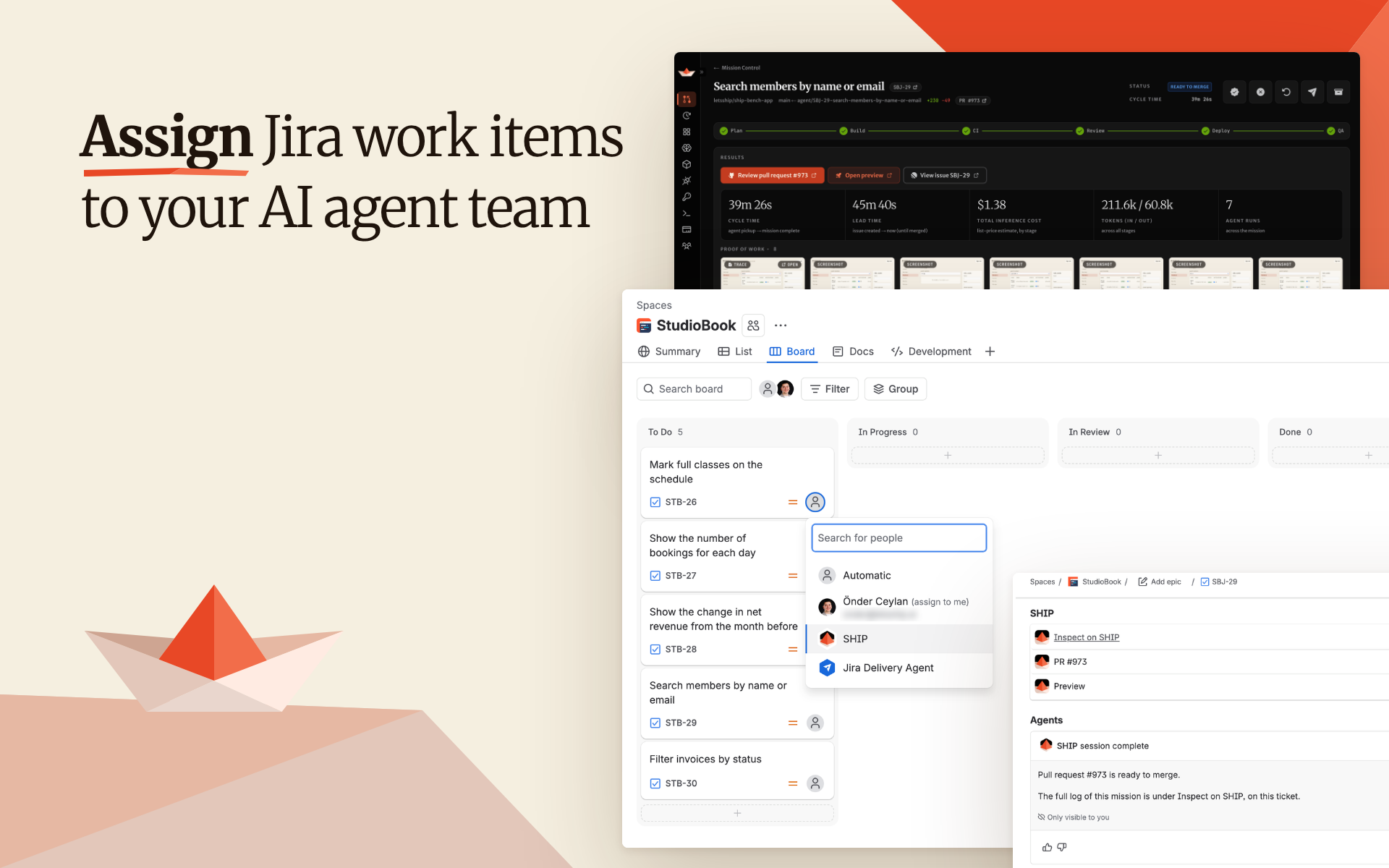
- Clear your backlog without writing the code yourself: assign a Linear, Jira or GitHub issue and an autonomous AI software team returns a finished pull request.
- Get pull requests that already pass CI: the Builder agent pulls failing CI logs, fixes the code and re-runs the build until every check passes.
- Start every change from a spec that fits your codebase: the Planner reads the ticket, repository, project docs and prior pull requests, then writes an implementation plan with acceptance criteria.
- Merge code that meets your team's standards: the Reviewer agent compares the diff against the plan and your repository rules, blocks critical issues and signs off only on compliant changes.
- See working features before you merge: the Tester agent runs happy-path and failure-path tests on an isolated preview deploy, shares the preview URL and attaches screenshots, video and test traces to the PR.
- Pay only for the inference you use: bring your own OpenAI, Claude or other model keys and contracts, get billed by your provider directly, view a per-stage cost breakdown for every mission, and get credits back when a mission ends without a pull request.
- Route work to the best-performing setup: pick Claude Code, Codex, OpenCode, Kilo Code or the pi coding agent, plus the model, for each of the Planner, Builder, Reviewer and Tester roles, then compare agent and model stacks side by side on performance and expense in Mission Control.
- Keep repositories and secrets locked down: every agent runs in an isolated sandbox, credentials are encrypted at rest, raw keys never reach agents, and scoped short-lived tokens grant only task-specific permissions on private repos with branch protection respected.
- Pass compliance reviews with a complete record: every mission logs session data, metrics, model choices, duration and a full audit trail on a visual timeline.
- Meet data residency requirements: run inference in the region you select through your linked provider accounts.
- Delegate any SDLC stage from the tools you already use: operate the headless agent team from your AI assistant, the web console, a REST API, the ship CLI, an MCP server or the A2A protocol.
- Keep dependencies and upkeep current without manual effort: schedule recurring maintenance missions that run on their own.
- Get output that follows your project's conventions: agents use your own skills, project memory and connected MCP servers.
- Trial the full workflow without commitment: your first missions are free, with no credit card required.
Pros & Cons
From the listing; not yet checked by our editors.
Pros
- Multi-agent workflow automation
- Specification-driven implementation planning
- Isolated sandbox code execution
- Automated linting, formatting, typing
- CI monitoring with auto-fix
- Automated diff review against plan
- Acceptance criteria validated via preview
- Visual proof: screenshots, testing traces
- Mission timeline logs agent actions
- Agent performance and cost metrics
- Multi-model cost optimization
- Compare agents per issue
- Provider-agnostic model integration
- Inference billed to org account
- Region-specific inference deployment
- Encrypted credentials at rest
- Zero-trust edge credential attachment
- Role-based access control
- Full audit trail
- Agent attribution for changes
- Automated maintenance workflows
- Incident response automation
- GitHub and Linear integration
- Real-time issue tracker notifications
- Chat within issue thread
- No raw keys to agents
- Sandbox prevents side effects
- Proof of execution recorded
- Cost-aware task routing
- Governance gates before merge
- Structured development stages enforced
- Automated preview deployment per PR
- Failure path testing automated
- Test recordings attached to PR
- Custom formatter/linter configs support
- Scalable enterprise workload support
- Custom CI pipeline compatibility
- Secure network edge authorization
- Session data under platform controls
- Model stack pricing comparison
- CLI and API automation
- Works with existing dev tools
- Free first mission, no card
Cons
- Code must be hosted on GitHub
- Needs your own model key or coding subscription
- No offline/airgapped mode
Alternatives to SHIP
Tools that share the most tags with SHIP.
- Google Antigravity
Google's agentic development platform: agents plan and run coding tasks across an app, a CLI, an IDE, IDE extensions and a Python SDK.
Freemium · from $30/month
$30/month
Nov 24, 2026
- Base44
Transform your ideas into working apps in minutes using simple conversation instead of complex coding
Freemium · from $16/month
$16/month
Not yet checked
- CodeRabbit
Eliminate manual code review bottlenecks with instant PR summaries and intelligent code walkthroughs that accelerate your development workflow
Free trial · from $24/month
$24/month
Not yet checked
- Rocket
Launch complete applications in minutes instead of weeks by generating full-stack code from a single description
Freemium · from $25/month
$25/month
Not yet checked
- OnSpace.AI - AI Mobile App Builder
Launch mobile apps in hours instead of months using conversational AI that transforms your descriptions into working applications
Freemium · from $25/month
$25/month
Not yet checked
- Durable AI Website Builder
Launch a complete business website in 30 seconds with AI-generated content and curated imagery tailored to your industry
Paid · from $12/month
$12/month
Not yet checked
Reviews
Rate this tool
Loading reviews...
Frequently asked questions
What does SHIP's Planner actually read to generate a spec?
The Planner reads the backlog ticket, the repository codebase, project documentation, and prior pull requests to generate an implementation and testing specification.
Can I choose which LLM model each SHIP agent uses?
Yes. SHIP lets you assign a specific LLM model to each agent role (Planner, Builder, Reviewer, Tester) and you can mix and match models across agents.
How does SHIP calculate and display the cost per mission?
SHIP tracks token in/out counts for each agent turn, multiplies them by the published list price of the model used, aggregates the cost per stage and shows a breakdown and total cost on the mission timeline.
Is the code built by SHIP's Builder run in an isolated sandbox?
Yes. The Builder writes and executes code inside an isolated sandbox before pushing any changes.
What security measures does SHIP use to protect my API keys?
Credentials are encrypted at rest, agents never receive raw keys, a placeholder key is sent to the sandbox and the real key is swapped in at the network edge, and access is granted via short‑lived, scoped tokens under a zero‑trust edge‑authorization model.
How does SHIP integrate with GitHub pull requests?
After connecting a GitHub repository, SHIP creates a pull request, pushes the Builder's code, monitors CI checks, and adds an agent attribution footnote with run ID, harness, model, and stage to the PR.
Can I connect SHIP to issue trackers other than Linear?
IDK
What does the Reviewer agent check before approving a PR?
The Reviewer compares the PR diff against the Planner's specification and any project guidelines you have defined, blocks critical issues, and only signs off when the changes comply.