

Societies | Talk of the Town
See how far your idea travels before you launch it: introduce a concept to a single simulated persona and track its spread across an entire simulated city over a simulated week.
Listing not yet reviewed by our editors · How we check
Overview
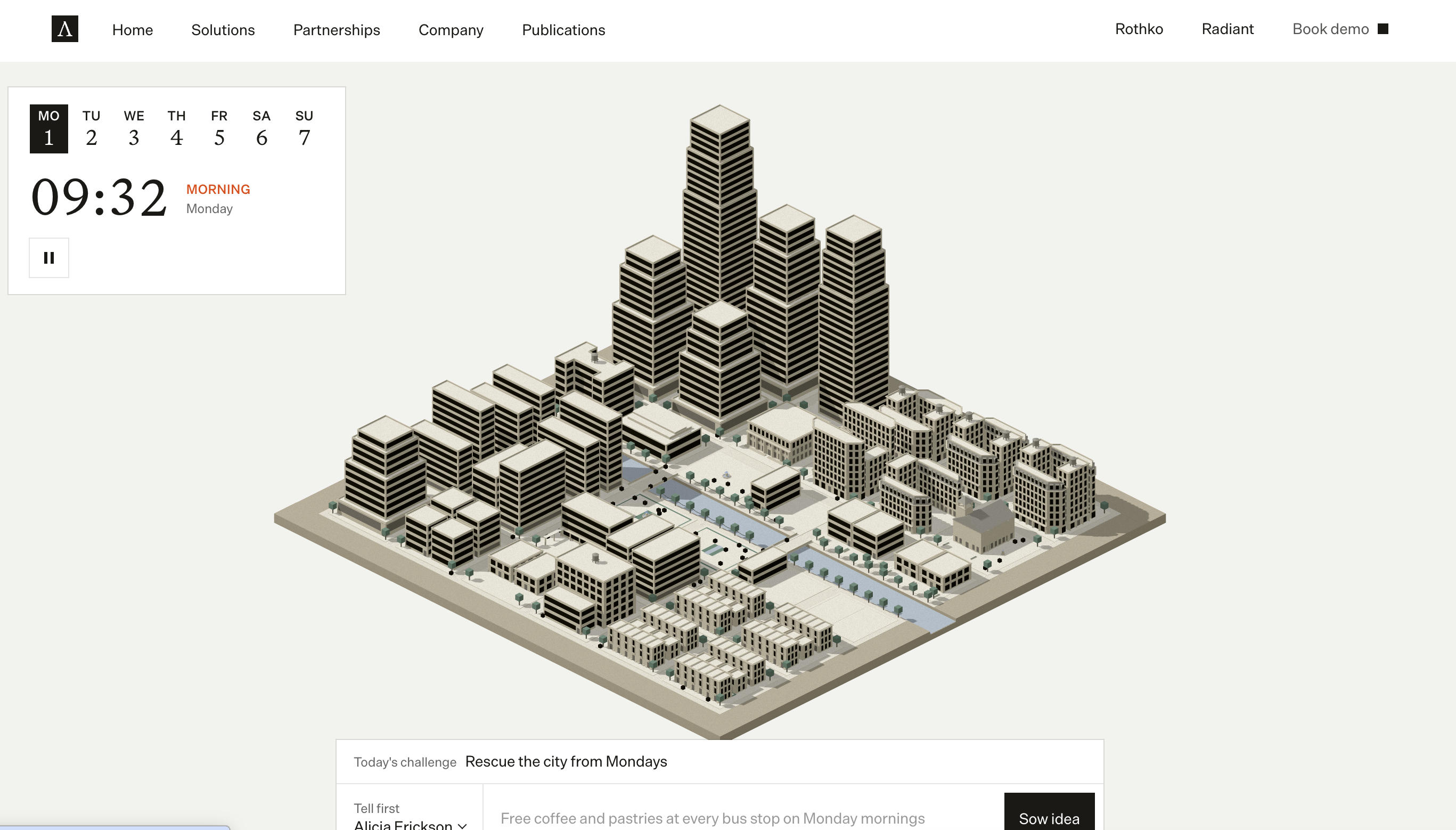
- See how far your idea travels before you launch it: introduce a concept to a single simulated persona and track its spread across an entire simulated city over a simulated week.
- Identify which voices actually drive adoption: follow how different personas react to and pass on your idea to find the influencers who accelerate information flow.
- Ground your audience research in realistic behavior: simulated personas are built from anonymised real-world data, giving you a closer read on how real audiences decide and share.
- Run social experiments without privacy risk: personas do not represent real individuals or reflect any real person's beliefs, so you study audience behavior with no exposure of personal data.
- Measure how fast and how widely an idea diffuses: watch adoption unfold over time and across 2,721 simulated personas to turn idea propagation into data you can analyze.
- Turn idea testing into daily competition: the daily challenge, closing at 08:00 GMT, ranks every submission by spread and influence, while the all-time leaderboard showcases top free-play ideas.
- Teach social dynamics through hands-on play: students and researchers interact directly with the information flow simulation instead of studying static diagrams.
- Apply the simulation to your own business decisions: book a demo with Artificial Societies to explore use cases for decision simulation and audience behavior analysis.
Pros & Cons
From the listing; not yet checked by our editors.
Pros
- Simulates real-world dynamics
- Fully interactive interface
- Simulated idea propagation
- Built on anonymised data
- Daily challenge feature
- Includes leaderboard system
- Insights for business decisions
- Versatile in application
- Useful for education
- Potential research tool
- Entertainment functionality
- Facilitates audience understanding
- Offered demo availability
- Helps explore use cases
- Personalized idea testing
Cons
- Propagates only one idea
- Not reflecting real sentiments
- Potentially expensive demo request
- Unknown synthetic data quality
- Leaderboard system irrelevant
- Missing API
- Limited educational application
- Unknown processing speed
- Limited audience representation
Reviews
Rate this tool
Loading reviews...
Frequently asked questions
What is Talk of the Town?
Talk of the Town is a simulation tool developed by Artificial Societies enabling users to introduce an idea to one of the simulated personas and track how it spreads within a simulated city over the duration of a simulated week.
How does Talk of the Town work?
Users introduce an idea to one of the many simulated personas in Talk of the Town. The idea then gets propagated through a simulated city, and users can interactively track the spread of this idea. The propagation and spreading of the idea occur over a simulated week.
What kind of data does Talk of the Town use to create simulated personas?
Talk of the Town uses anonymized real-world data to create its simulated personas. However, it underlines that these personas do not represent real individuals or reflect any real person's beliefs.
How does an idea propagate in the simulated city in Talk of the Town?
In Talk of the Town, an idea propagates through a simulated city over the course of a week in the system. Users can watch how the idea spreads across a variety of disparate personas in an interactive, dynamic fashion.
Can Talk of the Town be used for business decision making?
Yes, Talk of the Town can indeed be utilized for business decision-making. By simulating decisions and understanding audience behavior, the tool can provide potential insights that can inform and support business decision-making processes.
What is the daily challenge and leaderboard system in Talk of the Town?
The daily challenge and leaderboard system in Talk of the Town is a gaming feature. It ranks users' activities based on the spread and influence of their introduced ideas. The daily challenge ranks ideas for the day, closing at 08:00 GMT. The leaderboard also ranks 'free play' ideas, showing them once they pass a certain check.
Does Talk of the Town represent the beliefs of real individuals?
No, Talk of the Town's simulated personas do not represent or reflect the beliefs of real individuals. They are derived from anonymized real-world data, but should not be misconstrued as mirroring real person's opinions or beliefs.
Is Talk of the Town suitable for educational purposes?
Yes, Talk of the Town is suitable for educational purposes. It provides a hands-on learning tool for understanding information flow and social dynamics in a simplified environment, making it an engaging means of illustrating these concepts for educational purposes.