

Overview
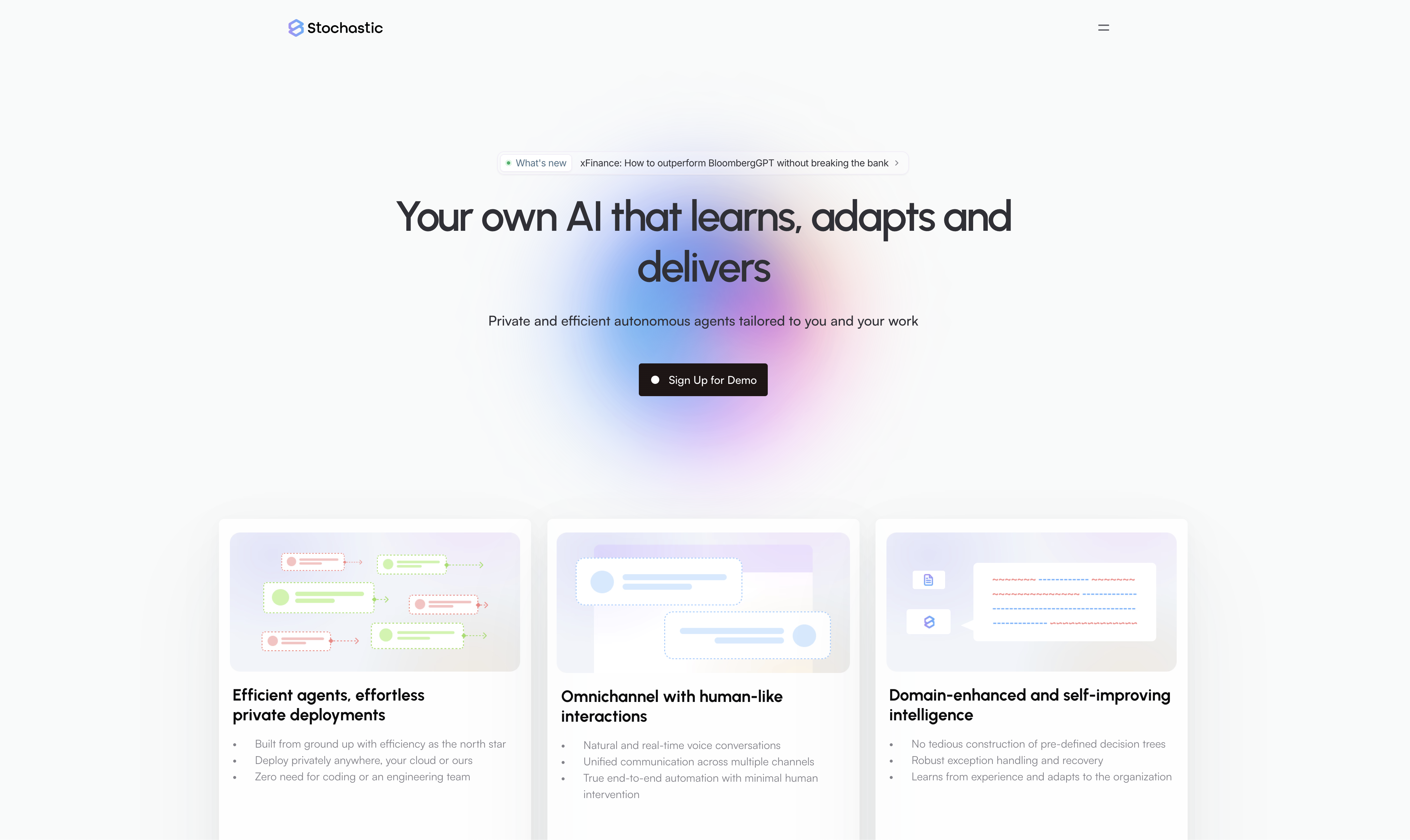
- Build custom AI applications tailored to your specific data and use cases with just three lines of code using the simplified development tool chain
- Train models faster while using fewer GPUs through state-of-the-art hardware-efficient algorithms that reduce computational requirements
- Deploy enterprise-ready AI systems that scale to millions of users without an engineering team through automated cloud deployment
- Maintain complete oversight of performance and expenses with real-time logging and monitoring of resource utilization and cloud costs
- Keep sensitive data secure by training models locally on your own infrastructure before cloud deployment
- Access flexible AI development without licensing restrictions through the open-source library that's freely modifiable
Pros & Cons
Pros
- Open-source library
- LLM personalization
- Simple user interface
- Hardware-efficient algorithms
- Fast fine-tuning
- Fewer GPUs needed
- Local data training
- Cloud deployment
- Scales without engineering team
- Real-time logging
- Cloud cost monitoring
- Customizable open-source LLMs
- Relevant for multiple applications
- Support for large language models
- Efficient resource utilization
- Supports millions of users
- Personalized Deep learning platform
Cons
- No mobile support
- No multi-language support
- No ready-to-use models
- No data security assurance
- Limited documentation
- No community support
- Dependencies on specific hardware
- Cannot handle large data sets
- No GUI
- UX not user-friendly
Reviews
Rate this tool
Loading reviews...
❓ Frequently Asked Questions
Stochastic's XTURING is an open-source library that lets users create and control Large Language Models (LLMs) for personalized AI applications. It offers simplified methods to fine-tune LLMs with custom data and customize them using cutting-edge, hardware-efficient algorithms.
XTURING helps in building Large Language Models by providing a simplified interface that allows the fine-tuning of LLMs with your personal data. It offers a development tool chain requiring only three lines of code for creating LLMs with your data.
While having a technical background can be beneficial, XTURING is designed to be user-friendly. It simplifies the process of building and controlling personalized AI systems, requiring only three lines of code to build an LLM with your data, which suggests a minimal need for extensive coding or technical expertise.
The primary use of XTURING is to simplify the construction and administration of personalized AI systems. This is achieved by providing a simple interface for fine-tuning LLMs with personal data, focusing on hardware efficiency, and offering enterprise-level features such as local training, cloud deployment, and monitoring capabilities.
Focusing on hardware efficiency means that XTURING utilizes state-of-the-art algorithms that are optimized to reduce the amount of computational resources, like GPUs, required for model fine-tuning. This leads to faster processing times and reduced costs.
Yes, you do need to have your own data to fine-tune models using XTURING. The platform emphasizes personalization and allows users to tune LLMs using their own datasets, which enables the creation of highly individualized AI applications.
You customize your Large Language Models with XTURING by using the provided interface to personalize models with your own data. Additionally, XTURING employs advanced, hardware-efficient algorithms which can be used to adjust the LLMs to your specific needs.
XTURING makes deep learning acceleration easy by offering a user-friendly interface and a development tool chain that lets users to quickly create LLMs. Moreover, it employs hardware-efficient algorithms that enable faster fine-tuning which results in decreased utilization and lower cost.
Yes, XTURING can train models locally on your own data. It provides an enterprise-ready AI system that trains on user data locally before deploying on the cloud, maintaining data security and efficiency.
XTURING deploys models in the cloud as part of its enterprise-ready AI system. While specifics are not detailed, it's implied that this service is designed to scale and support millions of users without the necessity of an engineering team, suggesting a largely automated and streamlined deployment process.
Yes, XTURING can handle large user volumes. The tool scales to support millions of users, implying it has high scalability and performance capabilities to meet the requirements of both enterprise-level applications and individual users.
Yes, XTURING does offer real-time logging and cloud cost monitoring. The service provides tracking of resource utilization and expenditure on cloud deployment of models, allowing users to maintain oversight of their application performance and costs.
The information provided does not specify an upper limit on the number of GPUs that can be used to deploy LLMs with XTURING. The focus is on hardware-efficiency, which suggests that the tool is designed to maximize performance even when working with a limited number of GPUs.
XTURING plays a crucial role in building a personalized AI system by enabling easy creation and control of LLMs. It allows for fine-tuning of these models with personal data, delivering a unique AI setup. Moreover, it also offers cloud deployment, and real-time logging and monitoring, bundling all necessary features for building a personalized AI system into a single platform.
The specific three lines of code required to build an LLM with XTURING are not provided. However, XTURING emphasizes a simplified interface and process, requiring only three coding lines for constructing LLMs, emphasizing the tool's user-friendliness and efficiency.
Enterprises can benefit from using XTURING by leveraging it to create personalized AI systems. Its features like local training, cloud deployment, real-time logging, monitoring capabilities, and ability to scale effectively to handle large volumes of users, make it beneficial for enterprise-level applications, even without a dedicated engineering team.
With XTURING, you can build various types of AI systems. The examples provided include XMAGIC, a personal AI assistant for answering questions on your files, generating summaries, reports, emails, and automating your workflows, and XFINANCE, a domain-specific LLM trained on open-source financial data.
Hardware-efficient algorithms are important in fine-tuning LLMs because they reduce the compute resources required, leading to faster processing times and lower GPU usage. This efficiency not only cuts costs but also speeds up the whole AI development process, contributing to faster turnaround times and reduced expenditure on hardware.
Yes, XTURING can speed up the model training process. By employing hardware-efficient algorithms, it can facilitate faster fine-tuning processes within a limited number of GPUs, essentially accelerating the overall model training process.
Yes, XTURING is available as an open-source library. This means that it is publicly accessible and can be freely used and modified by users, providing a flexible and cost-effective tool for building and controlling personalized LLMs.
Pricing
Pricing model
No Pricing