
Overview
- Build complete computer vision applications without writing code using the all-in-one Nexus platform
- Create pixel-perfect annotations in seconds instead of hours with AI-assisted IntelliBrush labeling
- Deploy models that integrate seamlessly with existing systems through TensorFlow, ONNX, and PyTorch export
- Collaborate across teams on a single platform with shared workspaces for annotation, training, and deployment
- Maintain enterprise-level data security with SOC 2 and HIPAA compliance for sensitive industries
- Test model performance visually before deployment using the open-source Portal visualization platform
- Scale computer vision projects across healthcare, retail, and manufacturing with industry-tested algorithms
- Manage large datasets efficiently with version control and automated upload via API integration
Pros & Cons
Pros
- No code platform
- Multi-component structure
- Open source platform
- Model Formats compatibility
- Seamless connectivity with Nexus
- Industry tested algorithms
- Market validated insights
- Plug and Play Solution
- Customised integrations
- Advanced security measures
- Rich resources section
- Wide industry application
- Supports all model formats
- Collaborative platform
- Pixel-perfect annotations
- Ability to visualize models
- Version controls for datasets
- Model training management
- Deployment solutions for models
- User-friendly interface
- Boosted business productivity
- Deployment security measures
- Supports popular annotations formats
- Rapid experiment to production
- Automated model training
- Flexible and interoperable artifacts
- Scalable model deploy
- Robust production inference performance
- Supports multi-GPU training
- Real-time performance insights
- Diverse artifact export formats
- Scalable deployments
- Seamless integrations to applications
- Enhanced fitness tracking
- Facial expression analysis
- Object localization
- Augmented reality capabilities
- Interactive gaming solutions
- Detailed model performance evaluation
- Data management capabilities
- Supports image and video data
Cons
- No explicit pricing information
- No offline accessibility
- Potential complexity for beginners
- No code aspect could limit customization
- Dependent on server availability
- Limited platform compatibility information
- No information on backup and recovery
- Not specifically designed for small businesses
- Absence of multi-language support
- No stated support for 3D data
Reviews
Rate this tool
Loading reviews...
❓ Frequently Asked Questions
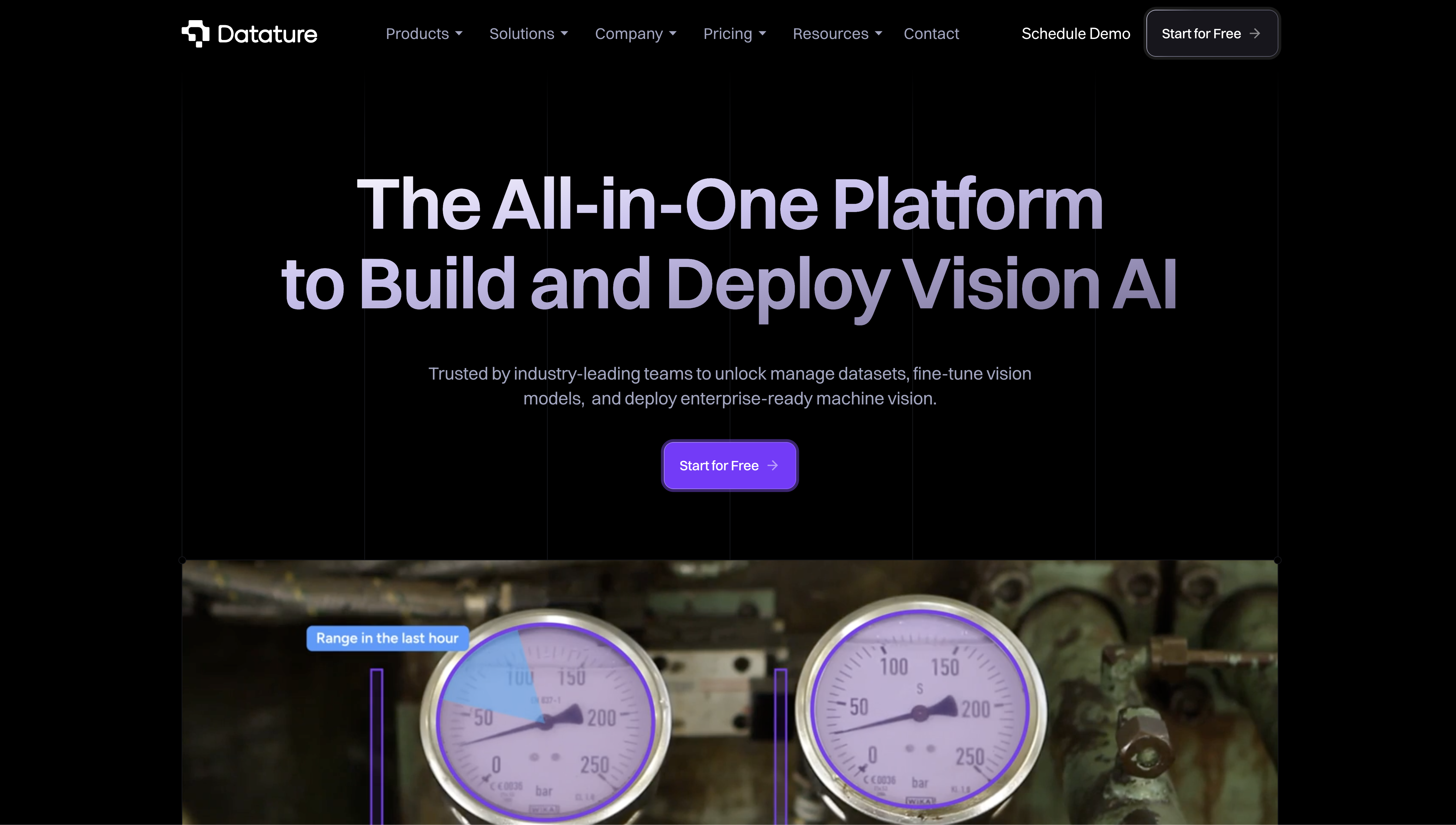
Datature is a comprehensive AI vision platform designed to build computer vision applications efficiently and without the need for coding. It offers processes to manage, annotate, train, and deploy computer vision models. Its solutions extend to sectors such as pharmaceutical & healthcare, retail & e-commerce, smart city, utilities & energy, agriculture, and manufacturing & construction. Notably, Datature is suitable for enterprises, high-growth companies, early-stage startups, researchers, and academia.
Datature comprises three main components: Nexus, IntelliBrush, and Portal. Nexus is the cornerstone of the platform that facilitates collaboration, annotation, training, and deployment of multiple computer vision models. IntelliBrush is an AI-assisted labelling tool focused on helping users quickly create pixel-perfect annotations, and Portal is an open-source platform for users to upload their models, test images and evaluate the performance and accuracy of these computer vision models.
Nexus is the core platform of Datature, allowing users to collaborate, annotate, train, and deploy multiple computer vision models on a single no-code platform. It is designed to enhance the workflow and increase efficiencies by providing a centralized and integrated environment for project collaboration and management.
IntelliBrush in Datature is an AI-assisted labelling tool designed to expedite the creation of pixel-perfect annotations. With just few clicks, users can annotate images efficiently and accurately, making it an integral tool for preparing data for training computer vision models.
The Portal component of Datature is essentially a free, open-source platform that allows users to upload their models and test images. It provides a simple drag-and-drop functionality to evaluate and measure the performance and accuracy of the computer vision models. Results of the tests can be evaluated visually, thus enhancing understanding and analysis of the AI model's performance.
Datature offers a wide range of features, including efficient data management, annotation, model training and deployment, collaboration capabilities, secure integration, and visualisation of model performance. It provides compatibility with all model formats, offers a rich open source support, incorporates industry-tested algorithms, market validated insights, and a seamless connection with Nexus. Additional features like IntelliBrush make annotation rapid and precise, and the Portal provides easy visualisation of model accuracy.
Datature is designed to be used by a wide spectrum of users, including enterprises, high-growth companies, early-stage startups, researchers and academia. Essentially, any team or individual seeking to build and deploy computer vision applications can leverage the benefits of Datature.
No, Datature does not require users to possess coding skills to operate. It is a no-code platform that simplifies the entire process of building, training, and deploying computer vision models, thus being accessible to non-technical users as well.
Datature supports customised integrations by accommodating various model formats and maintaining compatibility with the Nexus platform. Its platform can be effortlessly integrated with existing systems and processes, making it highly scalable and adaptable for both enterprises and startups.
Datature ensures high security measures including compatibility with all chain of custody requirements and compliance with data security standards such as SOC 2 and HIPAA. It is built with enterprise-level security to protect the data and models of users, making it trustworthy.
Datature is versatile and adaptable, making it suitable for diverse sectors. Its nexus platform supports various computer vision models that can be applied across sectors like pharmaceutical & healthcare, utilities & energy, etc. From drug discovery to medical image analysis in healthcare, to energy consumption prediction and asset inspection in Energy & Utilities, Datature's applications are scalable and sector-agnostic.
Datature provides a wide array of resources for its users. It features a resources section that provides glossaries, documentation, tutorials, and articles highlighting best industry practices and trend developments in AI. There are also events for users to keep updated on platform developments and industry best practices. It also maintains a blog that explains product features and industry trends in detail.
Data management in Datature involves managing and annotating images, videos, and annotations via drag-and-drop or automatic upload via API. It supports popular formats such as COCO and YOLO, enabling precise searches for streamlined dataset management. The platform also supports managing large datasets with version controls and customised labelling workflows.
Datature's IntelliBrush is an efficient tool for creating pixel-perfect annotations swiftly. It offers the advantage of AI assistance, allowing users to annotate images accurately for model training. The feature supports various types of image classification, object detection, semantic segmentation, instance segmentation, and pose estimation, reducing the time and effort spent on the annotation process.
Datature offers extensive compatibility with regards to model formats. User-created models may be exported in popular forms such as TensorFlow, ONNX, PyTorch, etc. This range of compatibility ensures that users can effortlessly integrate their trained models with existing systems and processes.
Yes, Datature does support an open-source community. It offers an open-source platform, Portal, and maintains a rich open-source community, thereby encouraging collaboration, innovation and widespread use of the platform.
'Industry tested algorithms' and 'market validated insights' in context of Datature refer to the application of well-vetted algorithms and insights from a variety of sectors that have proven their effectiveness and efficiency in the market. These, when incorporated in the platform, enhance the variety and accuracy of solutions that users can develop on Datature.
Teams can collaborate using Datature through its Nexus platform. This platform provides a collaborative workspace where users can work together seamlessly on projects, conduct robust annotation, train multiple computer vision models, and deploy them on a single platform. By integrating all these processes into one, Nexus promotes effective teamwork and productivity.
Datature allows multiple computer vision models to be trained concurrently on its Nexus platform. Users can set up model training strategies, manage dataset versions, fine-tune hyperparameters, and select model architectures through an intuitive visual workflow. The platform supports export formats such as TensorFlow, ONNX, PyTorch, etc., catering to the different requirements users might have.
Datature 'plugs seamlessly into the Nexus' means that all components and features of Datature, like IntelliBrush or the various model integration tools, integrate smoothly with the Nexus platform. This results in a seamless and cohesive user experience, where all components work coherently to aid the process of building, training, and deploying computer vision models.
Pricing
Pricing model
Freemium
Paid options from
$499/month
Billing frequency
Monthly
Related Videos
Introduction to the Annotator
Datature•302 views•Feb 24, 2025