

ekai
Skip weeks of manual data extraction: ekai profiles your data in place inside your warehouse and infers structure automatically, so semantic modeling starts from your raw data instead of from exports.
Listing not yet reviewed by our editors · How we check
Overview
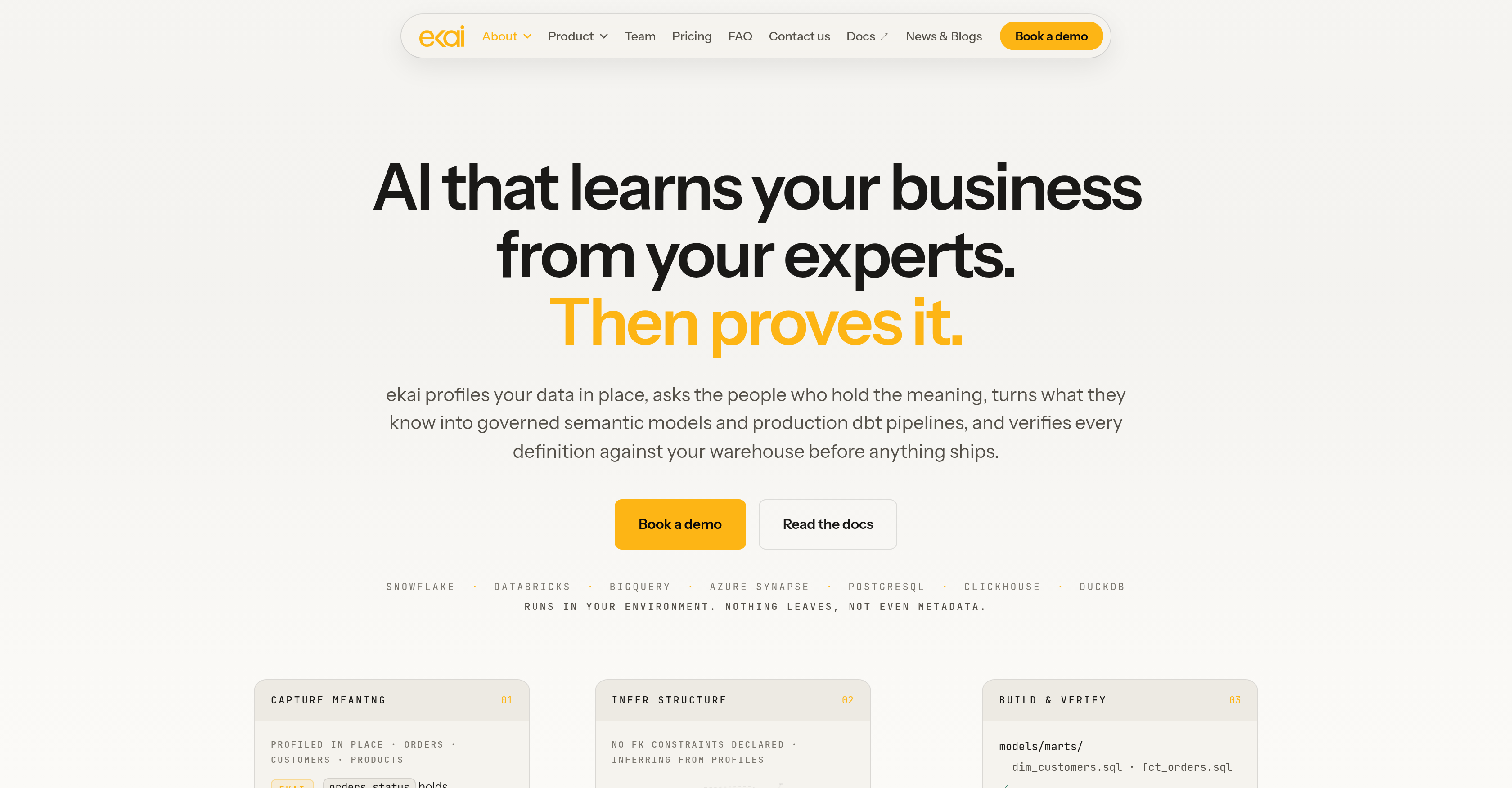
- Skip weeks of manual data extraction: ekai profiles your data in place inside your warehouse and infers structure automatically, so semantic modeling starts from your raw data instead of from exports.
- Turn tribal knowledge into shared business definitions: ekai works directly with your domain experts to capture their definitions and converts them into governed semantic models.
- Ship trusted metrics with no bad definitions in production: every definition is verified against your data warehouse before anything is published.
- Deploy production-ready data pipelines without hand-writing them: ekai generates dbt code, tests, and models that run inside your warehouse.
- Get documentation, a business glossary, metrics, and data lineage automatically: ekai produces them with every model, so analysts can trace where data comes from, where it goes, and how it changes.
- Keep your existing data stack: native integrations cover Snowflake, Databricks, BigQuery, Postgres, Azure Synapse, ClickHouse, and DuckDB.
- Get AI insights and reports you can rely on: ekai grounds AI analysis and data questions in verified semantic models built from your own definitions, not guesses about your raw tables.
Pros & Cons
From the listing; not yet checked by our editors.
Pros
- Semantic model automation
- Integration with multiple platforms
- Transforms expert knowledge into models
- Generation of production dbt pipelines
- Data profiling in place
- Automated, no manual extraction
- Autogenerated dbt code
- Autogenerated tests
- Autogenerated documentation
- Generates glossary, metrics, lineage
- Everything executed inside warehouse
- Understands team definitions
- Verifies definitions against warehouse
- Runs in user environment
- No data leaves account
- Inferred structure from data
- Interacts with experts
- Integrates with Snowflake, Databricks, BigQuery
- Integrates with Postgres, Azure Synapse
- Integrates with ClickHouse, DuckDB
- Modeling anchored in expert knowledge
- Governed semantic models
- Semantic Models ready in hours
- Proactive data warehouse querying
- Auto entity, relationship inferring
- Considers business context
- Draft logical model creation
- Auto dbt, metrics, lineage generation
- Layer publishing in business environment
- Hand-authored YAML not needed
- Model verification against set facts
- Model validation before shipping
- Makes accountability integral
- Output in standard dbt, YAML,
- JSON output owned by user
- Models reviewed by user team
- Semantic layer built from meaning
- Neutral by design, no lock-in
- Semantic modeling inside user boundary
- Read-only warehouse connections
- Coverage across multiple platforms
- Git native versioning of artifacts
- Open, portable artifact outputs
- Model traffic follows cloud agreements
- Versioned to GitHub, GitLab, Bitbucket
Cons
- No real-time data updating
- Lacks query history mining
- Dependency on external experts
- Requires rigorous pre-publish checks
- No native Postgres, Azure Synapse, ClickHouse, DuckDB integrations
- Doesn't facilitate private routing
- Data stays put, limiting mobile access
- No direct YAML authoring
- Data profiling could be resource-intensive
Alternatives to ekai
Tools that share the most tags with ekai.
- Yorph AI
Transform raw data into strategic decisions automatically with intelligent automation that processes and analyzes information
Freemium · from $29.99/month
$29.99/month
Not yet checked
- Infograph.app
Transform complex data into clear visuals instantly using AI that analyzes any text or raw numbers
Free
Not listed
Not yet checked
- Arria
Automatically generate enterprise reports and financial analysis from raw data using patented NLG technology that mimics expert analysts
Free trial · from $15/month
$15/month
Not yet checked
- VibeChart
Create charts instantly using plain English instead of complex software with the Text-to-Chart interface
Free trial · from $20/month
$20/month
Not yet checked
- GigaSpaces eRAG GenAI
Get instant, accurate answers from all your operational data by asking questions in plain English, powered by advanced semantic reasoning that translates your intent into precise SQL queries.
Not listed
Not listed
Not yet checked
- PromptLoop
Transform messy text into structured data instantly using a simple spreadsheet formula that works like SUM or VLOOKUP
Freemium · from $49/month
$49/month
Not yet checked
Reviews
Rate this tool
Loading reviews...
Frequently asked questions
What is ekai?
Ekai is a data management tool that simplifies the process of semantic modeling by automating it. It reads, understands, and writes your data after analyzing it from your Snowflake warehouse. It effectively captures your team's definitions and writes the necessary models and dbt code.
How is ekai integrating with Snowflake?
Ekai integrates with Snowflake by reading data from your Snowflake warehouse. Any data definitions made by your team are understood and the corresponding models and dbt code are written. Automation processes let this operation happen swiftly and efficiently.
What data platforms does ekai support?
Ekai supports various data platforms including Snowflake, Databricks, BigQuery, Postgres, Azure Synapse, ClickHouse, and DuckDB.
How does ekai create semantic models?
Ekai creates semantic models by reading and understanding your data. This information is extracted from your data warehouse and definitions provided by your team are integrated into the model. It then writes the dbt code required for these models.
What is the role of expert knowledge in ekai?
In Ekai, expert knowledge plays a significant role in developing definitions for semantic modeling. Ekai interacts with your experts, obtains their input, and transforms it into semantic models and dbt pipelines.
How does ekai ensure accuracy and reliability of the data?
Ekai ensures data accuracy and reliability by verifying every definition generated against the industry-standard data warehouse before publishing.
What is the automation process in ekai?
In Ekai, automation plays a crucial part in the operation, removing the typically slow process of manual extraction. The process includes capturing meaning from data, creating and verifying models, asking and analyzing data and finally, executing the resulting models, tests, documentation, glossary, metrics and lineage inside your warehouse.
What does it mean to have governed semantic models in ekai?
Governed semantic models in Ekai refer to the creation of semantic models based on expert knowledge and fully approved before being run in production. These models, as part of dbt pipelines, are verified against the industry-standard data warehouse before any publishing takes place.