
Framebreaker
Go from raw screenplay to a ready shot list in minutes: AI script breakdown splits commercial, short drama and cinematic scripts by shot, episode or scene, with running time and pacing setting the shot count for every stage.
Listing not yet reviewed by our editors · How we check
Overview
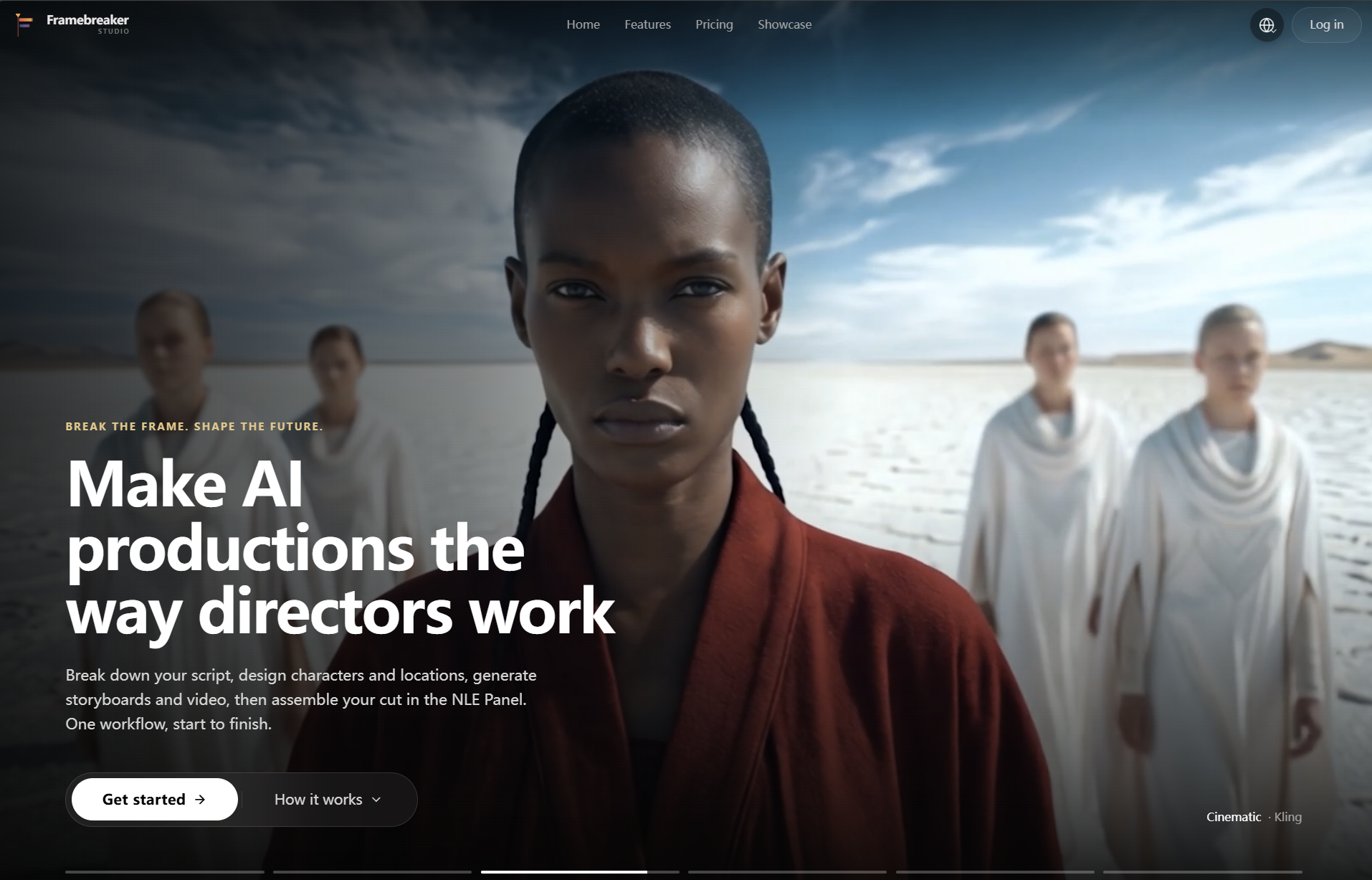
- Go from raw screenplay to a ready shot list in minutes: AI script breakdown splits commercial, short drama and cinematic scripts by shot, episode or scene, with running time and pacing setting the shot count for every stage.
- Keep the same faces, costumes and locations across every cut: characters, locations, props and products are defined once, bound to each storyboard frame by priority, and used as first-frame anchors for video generation, ending AI character drift.
- Spend credits only on shots you have already approved: AI storyboard generation lets directors inspect, inpaint and fine-tune keyframes, locking composition, lighting and style before any video renders.
- Match the right engine to every shot without juggling subscriptions or API keys: the Multi-model Video Studio assigns Kling, Google Veo, Wan, Seedance, MiniMax or Gemini Omni shot by shot within one project.
- Finish dialogue, voiceover and sound design without leaving the project: ElevenLabs, MiniMax and Kling power voice cloning, expressive multilingual text-to-speech, contextual sound effects and background score on dedicated tracks.
- Deliver fluid motion and natural transitions between connected beats: shot groups use end-frame bridging or multi-shot sequences to keep shared lighting, visual identity and synchronized multi-speaker dialogue across a scene.
- Revise any element late in production without starting over: independent timeline tracks let you swap a video engine, re-record a line or replace an audio stem on one shot, while asset and script edits sync automatically through shot lists, storyboards and the timeline.
- Hand off a structured pre-edit straight to your editor: the NLE Panel assembles shots, voice and sound with AI auto-edit, then exports timeline XML or FCPXML to Premiere Pro, DaVinci Resolve or Final Cut Pro.
- Pay nothing for failed generations and avoid monthly lock-in: pay-as-you-go BP credits are held at job start and released if a render fails, with free welcome credits, referral rewards and one-time Starter, Creator or Studio packages.
- Bring directors, ad agencies and production teams up to speed fast: a guided Director's Slate to Video Studio workflow replaces complex node graphs and runs in English and Chinese.
Pros & Cons
From the listing; not yet checked by our editors.
Pros
- Automates traditional directors' workflows
- Auto script breakdown
- Pre-edit feature in NLE panel
- Export XML to Premiere Pro, Final Cut Pro, DaVinci Resolve
- Automatic reference matching for consistency
- Pay-as-you-go using BP credits
- No charges for failed generations
- Full project accessibility via browser
- Assists in creating multiple media formats
- Cinematic story creation tool
- Automates commercial creation
- Streamlines short film production
- Format-specific workflows
- Art direction for characters and locations
- Assets defined before storyboard generation
- Video generated from storyboard frames
- Multi-model video, voice, sound creation
- Separate browser windows for Storyboard, Gallery, Video Studio, Media Center
- Transparent cost tracking per project
- Multiple video, voice, sound models available
- Premiere Pro, DaVinci Resolve and Final Cut Pro compatibility
- Automatic storyboard frames matching with references
- Hand edits or Auto Edit options in NLE Panel
- NLE Panel for video and sound assembly
- Auto Edit and XML export options
- No cost for failed generations
- Different window panels kept in-sync
- Specific script structure for various formats
Cons
- Browser-based only
- Requires BP credits
- Pay-as-you-go system
Alternatives to Framebreaker
Tools that share the most tags with Framebreaker.
- Flawless
Eliminate language barriers for global distribution with perfectly lip-synced performances in any language using Visual Dubbing technology
Not listed
Not listed
Not yet checked
- Veo
Create high-definition 1080p videos that run longer than a minute from simple text descriptions
Paid · from $49.90/month
$49.90/month
Not yet checked
- VidSbo - AI Storyboard Generator
Transform a simple text idea into a production-ready storyboard with detailed scene descriptions, shot types, and camera movements in seconds, using AI analysis of your concept.
Free trial · from $19/month
$19/month
Not yet checked
- Beeble
Transform lighting conditions after filming with AI-generated depth, normal, and albedo passes that describe how light interacts with surfaces
Freemium · from $16/month
$16/month
Not yet checked
- Melies AI Screenwriting Software
Break through writer's block with AI-powered story generation that explores countless narrative possibilities for shorts, features, or TV series
Paid · from $29/month
$29/month
Not yet checked
- Vanity AI
Complete entire VFX sequences in hours instead of months with AI-powered processing that's 300x faster than traditional pipelines
Not listed
Not listed
Not yet checked
Reviews
Rate this tool
Loading reviews...
Frequently asked questions
What is Framebreaker?
Kenn 🛠️ 1 tool wrote:Framebreaker is an AI-driven production platform designed to facilitate the creation of commercials, short films, cinematic stories, among other forms of media. Rather than functioning as a disconnected prompt box or an overly complex node-based canvas, Framebreaker unifies the entire cinematic workflow into a single structured pipeline: from intelligent script breakdown and art direction to consistent character/location design, multi-model video generation, and in-browser timeline editing with industry-standard XML export.
How does Framebreaker streamline the creation of commercials and short films?
Kenn 🛠️ 1 tool wrote:Framebreaker replaces fragmented tool stacks with a continuous, production-first workflow: Structured Pre-Production: Automatically breaks raw screenplays into structured scenes, shot lists, visual prompts, and camera directions. Identity & Art Consistency: Locks character identities, location references, and product assets prior to video generation, eliminating the persistent character drift found in traditional AI video generators. Unified Multi-Model Pipeline: Allows creators to dispatch different specialized video models (such as Kling, Veo, Seedance, Wan, and MiniMax) shot-by-shot within the same project. Frictionless Finishing: Assembles rendered shots, synthetic voiceovers, and sound effects directly on a timeline, ready to export into standard post-production software without manual file juggling.
What automation does Framebreaker incorporate?
Kenn 🛠️ 1 tool wrote:Framebreaker incorporates a range of automation approaches, includings script breakdown, character and location art direction, creation of storyboards. Framebreaker initially uses AI to parse and understand scripts, then it automatically creates assets such as characters and locations based on the context in the script. Dynamically prioritizes and binds approved character sheets, location concept art, and product references to specific storyboard frames.
How are AI-generated storyboards used in Framebreaker?
Kenn 🛠️ 1 tool wrote:In Framebreaker, storyboards are not just static concept illustrations—they act as the executable visual blueprint for video synthesis. Each storyboard frame is generated against pre-defined character models and stylistic constraints. Directors can inspect, inpaint, or fine-tune keyframes before committing credits to video rendering. Once confirmed, these storyboard images serve directly as visual anchors (first-frame reference seeds) for multi-model video generation, ensuring that final video outputs match the intended composition, lighting, and performance.
What different AI models does Framebreaker integrate?
Kenn 🛠️ 1 tool wrote:Framebreaker integrates an enterprise-grade, multi-model AI ecosystem that allows directors to assign the optimal engine for each specific creative task: Video Generation: Kling, Google Veo, Wan, Seedance, MiniMax, and Google Gemini Omni—selectable shot-by-shot based on motion dynamics, realism, or stylistic needs. Visual & Concept Art: Nano Banana, OpenAI GPT Image, Seedream, and Wan Image for concept stills, character portraits, and storyboard keyframes. Voice & Audio Production: ElevenLabs, MiniMax, and Kling for voice cloning, expressive dialogue text-to-speech (TTS), contextual sound effects, and atmospheric background score. Creators can switch between leading foundation models freely within the same sequence without managing multiple subscriptions or external API configurations.
What are BP credits, and how does Framebreaker's pricing work?
Kenn 🛠️ 1 tool wrote:BP (BreakPoint) is Framebreaker’s unified platform credit used to meter compute across AI text, image, video, and audio pipelines. Our pricing is strictly pay-as-you-go and performance-safe: Transparent, Dynamic Consumption: Credits are billed dynamically based on model tier, resolution, video duration, and feature type—so you only pay for the exact compute your project requires. Failure-Safe Guarantee: Credits are held when a generation job begins and are only settled upon successful deliverable generation. If a generation fails or is rejected, the held credits are automatically released back to your balance. Flexible Packages: Creators can get started with free welcome credits, earn referral rewards, or purchase one-time credit packages (Starter, Creator, or Studio) without being trapped in recurring monthly subscription locks.
How does Framebreaker maintain character, location, and visual consistency across scenes?
Kenn 🛠️ 1 tool wrote:Framebreaker eliminates the "character drift" common in AI video by locking visual identities in pre-production before generating video: Dedicated Pre-Production Slates: Directors define character looks, costume, props, and location architecture upfront, establishing visual reference profiles. Priority-Based Reference Binding: The system automatically cross-references and attaches approved character sheets and location moodboards to individual storyboard frames by priority. Confirmed Keyframe Anchors: Confirmed storyboard frames act as the visual seed (first-frame reference) for video synthesis, forcing the video models to preserve facial features, costume details, lighting, and camera perspective across sequential cuts. Universal Asset Sync: When an asset or script beat is adjusted, the changes propagate synchronously through the shot lists, storyboard frames, and NLE timeline.
What flexibility does Framebreaker provide for varied choices for video, image, voice, sound effects, and music generation?
Kenn 🛠️ 1 tool wrote:Rather than locking creators into a single proprietary algorithm, Framebreaker functions as an intelligent production harness. It orchestrates the native strengths of the world’s leading foundation models across all audiovisual layers, giving creators unprecedented flexibility across two dimensions: production scale and modality independence. 1. Flexible Production Granularity: Single Shot vs. Shot Group Single-Shot Precision (Micro-Control): Perfect for meticulous directorial tuning. Creators can direct isolated shots with custom camera motions, multi-slot references (visual, audio, and motion), and in-canvas inpainting—allowing shot-level iteration without disrupting neighboring cuts. Shot Group Continuity (Macro-Control): Designed for seamless narrative flow. Creators can group consecutive storyboard shots using either: End-Frame Bridging: Anchoring start and end keyframes to generate fluid motion and natural physical transitions. Multi-Shot Sequences: Batch-synthesizing connected narrative beats in a single pass, maintaining visual identity, shared lighting, and synchronized multi-speaker dialogue. Hybrid Timeline Assembly: Framebreaker’s multi-track NLE and AI auto-edit engine natively harmonize single shots and shot groups on the same timeline, giving creators full freedom to mix continuous sequence takes with precise standalone coverage. 2. Native Strength Orchestration Across All Modalities Harnessing Model Superpowers: Video, concept art, voice synthesis, Foley/SFX, and background scores are completely decoupled. Directors can leverage whichever foundation model excels at a specific task—whether that means choosing an engine optimized for complex physical motion, one built for expressive multilingual voice cloning, or one specialized in cinematic scoring. Non-Destructive Iteration: Because all modalities exist on independent timeline tracks, you can audition different video engines, re-record a dialogue line, or swap an audio stem on any individual shot or group at any point—without re-rendering or compromising the rest of your production.