

HeyDeer
Spend review time only on real problems: every finding is verified against the code before it posts, separate reviewers examine each change, and you filter reports by confidence and severity, exclude generated files, and decline findings so they never return in later pull request reviews.
Listing not yet reviewed by our editors · How we check
Overview
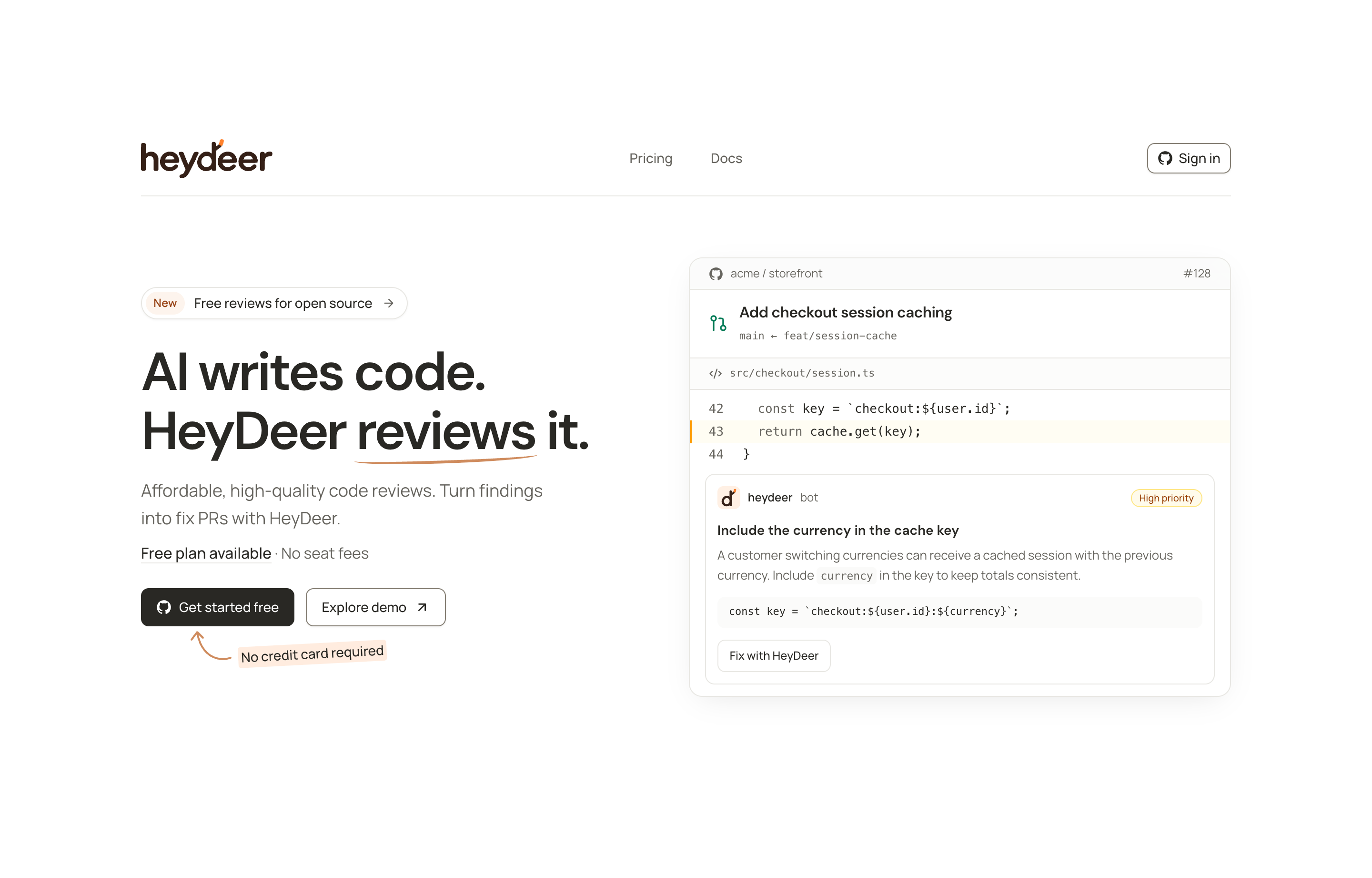
- Spend review time only on real problems: every finding is verified against the code before it posts, separate reviewers examine each change, and you filter reports by confidence and severity, exclude generated files, and decline findings so they never return in later pull request reviews.
- Catch bugs a diff alone hides: each GitHub pull request is reviewed against your entire repository, so issues that only surface in context reach you before merge.
- Act on feedback right where you read it: inline PR comments state the severity, what goes wrong, and a suggested fix, and follow-up reviews recheck earlier findings to confirm they are resolved.
- Resolve findings without losing control of your branch: Fix with HeyDeer writes the changes for the findings you select, follows any instructions you add, and opens a separate PR against your branch. Your branch stays unchanged until you merge.
- Enforce your team's coding standards on every PR: automated code review follows the conventions in your AGENTS.md, verifies the requirements you write in .agents/checks on matching files, and applies review instructions set per workspace or per repository.
- Block risky merges and clear clean ones: require the HeyDeer Review check before merging, and let HeyDeer approve pull requests that pass.
- Review exactly the PRs you choose with no setup: review every push automatically, filter by label, author, or draft state, or comment @heydeer review on demand. The first review needs no configuration.
- Match review depth to code risk: Standard covers most pull requests, while Deep spends longer on each step for payments, authentication, and other sensitive code.
- Get findings grounded in your requirements, not just your code: on paid plans, MCP servers let reviews look up your documentation and tickets.
- Keep feedback readable for your whole team: reviews are written in your team's language.
- Scale code review without seat fees: every plan includes unlimited developers and repositories. The Free plan covers private repositories with 1,000 credits in the first month and 300 monthly after, needs no credit card, and paid plans start at $12/month. Open-source repository reviews are free up to a fair-use limit.
- Keep proprietary code private: HeyDeer never trains its models on your code, instructions, or review results. Reviews and fixes run in temporary sandboxes, and every model runs with Zero Data Retention.
Pros & Cons
From the listing; not yet checked by our editors.
Pros
- Checks each finding against the code before posting
- Turns chosen findings into fix PRs you review and merge
- Reviews against AGENTS.md and your own repository checks
- Requirable GitHub check and automatic approval
- Standard or Deep depth for routine or sensitive changes
- Free plan includes private repositories
- Unlimited developers and repositories, no seat fees
- Doesn't train its models on your code
Cons
- Only integrates with GitHub currently
Alternatives to HeyDeer
Tools that share the most tags with HeyDeer.
- CodeRabbit
Eliminate manual code review bottlenecks with instant PR summaries and intelligent code walkthroughs that accelerate your development workflow
Free trial · from $24/month
$24/month
Not yet checked
- Kilo | Code Reviewer
Eliminate post-merge bugs and security vulnerabilities by catching them in your IDE before committing, using the local code review feature that provides real-time feedback on uncommitted changes.
Freemium · from $15/month
$15/month
Not yet checked
- Coderbuds
Get instant code reviews without waiting for teammates through AI analysis of pull requests under 200 lines
Free trial · from $20/month
$20/month
Not yet checked
- Codiga
Automatically fix security vulnerabilities and coding issues with one-click automated code fixes directly in your IDE
Freemium · from $14/month
$14/month
Not yet checked
- Codoki AI
Merge pull requests faster with structured reviews that highlight only high-impact issues, cutting through noise to focus on what matters
Freemium · from $12.50/month
$12.50/month
Not yet checked
- Mo
Eliminate shipping errors by ensuring your final code matches exactly what your team approved in Slack, using AI to cross-check merge requests for discrepancies before they are merged.
Free trial · from $49/month
$49/month
Not yet checked
Reviews
Rate this tool
Loading reviews...
Frequently asked questions
What is HeyDeer?
Zihua Li 🛠️ 1 tool wrote:HeyDeer is an AI code reviewer for GitHub pull requests. It reviews each change against your repository and your team's standards, posts its findings as inline comments, reports the result in a check you can require, and fixes the findings you choose when you ask.
How do I get started with HeyDeer?
Zihua Li 🛠️ 1 tool wrote:Install the HeyDeer GitHub App, choose your repositories, and comment @heydeer review on a pull request. To review pull requests automatically, choose a review schedule in Workspace settings → Review rules. You don't need to configure anything before the first review.
Which platforms does HeyDeer support?
Zihua Li 🛠️ 1 tool wrote:GitHub, for both organizations and personal accounts.
How does HeyDeer keep reviews low on noise?
Zihua Li 🛠️ 1 tool wrote:Separate reviewers examine each change, and HeyDeer checks every finding against the code before posting it. You can also choose which findings it reports by confidence and severity, exclude generated files, and decline a finding by replying in its conversation so later reviews don't post it again.
Can HeyDeer fix the issues it finds?
Zihua Li 🛠️ 1 tool wrote:Yes. Select Fix with HeyDeer in a review, choose the findings and add any instructions. HeyDeer writes the changes and opens a separate PR against your original branch. You review and merge it; your branch stays unchanged until you do.
How do I teach HeyDeer my team's standards?
Zihua Li 🛠️ 1 tool wrote:Put coding conventions in AGENTS.md, write requirements in .agents/checks for HeyDeer to verify on the files they cover, and add review instructions for the whole workspace or one repository. Paid plans can also connect MCP servers so reviews can look up your documentation and tickets.
What's the difference between Standard and Deep reviews?
Zihua Li 🛠️ 1 tool wrote:Standard reviews the change from independent perspectives and verifies each finding against the code, which suits most pull requests. Deep follows the same steps but spends longer on each, for payments, authentication or other sensitive code. Deep uses more credits.
How much does HeyDeer cost?
Zihua Li 🛠️ 1 tool wrote:The Free plan includes 1,000 credits in the first month and 300 each month after that, with private repositories and no credit card required. Starter is $12/month for 1,500 credits and Pro is $60/month for 10,000 credits. Every plan includes unlimited developers and repositories with no seat fees. Credits pay for the work each review or fix does, so the cost depends on the size of the change and the review depth.