

iGPT
Feed AI agents live, structured context from emails and documents without manual parsing or prompt tuning via a single unified API call
Listing not yet reviewed by our editors · How we check
Overview
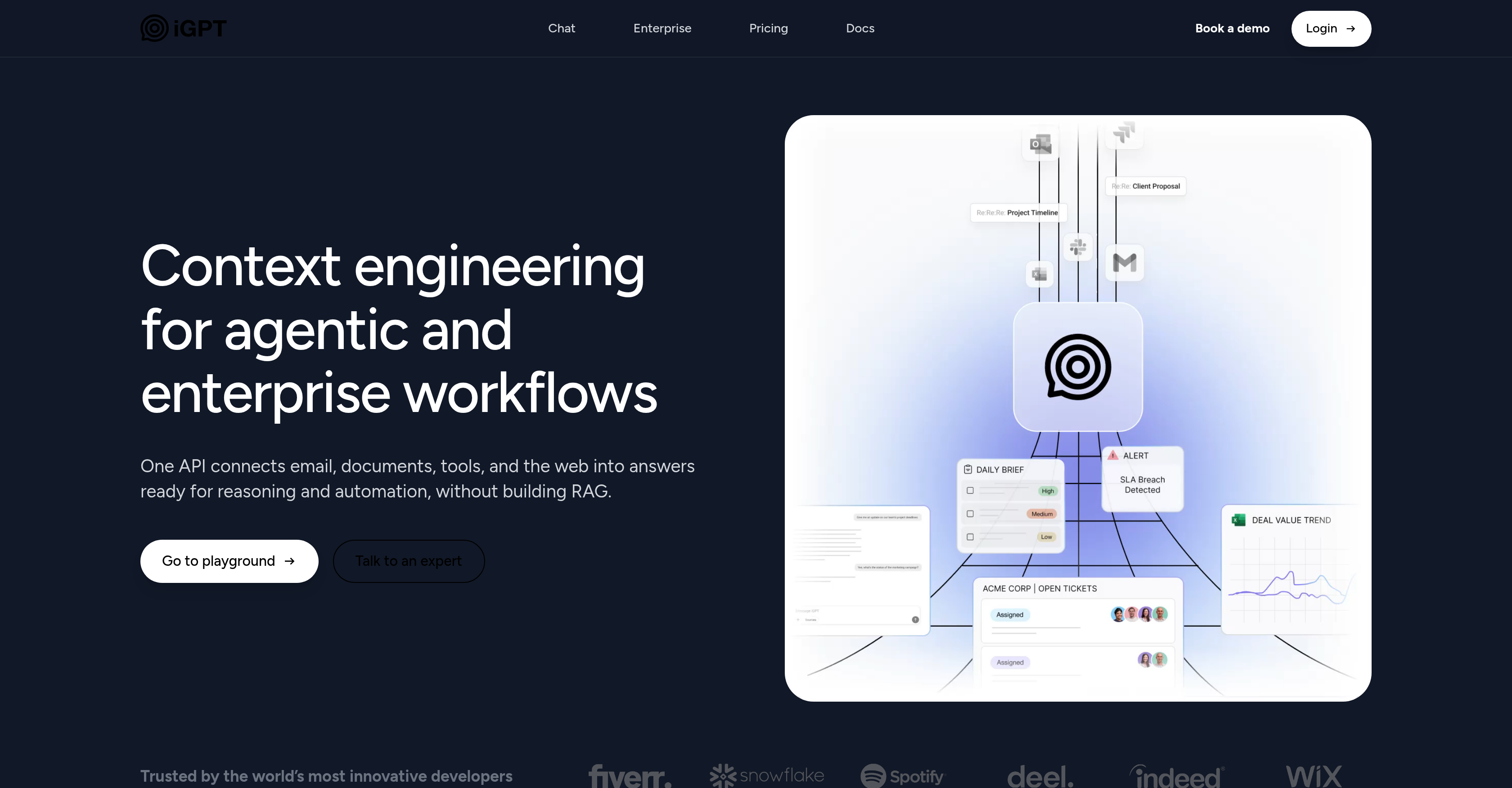
- Feed AI agents live, structured context from emails and documents without manual parsing or prompt tuning via a single unified API call
- Extract actionable insights, detect action items, and surface priorities from communication threads for sales and recruiting workflows using automated data transformation
- Power precise compliance reviews and audit trails by connecting threads and attachments so your tools can trace evidence and decisions with full transparency
- Deploy with enterprise-grade security using Role-Based Access Control, zero data retention, and private on-premise or hybrid cloud options for complete data control
- Enable real-time reasoning and automation for account intelligence and internal analytics with continuously updated, indexed data from new messages and attachments
- Retrieve the most relevant information using a hybrid system that combines semantic understanding and keyword filters in one call for accurate results
Pros & Cons
From the listing; not yet checked by our editors.
Pros
- Transforms unstructured emails into actionable data
- Unified endpoint for retrieval, shaping, context shaping, reasoning
- No need for parsing, indexing, chunking, or prompt tuning
- Supports input in any preferred language
- Structured JSON responses
- Real-time ingestion of new messages and attachments
- Offers combined semantic and keyword filters
- Automated processing of communication threads, structured data, and text
- Enables continuous flow of data
- Extensive application in sales, automation, recruitment, compliance, intelligence support, internal analytics
- Emphasizes security: doesn't use data for model training
- Stores zero data after processing
- Role-Based Access Control
- Full transparency in processing steps
- Options for cloud, hybrid, and private deployments
- Real-time transformation of company data into actionable context
- Single API call for context-rich data
- Integrates with CRMs, project tools, and collaboration platforms
- Can detect and structure action items, deadlines, follow-ups, sentiment, priorities, relationship maps
- Integrates seamlessly with Python, JavaScript/TypeScript, and Go
- Data never leaves company's control
- Facilitates intent extraction from communication threads
- Automatically processes attachments
- SDKs and live examples for easy integration
- Context extraction from large inboxes
- Enables workflow-focused builds instead of email parsing
- Structured responses for reasoning and automation
- Utility in audit support tasks
- Processing of emails into structured reasoning context
- Facilitates agent memory based on past interactions
- Automatic detection of intent and decisions in emails
- Provides key insights like tone, confidence levels, and blockers
- Rapid prototyping for production
- Secure OAuth-only processing
- Restricted to authorized accounts
- Complies with SOC2 and GDPR regulations
- Enables risk pattern extraction for legal data discovery
- Enables CRM sales, customer success support
- Ideal for workflow automation, BI & Analytics, and agent triggers
- Compatible with operations management and project management tools
- Provides cited responses for verification and audit
- Ready to use API with no credit card required for initial use
- Enables automatic task updates based on email content
- API response well structured for developer use
Cons
- No offline functionality
- Possible delay real-time ingestion
- Depends on third-party email services
- Requires continuous data flow
- Comprehension restricted to email threads
- No standalone data storage
- Unspecified SOC2, GDPR compliance schedule
- Unclear retrieval accuracy rate
- No built-in CRM functionality
- Data privacy heavily reliant on deployment model
Alternatives to iGPT
Tools that share the most tags with iGPT.
- NjectAI
Get answers that fit your work from the first message: context injection adds your saved business, audience, voice and project details to every prompt.
Free trial · from $9/month
$9/month
Not yet checked
Reviews
Rate this tool
Loading reviews...
Frequently asked questions
What's the main functionality of iGPT?
iGPT's main functionality is to transform company data, tools, and knowledge into content that can be used for reasoning by different AI systems, workflows, and teams. It achieves this by deeply indexing email, documents, and work data and connecting them into a unified endpoint for retrieval, context shaping, and reasoning in one pipeline.
What does 'context engineering' mean in relation to iGPT?
In relation to iGPT, 'context engineering' essentially involves transforming varied data forms, including email, documents, and work data into usable context. This context can then be deployed by different AI systems, workflows, and teams for reasoning and automation.
How does iGPT index data?
iGPT indexes data by deeply delving into the contents of emails, documents, and work data, and then connecting them into a unified endpoint. This extensive process ensures that the maximum context is derived from the indexed data.
What is the 'unified endpoint' in iGPT?
The 'unified endpoint' in iGPT refers to the single call that carries out retrieval, context shaping, and reasoning in one pipeline. This system ensures a seamless information workflow and eliminates the need for individual parsing, chunking, and indexing procedures.
How does iGPT enable reasoning and automation?
iGPT enables reasoning and automation by providing responses that are structured in such a way that it can be effectively utilized by AI systems for action and decision making. The context derived from data offers valuable insight, which forms the basis of reasoning.
What kind of input does iGPT accept?
iGPT accepts input in the language preferred by the user. This makes the tool highly accessible and easy to use.
What is the 'hybrid retrieval' feature of iGPT?
iGPT has a 'hybrid retrieval' feature that combines semantic and keyword filters and scores in a single call. This approach ensures holistic content retrieval, offering a mix of keyword-based and meaning-based results.
How does iGPT process communication threads?
iGPT processes communication threads by automatically transforming structured data and text from documents into a continuous flow of data. This helps in maintaining a regular flow of actionable insights from the communication threads.