

LLM Gateway
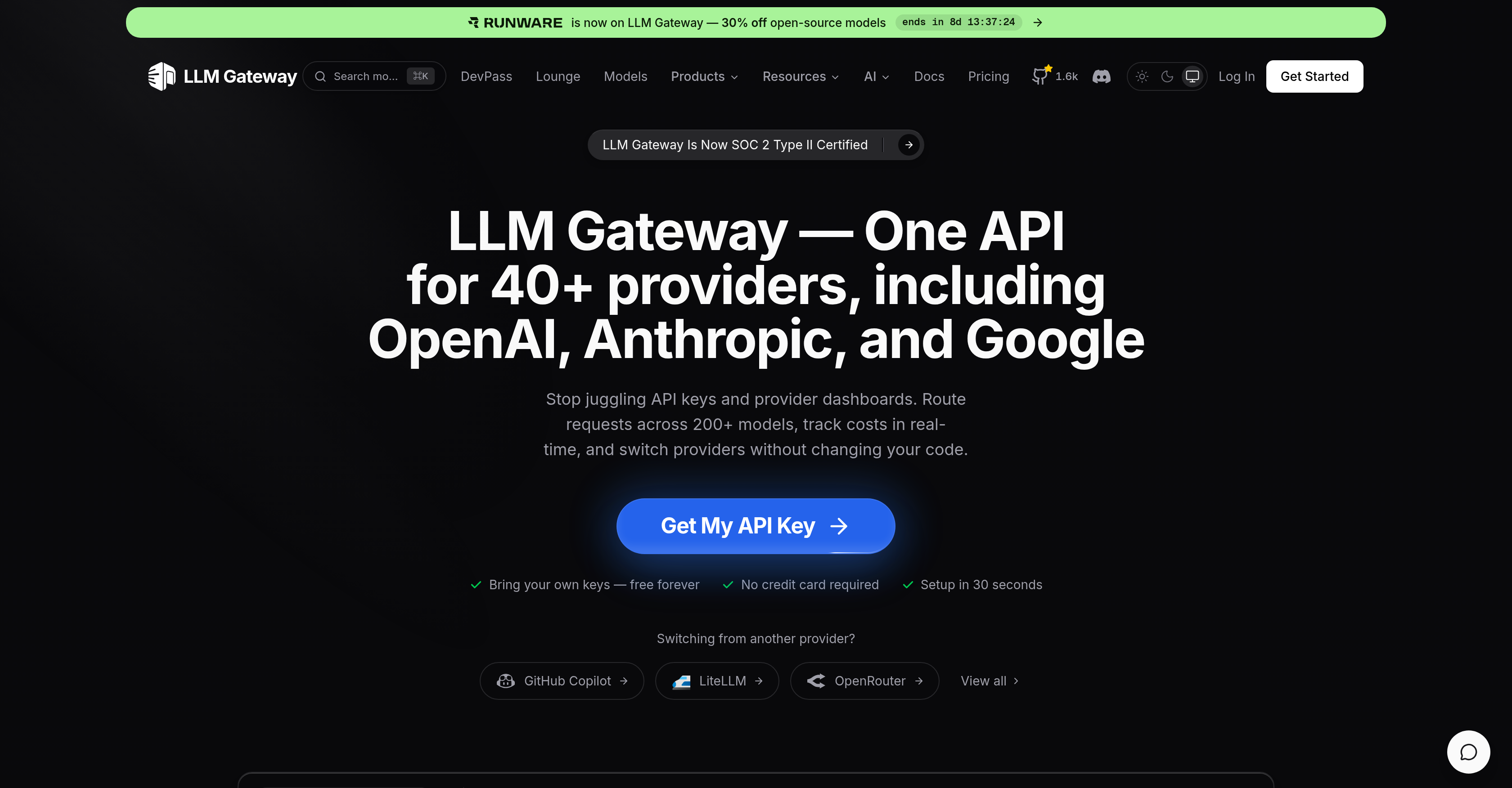
Keep your AI application online during provider outages: automatic failover routes LLM requests to healthy providers.
Listing not yet reviewed by our editors · How we check
Overview
- Keep your AI application online during provider outages: automatic failover routes LLM requests to healthy providers.
- Switch between OpenAI, Anthropic, Google, and other LLM providers without rewriting code: one unified LLM API handles routing across models.
- Stop juggling scattered API keys and provider dashboards: centralized, secure API key management keeps every credential in one place and reduces exposure risk.
- Cut LLM spend by spotting costly outliers fast: real-time cost tracking shows requests, tokens, total spend, and average cost per 1K tokens, broken down by provider and model.
- Pick the right model for each use case with evidence: side-by-side latency, cost, and quality comparison across models.
- Catch reliability problems before users notice: a monitoring dashboard tracks error rates, cache hit rates, and reliability trends.
- Protect user data and meet privacy requirements: built-in guardrails detect PII, prevent prompt injection, and block malicious requests.
- Align your LLM infrastructure with internal security policies: self-host the gateway for full operational control, or run it on cloud infrastructure to offload operations.
Pros & Cons
From the listing; not yet checked by our editors.
Pros
- Unified API Interface
- Multi-provider Support
- Performance Monitoring
- Secure Key Management
- Self-hosted and Cloud option
- Cost-aware analytics
- Per-model/provider breakdown
- Errors and reliability monitoring
- Project-level usage exploration
- Enterprise Audit Logs
- Guardrail features
- Automatic request routing
- Cost per token analysis
- No code alteration for provider switch
- Real-time cost tracking
- Detection of PII
- Prevents prompt injection
- Blocks malicious requests
- Tolerance for provider downtime
- Centralized key management
- Freedom of operation
- Option to delegate
- Facility for self-hosting
- Data on requests, tokens
- Reliability trends monitoring
- Breakdown of usage and spend
- Uninterrupted service guarantee
Cons
- No mention of SLA
- Dependent on provider uptime
- Lack of specific technical specs
- No offline capabilities
- Potential security risk with key management
- No multi-language support mentioned
- May introduce latency
- Complexity with self-hosting
- No transparent error handling
Alternatives to LLM Gateway
Tools that share the most tags with LLM Gateway.
- CometAPI
Eliminate multiple API integrations and reduce development time with unified access to 500+ AI models through a single endpoint
Freemium
Not listed
Not yet checked
- LiteAPI
Cut LLM API costs by up to 40% through preferred contracts secured with major providers
Freemium
Not listed
Not yet checked
- Text to API
Build production-ready AI APIs in seconds instead of days with rapid construction and deployment
Not listed
Not listed
Not yet checked
- APIMart
Cut AI API costs by up to 70% compared to direct providers and platforms like Fal.ai with a unified, pay-as-you-go platform that eliminates separate billing and accounts.
Not listed
Not listed
Not yet checked
- ZEGOCLOUD
Launch communication features faster with 20+ pre-built UIKits that eliminate building from scratch
Freemium · from $0.39/unit
$0.39/unit
Not yet checked
- PoYo.ai
Access dozens of premium AI models through a single unified API without managing multiple vendor integrations
Not listed
Not listed
Not yet checked
Reviews
Rate this tool
Loading reviews...
Frequently asked questions
What is the LLM Gateway?
LLM Gateway is a unified application programming interface that helps route, manage, and analyze Language Models requests across multiple providers. It consolidates the process of managing multiple API keys or provider dashboards by offering unified control through a single API. It's compatible with various LLM providers such as OpenAI, Anthropic, and Google, among others. It enables costs to be tracked in real-time and facilitates easy switching between providers. Its notable features include secure key management, comprehensive performance monitoring, and cost-aware analytics. It can be self-hosted or run on cloud-based infrastructure according to user preference.
How does LLM Gateway manage multiple API keys?
LLM Gateway provides seamless management of multiple API keys through its unified interface. It encapsulates the handling of various keys, preventing the necessity for users to juggle multiple sets of API keys or provider dashboards. By integrating with LLM Gateway, users can control all these entities via a single API. Secure key management is performed via a centralized dashboard, contributing to the overall security and convenience it offers.
What LLM providers does LLM Gateway support?
LLM Gateway supports various Language Models (LLM) providers. Notable among them are OpenAI, Anthropic, and Google. However, the support is not limited to these providers, enabling users to access an expansive range of providers via a single API.
How does the real-time cost tracking feature of LLM Gateway work?
LLM Gateway provides real-time cost tracking by displaying metrics related to tokens, total spend, and average cost per 1K tokens. It also offers in-depth analytics that show the expenditure associated with each provider and model. Thus, users can monitor their usage and control costs effectively.
Can I switch between AI providers without changing code using LLM Gateway?
Yes, LLM Gateway allows users to switch instantly between providers without the need to alter their code. By using LLM Gateway's unified API, users can transfer requests across a variety of models associated with different providers.
Does LLM Gateway offer secure key management?
Yes, LLM Gateway offers secure key management. It allows users to manage all provider keys through a single, centralized dashboard, increasing the security of credentials and reducing the risk of exposure.
What performance monitoring capabilities does the LLM Gateway offer?
LLM Gateway has comprehensive performance monitoring capabilities that help users analyze the performance of different models and select the most suitable fit for each use case. These capabilities include comparisons of latency, cost, and quality across models.
Is the LLM Gateway cloud-based or self-hosted?
LLM Gateway offers flexibility in its operation. It can either be self-hosted, giving full control of operation to the user, or run on a cloud-based infrastructure, allowing users to delegate operations to another provider.