

messages.dev
Launch AI agents that send iMessages, RCS, and SMS with native tapbacks, typing indicators, and read receipts using a single REST API
Listing not yet reviewed by our editors · How we check
Overview
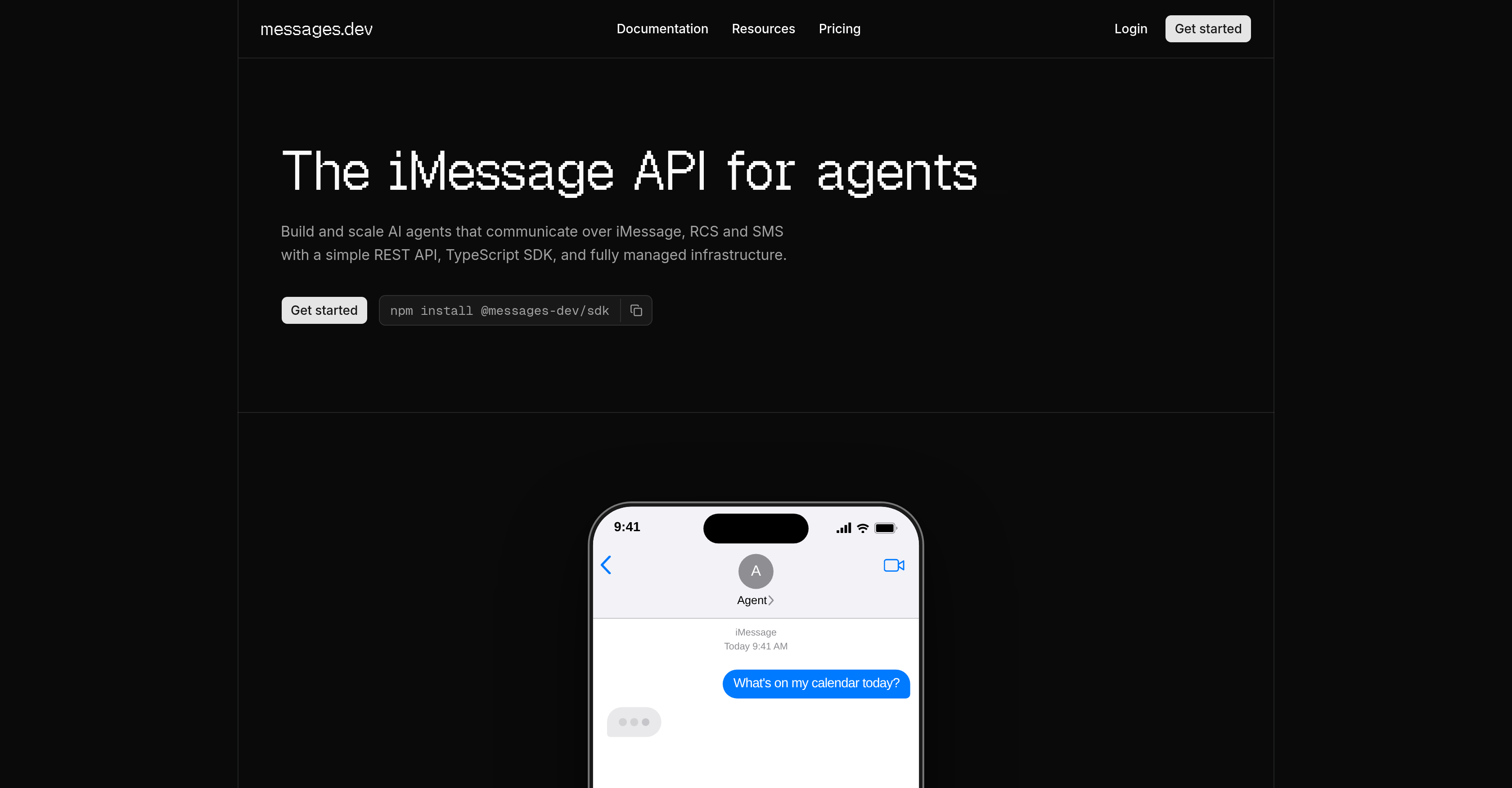
- Launch AI agents that send iMessages, RCS, and SMS with native tapbacks, typing indicators, and read receipts using a single REST API
- Skip infrastructure overhead and focus on agent logic while provisioning, scaling, and monitoring are handled automatically
- Test integrations risk-free before going live with a Sandbox environment that provides 50 free messages per day for AI agent development
- Receive instant notifications when messages arrive, reactions are added, or receipts are sent through real-time webhooks that deliver updates in milliseconds
- Secure all agent communications with end-to-end encryption, API key scoping, and webhook signature verification to prevent unauthorized access
- Achieve unified messaging across iMessage, RCS, and SMS through a single TypeScript SDK that simplifies interaction with the platform
Pros & Cons
From the listing; not yet checked by our editors.
Pros
- REST API
- TypeScript SDK
- Managed infrastructure
- Unified messaging over iMessage/SMS/RCS
- Tapback reactions support
- Typing indicators support
- Read receipts support
- Sandbox testing
- Free daily messages
- Real-time webhooks
- Instant notification for messages/reactions/receipts
- End-to-end encryption
- API key scoping
- Webhook signature verification
- Simplified setup
- Focus on agent logic
- Handles provisioning/scaling/monitoring
- Secure operation
- Quick message sending capabilities
- Supports native iMessage features
- Accurate tracking of interactions
Cons
- Limited Sandbox environment
- Only supports REST API
- No SDK for other languages
- Limited free messages per day
- No granularity in webhook notifications
- Reliant on provisioning management
- No customization of infrastructure
- No multi-channel support
- Requires TypeScript knowledge
- No explicit data backup system
Alternatives to messages.dev
Tools that share the most tags with messages.dev.
- Speechmatics | AI Voice Agents
Automate customer conversations instantly with sub-second speech-to-text that understands 55+ languages for global scalability
Free trial · from $0.24/unit
$0.24/unit
Not yet checked
- BrainyBear
Resolve 80% of customer questions instantly with AI agents trained on your specific content and knowledge bases
Free trial · from $38/month
$38/month
Not yet checked
- Monobot
Platform for building voice and chat agents that handle scheduling, reservations, appointment booking, order status, identity verification and lead qualification around the clock.
Paid · from $200
$200
Nov 23, 2026
- Vogent
Create human-like voice agents without writing code using the visual Flow Builder that designs conversation flows and probing questions
Paid · from $0.09/unit
$0.09/unit
Not yet checked
- Vozexo
Convert more inbound calls into qualified leads with an AI that answers instantly, qualifies interest, and routes only hot prospects to your sales team.
Paid · from $49/month
$49/month
Not yet checked
- Skymel ADK (Agent Development Kit)
Build production-ready AI agents in minutes without coding using simple English descriptions that automatically generate custom execution workflows
Paid · from $25
$25
Not yet checked
Reviews
Rate this tool
Loading reviews...
Frequently asked questions
What is messages.dev?
messages.dev is an AI tool that enables the building and scaling of AI agents for communication over platforms like iMessage, RCS, and SMS. It simplifies the setup and operation of these AI agents through a REST API, TypeScript SDK and a fully managed infrastructure.
What are the main features of messages.dev?
The main features of messages.dev include a simple REST API, TypeScript SDK, communication via iMessage, RCS, SMS, a sandbox environment, real-time webhooks, built-in tapbacks, typing indicators, read receipts, API key scoping, webhook signature verification, and a fully managed, scaled, and monitored infrastructure.
How does the TypeScript SDK in messages.dev work?
The TypeScript SDK in messages.dev has been designed for user convenience to quickly set up and initiate sending of messages. It simplifies the interaction with the messages.dev API in a more tailored and convient way using TypeScript language.
What is the REST API in messages.dev used for?
The REST API in messages.dev is used to allow the sending of iMessages, RCS, and SMS messages. It supports built-in features like tapbacks, typing indicators, and read receipts in these messages.
How does messages.dev allow for communication via iMessage, RCS, and SMS?
messages.dev allows communication over iMessage, RCS, and SMS through its simple REST API which lets the sending of iMessages, RCS, and SMS messages. It also supports a TypeScript SDK for added convenience, catering to various needs of multiple platforms.
What exactly does 'managed infrastructure' mean in the context of messages.dev?
In the context of messages.dev, 'managed infrastructure' refers to a system where it handles the provisioning, scaling, and monitoring of the AI agents, allowing users only to focus on crafting their agent logic.
What security measures does messages.dev have in place?
messages.dev places a high importance on security. It has features like end-to-end encryption ensuring secure communications, API key scoping offering flexibility and control in permissions, and webhook signature verification guaranteeing the authenticity of received data.
What is the Sandbox environment in messages.dev used for?
The Sandbox environment in messages.dev is used for development and testing purposes. It provides 50 free messages per day to users, enabling them to build and test their integration before their AI agents go live.