

Polymath Robotics Autonomous Navigation Modules
Overview
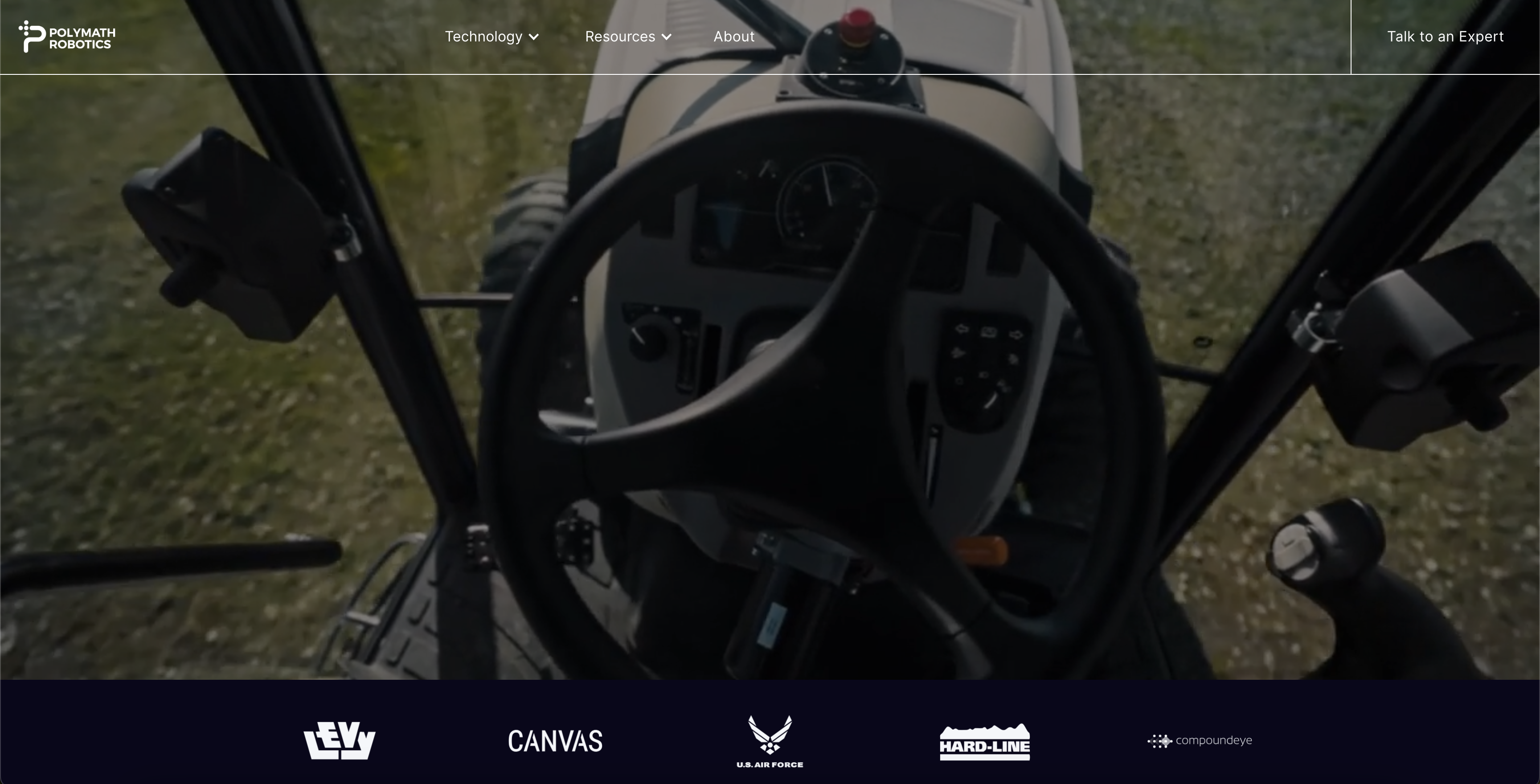
- Automate any industrial vehicle regardless of make or model with vehicle-agnostic autonomous navigation modules
- Integrate seamlessly with your existing hardware and sensors using sensor-compatible platform design
- Deploy autonomous operations in weeks instead of months with simplified development process and API control
- Execute first vehicle commands in simulation within 40 minutes using your preferred coding language
- Maintain operational efficiency with low network bandwidth overhead and mature vehicle dynamics model
- Ensure safe autonomous operations in off-road environments with built-in safety features
- Automate entire fleets quickly with done-for-you service options for fleet operators
- Future-proof your automation investment with compute-agnostic modules that adapt to any computing system
Pros & Cons
Pros
- Simplifies industrial vehicle autonomy
- Vehicle-agnostic platform
- Sensor-compatible system
- Off-road environment suitability
- API control integration
- Execution in preferred coding language
- Quick automation implementation
- Offers done-for-you options
- Straightforward monthly pricing
- Wide applicability across sectors
- Compute-agnostic modules
- Incorporates safety features
- Assistance in automating fleets
- Applications in heavy machinery
- Efficiently handles basic autonomy
- Integrates with existing hardware
- Low network bandwidth overhead
- Mature vehicle dynamics model
- Ease of installation
- Designed for large vehicles
- Adaptability to operational needs
Cons
- Limited to off-road vehicles
- Lacks indoor operation capability
- Doesn't support small vehicles
- Unsuitable for high-speed vehicles
- Could have complex API
- Unspecified safety features
- Service-dependent for fleet automation
- No specified customer support
- Lacks real-time tracking feature
- Needs low network bandwidth
Reviews
Rate this tool
Loading reviews...
❓ Frequently Asked Questions
Polymath Robotics is an AI tool designed to simplify the process of adding autonomy to industrial vehicles. It is vehicle-agnostic and sensor-compatible, allowing for the induction of autonomous operations into a variety of different heavy machinery like agricultural vehicles, mining equipment, ground support equipment, yard trucks, forestry machinery, and earth-moving equipment.
Polymath Robotics simplifies this process by being both vehicle-agnostic and sensor-compatible. This versatility means it can integrate with any existing hardware in an industrial vehicle and can be adapted to suit specific operational needs. It also allows developers to control their vehicles using an API, meaning it can be configured easily in the developers' preferred coding language.
Yes, Polymath Robotics can be used for all types of industrial vehicles. Its vehicle-agnostic nature and sensor compatibility allow it to be integrated into any industrial vehicle's existing hardware, making it suitable for a wide range of heavy machinery.
Yes, Polymath Robotics platform is compatible with most sensors. This compatibility feature allows the platform to integrate seamlessly with most industrial vehicles, making it a flexible and adaptable tool for automating machinery.
Vehicles can be controlled via the Polymath Robotics API using your preferred coding language. This allows for an easy integration and a simplified development process, making the task of inducing autonomous functions into industrial vehicles more straightforward.
Polymath Robotics is designed for large industrial vehicles operating in off-road environments. These can include but are not limited to agricultural fields, construction sites, mining areas, and other similar off-highway locations.
The cost of Polymath Robotics is not explicitly stated on their website, but they do feature simple monthly pricing.
With Polymath Robotics, you can add autonomy to your equipment in weeks. The exact time frame may vary depending on your specific operations and the hardware implementation requirements.
Yes, Polymath Robotics can speed up your vehicle's command execution in simulation. In fact, the platform asserts that users can execute their first vehicle commands in simulation using their preferred coding language in just 40 minutes.
Polymath Robotics offers done-for-you options for operators, providing them with a service to automate their existing vehicle fleets. This service is particularly useful for industrial operators that need assistance in converting their current vehicles into autonomous ones.
The Polymath Robotics team consists of engineers from established organizations like Clearpath Robotics, NASA, Google X, Amazon Lab 126, and Hyperloop.
The broad applicability of Polymath Robotics' system across industries is due to its vehicle-agnostic and sensor-compatible features. This allows it to be integrated into any industrial vehicle's existing hardware and adaptable for a variety of specific operational needs.
Polymath Robotics platform has built-in safety features that ensure safe autonomous operations for industrial vehicles. While the exact details of these safety features aren't specified on their website, the inclusion of them demonstrates a commitment to maximising safety while automating.
Yes, Polymath Robotics can integrate with software via its API. This ability allows for a seamless transition from the existing software of the vehicle to the autonomous system provided by Polymath Robotics.
Polymath Robotics offers a dedicated service to help automate existing vehicle fleets. This can be a beneficial feature for organizations that have large fleets of vehicles and are looking to transition into automated operations.
Polymath Robotics supports the coding language that the user prefers. This flexibility in language compatibility ensures a smoother and more comfortable development process during the automation of vehicles.
With Polymath Robotics, you can automate a wide variety of heavy machinery. This can include agricultural vehicles, mining equipment, ground support equipment, yard trucks, forestry equipment, and earth moving equipment.
Polymath Robotics uses a mature vehicle dynamics model, which is an integral part of their solution. However, the specific details of their vehicle dynamics model are not given on their website.
Polymath Robotics claims to have a low network bandwidth overhead. While it doesn't provide specific numbers, this suggests that it operates efficiently and can perform well even in settings with limited network resources.
Yes, Polymath Robotics has compute-agnostic autonomous navigation modules. This means the system can integrate with a range of computing systems, making it flexible and adaptable to the needs of any industrial vehicle.
Pricing
Pricing model
No Pricing