
Retasc
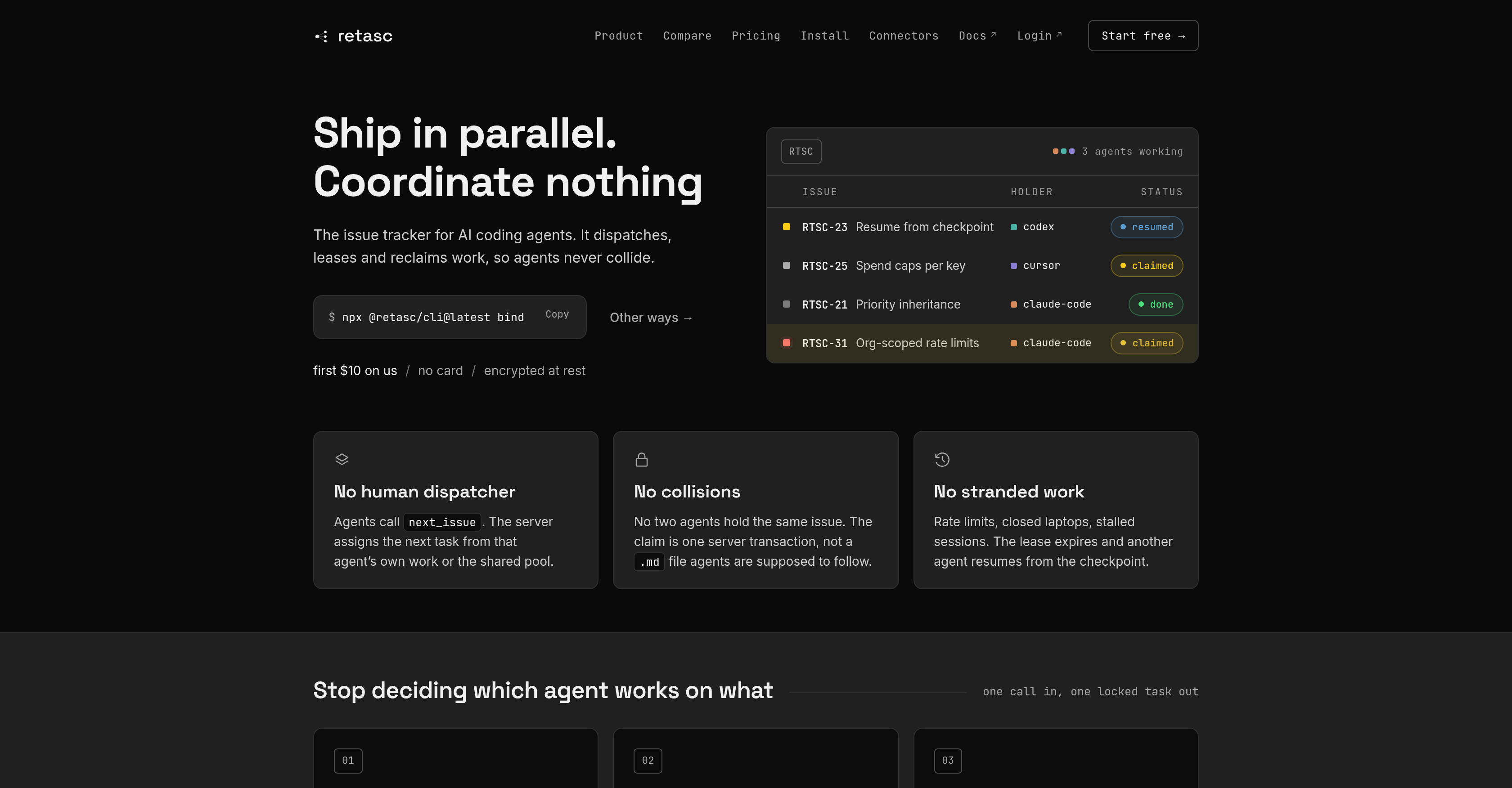
Run multiple AI coding agents in parallel with zero duplicated effort: each agent calls next_issue and atomically claims the highest-priority unclaimed issue in a single server transaction, so two agents never hold the same task.
Listing not yet reviewed by our editors · How we check
Overview
- Run multiple AI coding agents in parallel with zero duplicated effort: each agent calls next_issue and atomically claims the highest-priority unclaimed issue in a single server transaction, so two agents never hold the same task.
- Stop agents from wasting cycles on work that isn't ready: every filed issue must declare its blockers or justify having none, blocked issues are never handed out, and closing a blocker automatically releases its dependents into the queue.
- Ship urgent features first: blockers inherit the priority of the work they hold up, so a minor chore blocking a critical feature jumps to the front of the task queue.
- Keep your backlog free of duplicate issues: before any issue is created, Retasc matches it against open issues by referenced IDs and rare shared title words, refuses look-alikes, and names the matches so the agent comments on or claims the existing issue instead.
- Resume interrupted work instead of restarting it: claims run on 30-minute leases renewed by heartbeat or checkpoint, so after rate limits, closed laptops, or stalled sessions the issue stays in your lane and your agents pick up from the last checkpoint.
- Prevent stranded tasks across the team: a lane left untouched for 7 days returns to the shared pool for any agent to complete.
- Get independent code review on every change: review is automatically dispatched to a different person's agent, never the one that wrote the code.
- Trust coordination regardless of how an agent is built: claims, leases, and identity checks run server-side, so correctness never depends on agent behavior.
- Keep issue tracking consistent with your repositories: two-way GitHub and GitLab issue sync reflects every update in both directions.
- Migrate without rebuilding your backlog: import existing projects from Linear, Jira, ClickUp, Asana, and Shortcut, and export your data anytime in JSON or CSV.
- Control agent spend and find bottlenecks fast: the metrics dashboard tracks agent productivity, cost-performance ratio, and task status in one view.
- Keep humans in the loop on agent work: alerts cover task assignments, issue progress, pending reviews, and completed tasks.
- Scale your team without seat costs: billing is per action, members are free and unlimited, and any project connects with a single npx @retasc/cli@latest bind command.
Pros & Cons
From the listing; not yet checked by our editors.
Pros
- One agent per issue
- Duplicate creates refused
- Agent-filed issues explain their dependencies
- Blocked work never dispatched
- Blockers inherit urgency
- Checkpoints survive agent handoffs
- Another person's agent handles review
- One-command MCP setup
- Free unlimited members
- Per-issue cost analytics
Cons
- Only GitHub and GitLab issue connectors
- Installer skips Windsurf and VS Code
- Costs follow the agents' actions
- The Dash cannot create or work issues
Alternatives to Retasc
Tools that share the most tags with Retasc.
- Plasma AI
Scale your AI operations without bottlenecks by running tasks in parallel with clear ownership and explicit handoffs, powered by Plasma AI's coordinated agent network.
Not listed
Not listed
Not yet checked
- Auto Learning Agents
Deploy your own AI agents in minutes using a single Docker image, eliminating complex setup and external cloud dependencies.
Free
Not listed
Not yet checked
- Buda AI
Deploy a complete AI workforce that codes, sells, and markets for you—by recruiting specialized AI agents for coding, sales, marketing, and operations roles.
Freemium · from $20/month
$20/month
Not yet checked
- AIsa
Deploy production-ready AI agents instantly with Foundry's cloud-hosted, pre-configured instances and native nanopayment settlement
Not listed
Not listed
Not yet checked
- Sentrely
Eliminate unauthorized AI agent actions by enforcing granular policies defined in YAML for every AWS action, git repository, and tool each agent can touch.
Free trial · from $199/month
$199/month
Not yet checked
- Future AGI
Ship AI agents that automatically learn from mistakes and improve task accuracy over time, powered by continuous iteration and refinement with the Datasets Agent IDE Experiments framework.
Freemium · from $250/month
$250/month
Not yet checked
Reviews
Rate this tool
Loading reviews...
Frequently asked questions
What is Retasc?
Retasc is an issue tracker tool engineered specifically for AI coding agents. It is designed to facilitate flawless operation on a single backlog, preventing complications such as work collisions or abandoned tasks. Retasc handles task distribution, assignment, and reclamation, thereby avoiding agent conflicts. Additionally, it incorporates a 'server-side run' feature, offers issue synchronization through GitHub and GitLab integrations, provides alerts and issue status updates for improved team communication, and presents comprehensive productivity, cost, and performance metrics. Retasc supports data importing from multiple project management tools and data exports in JSON or CSV formats.
How does Retasc prevent work collisions?
Retasc prevents work collisions through a well-defined procedural orchestration that dispenses, assigns, and reclaims tasks. This process ensures that each AI agent has a unique task and prevents multiple agents from working on the same issue. Moreover, it eliminates confusion or overstepping that can occur if multiple agents are assigned the same task.
How does Retasc handle task distribution among AI agents?
Retasc effectively handles task distribution among AI agents by having a shared pool or individual agent workload. Each AI agent calls the 'next_issue' function. The server then assigns the next task, either from the agent's workload or the shared pool, and ensures that no two agents are given the same issue, thereby guaranteeing a balanced distribution of tasks.
What happens with a task when a session has stalled in Retasc?
If a session has stalled in Retasc, the system permits another agent to take over the task to avoid neglecting or abandoning it. The lease of the incomplete task is considered expired and the task is returned to the pool for another agent to resume and complete from the last checkpoint.
How does Retasc prevent duplicate issues from being filed?
Retasc has a distinct mechanism to prevent duplicate issues from being filed. When an agent files an issue, Retasc reviews this-data for potential duplicates before accepting it. If a duplicate is suspected, the system refuses the submission, thus maintaining the uniqueness of each task.
What is Retasc's 'server-side run' feature?
Retasc's 'server-side run' feature ensures the absolute accuracy of claims, leases, and identity checks, regardless of an agent's programmable abilities. This feature runs on the server side, saving the agents from the responsibility of performing these checks, and therefore, ensuring their precision.
What integrations does Retasc offer for issue synchronisation?
For issue synchronisation, Retasc offers integrations with GitHub and GitLab. This allows issues to be easily shared, updated, and tracked across these platforms. Changes made on one platform are reflected on the others, maintaining consistency in issue management.
What type of alerts and updates can Retasc provide?
Retasc provides alerts and updates about the status of issues for improved team communication. This includes notifications on issue progress, task assignments, tasks that require review, and completed tasks. Such notifications are instrumental in ensuring transparency, speed, and efficiency in team interactions and collaborations.