Overview
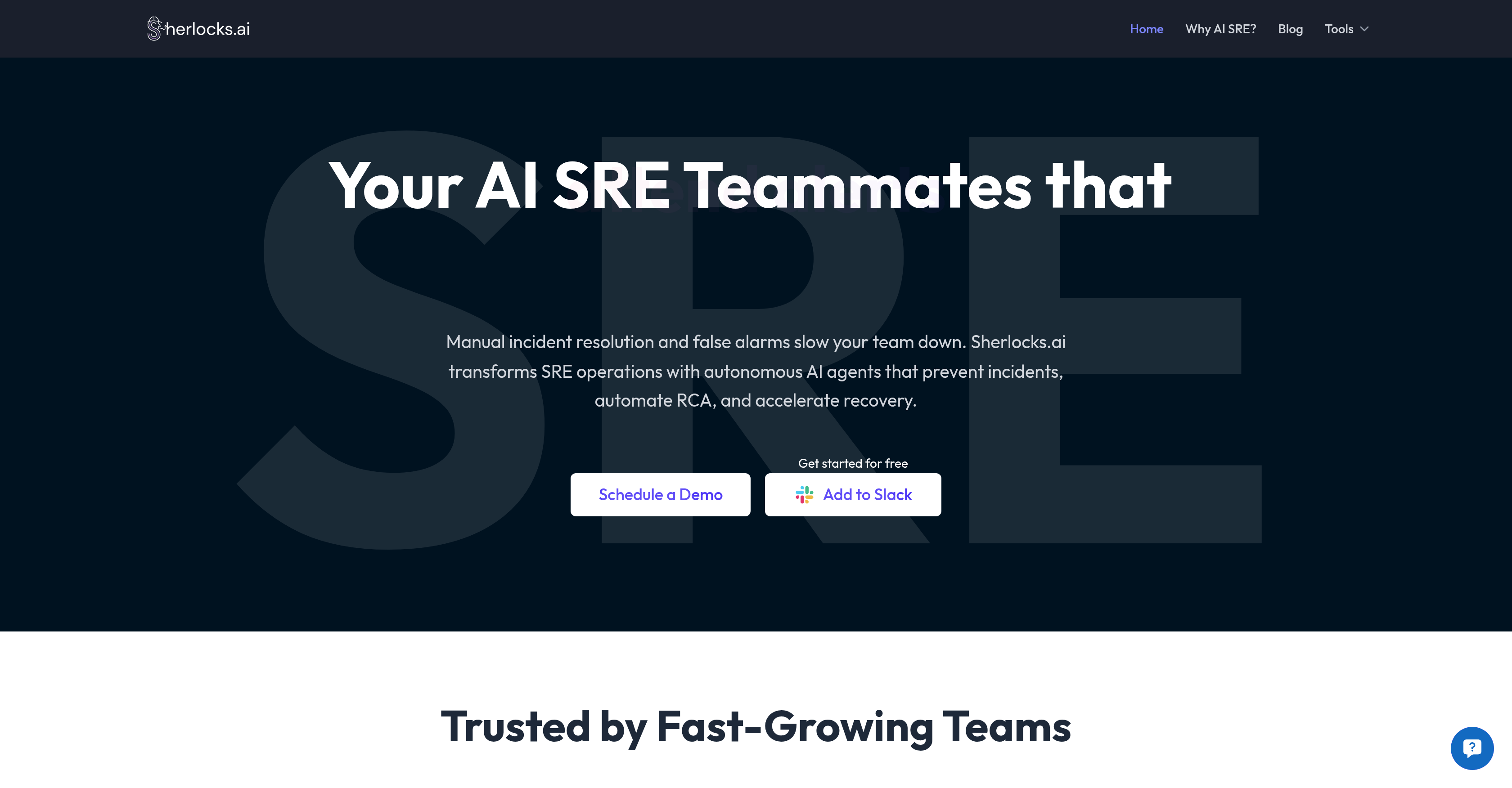
- Prevent outages before they impact customers using autonomous AI agents that learn from your system architecture and historical incidents
- Eliminate alert fatigue and focus only on critical issues through intelligent alert triage that automatically filters out noise
- Automate root cause analysis and accelerate recovery by leveraging historical incident data to provide instant context-aware solutions
- Transform SRE teams from reactive troubleshooting to proactive system design with automated incident management that frees up engineering time
- Maintain consistent uptime and protect revenue streams through proactive incident prevention that enhances customer experience and loyalty
- Integrate seamlessly with existing monitoring tools like Datadog, New Relic, and Prometheus without disrupting current workflows
Pros & Cons
Pros
- Prevents incidents
- Automates Root Cause Analysis
- Accelerates incident recovery
- Undisturbed deployment
- Datadog, New Relic, Prometheus compatibility
- Learns system architecture
- Leverages past incidents
- Delivers context-aware solutions
- Intelligent alert triage
- Reduces noise in alerts
- Focuses on key issues
- Automated diagnosis
- Recommends fixes
- Utilizes historical data
- Facilitates transition to resilience architects
- Fosters innovation in SRE
- Increases delivery speed
- Heightens operational velocity
- Prevents customer-impacting outages
- Guarantees consistent uptime
- Promotes teamwork
- Protects revenue
- Enhances customer lifetime value
- Improves net promoter score
Cons
- No mobile application
- Integrates only with specific tools
- Limited historical data utilization
- No multi-language support
- No on-premise deployment option
- Lacks external threat detection
- Overreliance on automation
- Limited error anticipation methods
- No stated GDPR compliance
- Undefined downtime reduction percentage
Reviews
Rate this tool
Loading reviews...
❓ Frequently Asked Questions
Sherlocks.ai is an AI-powered tool designed for Site Reliability Engineering (SRE) operations. It uses autonomous AI agents to prevent incidents, automate root cause analysis and to accelerate the recovery process. The AI agents are designed to learn from historical data and system architecture to provide context-aware solutions.
Sherlocks.ai stands apart through its autonomous AI agents that work constantly to prevent incidents, automate root cause analysis, and accelerate recovery times. The tool transitions SREs from being reactionary, dealing with issues as they arise, to being proactive, anticipating issues before they escalate.
Sherlocks.ai streamlines incident management by utilizing autonomous AI agents for tasks such as incident prevention, root cause analysis automation, and recovery acceleration. These agents triage alerts intelligently to minimize noise and focus on critical issues. They also auto-diagnose and suggest corrections based on historical incident data.
The autonomous AI agents in Sherlocks.ai are designed to continuously prevent incidents, automate the procedure of Root Cause Analysis (RCA) and hasten the recovery process. They learn from the system's architecture and previous incidents to provide context-aware solutions.
Sherlocks.ai integrates seamlessly with existing stacks and tools without causing any disruption to workflows. Its seamless integration feature allows it to connect with the existing tools without causing any hindrance or disrupting operational flow.
Yes, Sherlocks.ai is compatible with various tools including Datadog, New Relic, and Prometheus. Its seamless integration allows it to connect with these tools without disrupting the existing operational workflow.
Sherlocks.ai's AI agents study the system's architecture and historical incident data to provide solutions. They analyze past incidents, extract vital information and patterns, and use this data to recommend fixes during similar incidents.
Context-aware solutions in Sherlocks.ai refer to the solutions provided by the tool based on understanding the context of the system's architecture and past incidents. Its AI leverages this understanding to predict, prevent, and automate handling of similar future incidents.
The alert triage system in Sherlocks.ai is a mechanism for intelligent management of alerts. The system triages or sorts out alerts, reducing noise by focusing only on what matters. It offers priority to severe or significant alerts over trivial ones.
Sherlocks.ai reduces noise from alerts by making use of intelligent alert triage. The system sorts out alerts by their importance, allowing engineers to pay attention only to what matters, thereby reducing unnecessary noise.
Sherlocks.ai automatically suggests fixes based on its understanding of similar historical incidents. Using past incident data, it identifies patterns and potential fixes, which it then recommends when encountering a similar encounter in future.
Sherlocks.ai uses its AI capabilities to anticipate future incidents by learning from the system's architecture and past incidents. It applies the lessons learned to predict and prevent similar incidents from occurring in the future.
Sherlocks.ai increases operational efficiency by automating several processes such as incident prevention, root cause analysis, and recovery acceleration. It allows SREs to shift their focus to more important tasks, making them more productive and efficient in their roles.
Yes, Sherlocks.ai is designed to prevent outages before they impact customers. Through its proactive approach of learning from past incidents and system architecture, it anticipates potential issues and mitigates them before they escalate into full-blown outages.
Sherlocks.ai contributes to consistent uptime and increases the customer lifetime value by preventing outages before they occur. This ensures seamless service availability, enhances customer experience, and increases the longevity of a customer's relationship with the business.
When Sherlocks.ai facilitates the transition of SREs to architects of resilience, it means transforming their role from reactive problem solvers to proactive system designers. They shift from merely addressing issues as they arise to building robust systems that can withstand and recover from incidents quickly.
Net promoter score in Sherlocks.ai refers to a measurement of customer loyalty and satisfaction, which is improved as Sherlocks.ai prevents incidents before impacting customers, ensuring consistent uptime, and therefore enhancing the overall customer experience.
Sherlocks.ai ensures higher velocity through automation. By automating processes like incident prevention and root cause analysis, it frees engineers to innovate and speed up delivery. This acceleration in delivery and operation is referred to as increased operation velocity.
Sherlocks.ai can certainly improve team collaboration. By efficiently managing incidents, it enables teams to work together more effectively. Teams do not lose time stressing over incident handlings, contributing to improved productivity and collaboration.
Sherlocks.ai protects revenue by preventing incidents that could lead to outages before they impact customers. By ensuring consistent uptime, it enhances customer experience, preserves their loyalty, thereby protecting the revenue that comes from satisfied, long-term customers.
Pricing
Pricing model
Free Trial
Paid options from
$2,000/month
Billing frequency
Monthly
Refund policy
No Refunds