

WhisperUI
88
Overview
- Get accurate transcriptions even with strong accents and background noise using AI trained on diverse multilingual data
- Create ready-to-use subtitle files (SRT) directly from your audio for video content and presentations
- Transcribe technical language and specialized terminology effectively with comprehensive training data coverage
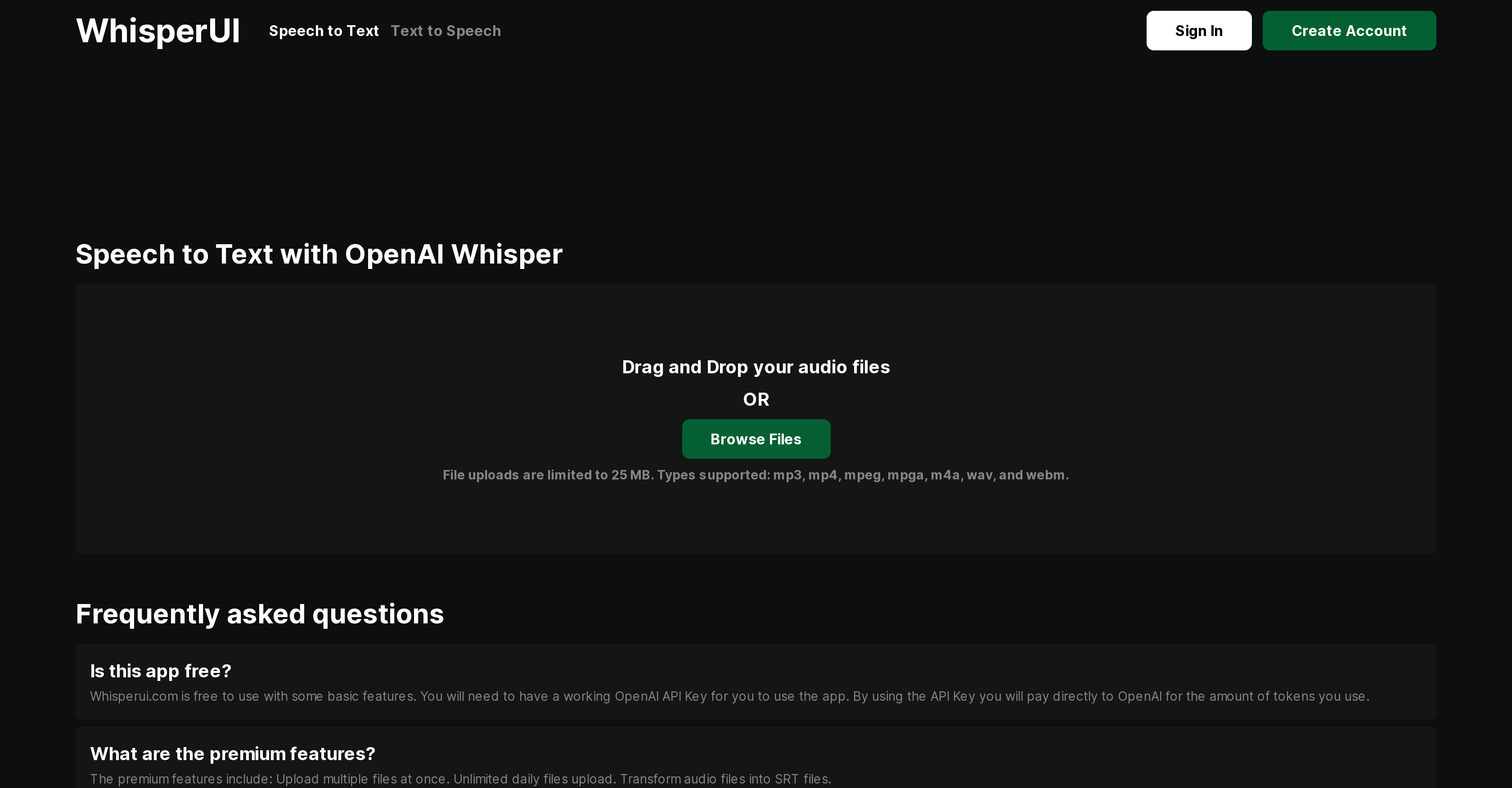
- Process multiple file formats including MP3, MP4, WAV, and WEBM without conversion headaches
- Translate non-English speech directly into English text while maintaining context and meaning
- Review and edit transcriptions easily within the same interface after processing completes
- Handle batch file uploads and unlimited daily processing with premium workflow capabilities
- Pay only for what you use through direct OpenAI billing without platform markup fees
Pros & Cons
Pros
- Supports numerous audio formats
- Optimized for various accents
- Handles technical language
- Effective with background noise
- Transcribes multiple languages
- Translation capabilities
- User-friendly web application
- Editable transcriptions
- Premium features available
- Bulk file uploading
- Daily unlimited uploads option
- Converts audio to SRT
- Robust dataset training
- Useful for linguistics analysis
- Subtitle generation functionality
- Broad application use
- High transcription accuracy
- Transcription speed efficiency
- Supports major languages
- File size limit 25MB
- API Key stored safely
- Affordable service costs
Cons
- Maximum file size limit
- Billing per token used
- Premium features cost extra
- Limited file format support
- Dependent on audio quality
- Potential language translation errors
- Transcription time varies
- Multitask data training limits
- No offline usage
Reviews
Rate this tool
Loading reviews...
❓ Frequently Asked Questions
WhisperUI is a Speech to Text service powered by OpenAI's state-of-the-art Automatic Speech Recognition (ASR) system, Whisper. It enables users to convert their audio files into text or SRT files, serving as a useful tool for transcription services, subtitle generation, or linguistic analysis.
WhisperUI utilizes OpenAI Whisper by importing audio files uploaded by the user to its web application. The Whisper ASR system then processes these audio files, transforming the spoken language into text or SRT files.
WhisperUI supports a variety of file types including MP3, MP4, MPEG, MPGA, M4A, WAV, and WEBM.
Yes, WhisperUI does have a maximum file size limit. The limit for file upload is set to 25MB by OpenAI.
WhisperUI's robustness against different accents and noisy backgrounds is derived from the fact that the underlying Whisper ASR system has been trained on a comprehensive and diversified dataset. This dataset includes multilingual and multitask supervised data from the web, allowing the platform to effectively handle various accents and navigate through background noise.
Yes, WhisperUI can transcribe speech in multiple languages. Moreover, it can also translate these transcriptions into English.
To transcribe audio files, a user begins by uploading their audio file to the WhisperUI web application. WhisperUI then employs OpenAI Whisper to transform the spoken words in the audio file into text. The transcribed text is then made available for the user to review and modify as required.
To access WhisperUI services, users need an active OpenAI API Key. Services can be availed through the WhisperUI web application.
Using WhisperUI does incur costs. While the app itself is free for basic use, users are required to have a working OpenAI API Key for which they pay directly to OpenAI based on the number of tokens used. More advanced features can be used through their premium services.
Subscription to premium features of WhisperUI allows users to upload multiple files at once and have unlimited daily file uploads. The premium feature set also includes the ability to transform audio files into SRT files.
Yes, WhisperUI can be used for linguistic analysis. By transcribing audio files into text, it can facilitate language-related studies and research.
Yes, WhisperUI helps in generating subtitles. It creates SRT files from audio files, making it a useful tool for subtitle generation.
Billing for WhisperUI is handled directly by OpenAI. Cost is determined by the number of tokens used in the service, and users pay directly through their OpenAI API Key.
WhisperUI can handle technical language in audio files as the ASR system, Whisper, has been trained on a vast and diverse dataset. This dataset includes technical language data, enabling the system to process and transcribe such audio files effectively.
Yes, WhisperUI does offer translation services. It can transcribe speech in various languages and also translate them into English.
WhisperUI qualifies as an ASR system because it uses OpenAI's state-of-the-art ASR system called Whisper. This system has been trained on a comprehensive dataset, ensuring robustness and high performance.
Yes, WhisperUI can find application in transcription services. It can convert language from audio files into text, making it a practical tool for transcription purposes.
For regular users, WhisperUI has a file size limit, but premium users have the additional benefit of unlimited daily file uploads.
An active OpenAI API Key is indispensable for using WhisperUI. It is used for access to the service and forms the basis on which users are billed directly by OpenAI for the tokens used.
Yes, with the premium feature set of WhisperUI, users can upload multiple files at once.
To transcribe audio files, a user begins by uploading their audio file to the WhisperUI web application. WhisperUI then employs OpenAI Whisper to transform the spoken words in the audio file into text. The transcribed text is then made available for the user to review and modify as required.
To access WhisperUI services, users need an active OpenAI API Key. Services can be availed through the WhisperUI web application.
Using WhisperUI does incur costs. While the app itself is free for basic use, users are required to have a working OpenAI API Key for which they pay directly to OpenAI based on the number of tokens used. More advanced features can be used through their premium services.
Subscription to premium features of WhisperUI allows users to upload multiple files at once and have unlimited daily file uploads. The premium feature set also includes the ability to transform audio files into SRT files.
Yes, WhisperUI can be used for linguistic analysis. By transcribing audio files into text, it can facilitate language-related studies and research.
Yes, WhisperUI helps in generating subtitles. It creates SRT files from audio files, making it a useful tool for subtitle generation.
Billing for WhisperUI is handled directly by OpenAI. Cost is determined by the number of tokens used in the service, and users pay directly through their OpenAI API Key.
WhisperUI can handle technical language in audio files as the ASR system, Whisper, has been trained on a vast and diverse dataset. This dataset includes technical language data, enabling the system to process and transcribe such audio files effectively.
Yes, WhisperUI does offer translation services. It can transcribe speech in various languages and also translate them into English.
WhisperUI qualifies as an ASR system because it uses OpenAI's state-of-the-art ASR system called Whisper. This system has been trained on a comprehensive dataset, ensuring robustness and high performance.
Yes, WhisperUI can find application in transcription services. It can convert language from audio files into text, making it a practical tool for transcription purposes.
For regular users, WhisperUI has a file size limit, but premium users have the additional benefit of unlimited daily file uploads.
An active OpenAI API Key is indispensable for using WhisperUI. It is used for access to the service and forms the basis on which users are billed directly by OpenAI for the tokens used.
Yes, with the premium feature set of WhisperUI, users can upload multiple files at once.
Pricing
Pricing model
Freemium
Paid options from
$5
Billing frequency
One-time