

Overview
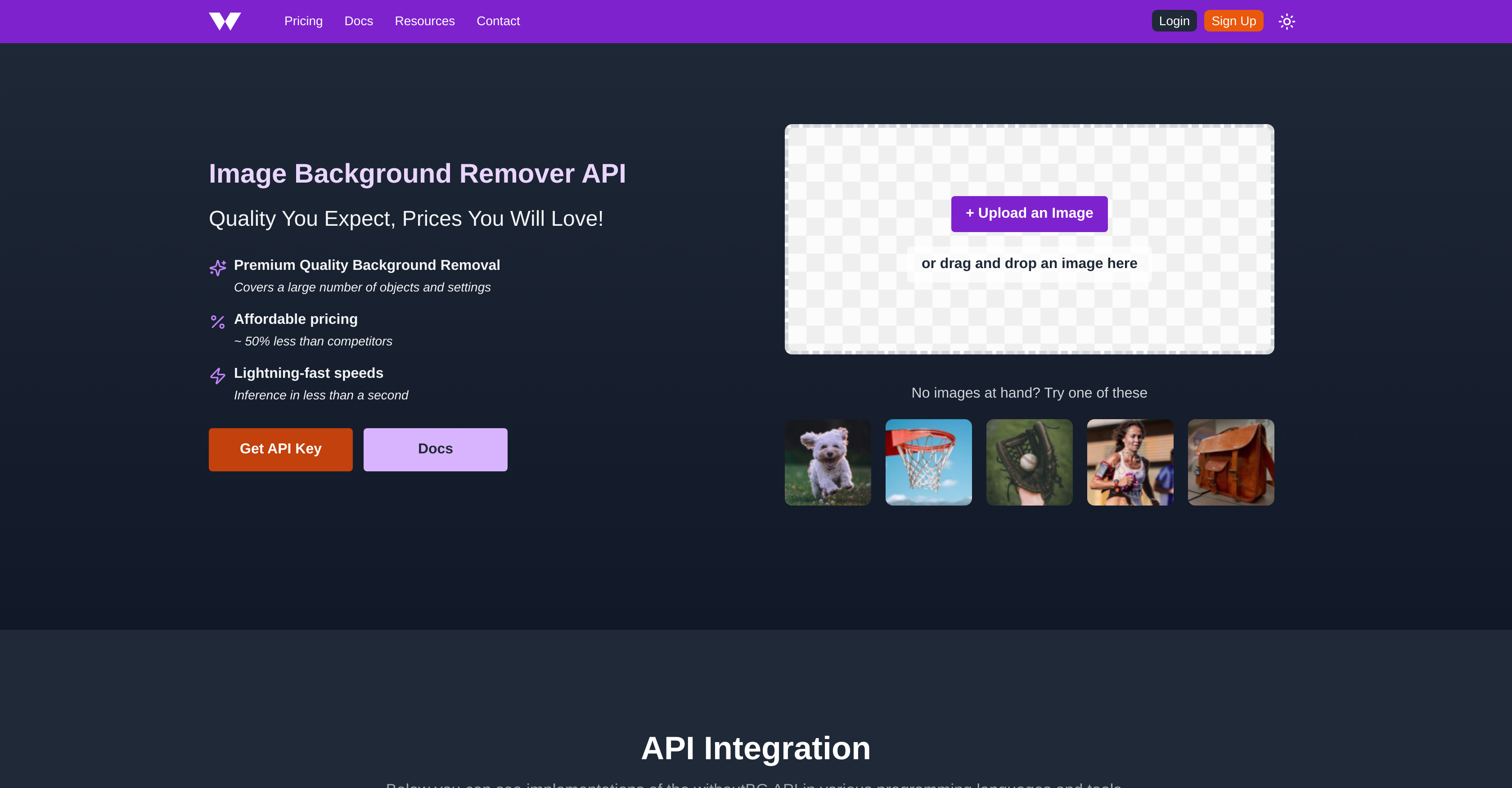
- Process thousands of product images in seconds with sub-second speeds powered by AWS Inferentia hardware
- Maintain professional image quality with full-resolution output that preserves every detail
- Integrate background removal into any application with code snippets for Python, JavaScript, and other popular languages
- Ensure complete data privacy with server memory processing that discards images immediately after use
- Get precise cutouts for diverse object categories thanks to AI trained on 100,000+ image pairs
- Scale effortlessly during traffic spikes with high-volume request handling and consistent performance
- Achieve accurate background separation even on complex images using hybrid transformer and CNN architectures
- Access immediate background removal capabilities with 50 free credits upon signup
Pros & Cons
Pros
- Uses hybrid approaches
- Advanced transformer architectures
- Employment of CNNs
- Precise object detection
- Accurate background separation
- Runs on AWS Inferentia
- High-performance computing
- Sub-second processing speeds
- Handles high-volume requests
- Exceptional output quality
- Trained on extensive dataset
- Versatile object categories
- Full resolution output
- Continual model improvement
- Provides code snippets
- Multiple programming languages support
- Interoperable with HTTP clients
- Assures image privacy
- Processes images in memory
- Fast image processing
- Affordable pricing model
- Premium quality removal
- Sub-second inference speed
- Handles variety of settings
- Sophisticated ML model
- Data-enhanced with realism
- Precise alpha channel mappings
- Quality-first approach
- Easy SDK integration
- Free interface integration
- Documentation examples
- Rate limits for fair usage
- Endpoint for credit balance
- Handles complex backgrounds
- Server location in Germany
- Immediate discard after processing
Cons
- Runs only on AWS Inferentia
- Quality depends on image type
- Credits expire after time
- Rate limit of 7 RPM
- Quality varies with network conditions
- No immediate persistent storage
- Servers only in Germany
- No SDK, only code snippets
Reviews
Rate this tool
Loading reviews...
❓ Frequently Asked Questions
Image Background Remover API is an advanced tool powered by artificial intelligence techniques to automatically remove backgrounds from images. It combines transformer architectures with convolutional neural networks for object detection and precise background separation. It's used in varied contexts, such as e-commerce products and portrait photos.
Image Background Remover API employs hybrid approaches that combine advanced transformer architectures with convolutional neural networks (CNNs) for precise object detection and accurate background separation. It achieves this performance by running on high-performance AWS Inferentia hardware.
AWS Inferentia hardware is crucial to Image Background Remover API because it allows it to maintain sub-second processing speeds, which is essential for handling high-volume requests while still providing exceptional quality. This hardware investment ensures that the API can swiftly process and operate tasks without sacrificing output quality.
Yes, the Image Background Remover API can handle high-volume requests. Its high-performance infrastructure, especially its deployment on AWS Inferentia hardware, ensures it can process a high volume of requests while maintaining exceptional quality.
No, Image Background Remover API does not reduce the quality of output images. It delivers full-resolution output without quality reduction. This focus on maintaining original image quality ensures the output retains the professional-grade specifications of the original image.
Image Background Remover API provides code snippets and examples for several popular programming languages, facilitating its interaction through any preferred HTTP client library. Examples provided cover languages such as cURL, Python, Java, PHP, Node.js, Go, Ruby, and JavaScript.
Image Background Remover API ensures privacy and security of images by processing uploaded images entirely in server memory and discarding them immediately after the background removal operation is completed. This prevents the persistence or accessibility of images post-operation, ensuring users' data privacy.
Image Background Remover API can remove the background from a wide range of images. However, for best results, it is recommended to use images that have smooth and solid backgrounds. This ensures the background removal is as accurate and seamless as possible.
Continuous model improvement in the Image Background Remover API is realized through extensive quality assurance and constant refinement of the AI model architectures. It harnesses advanced machine learning algorithms that allow for constant learning from new data patterns, leading to ongoing enhancements in object detection and background separation capabilities.
Image Background Remover API is trained on a sophisticated and comprehensive dataset of more than 100,000 image pairs, which includes high-quality natural images, synthetic data enhanced with realism, precise alpha channel mappings, and diverse object categories. This unique and extensive training allows for reliable background removal across multiple use cases.
Based on the available information from the website, there's not a specific mention of limitations on the size of images that can be uploaded to the Image Background Remover API.
Yes, Image Background Remover API offers a free trial. New users are given 50 free credits upon signing up.
The Image Background Remover API operates on a credit-based pricing model, where prices per credit start at €0.05. It offers different packages ranging from 100 to 10,000 credits, with prices ranging from €10 to €500. Packages also have varied validities from 30 to 360 days, and some packages offer up to 50% off as savings.
AWS Inferentia hardware in the Image Background Remover API operation is responsible for maintaining sub-second processing speeds, enabling the tool to handle high-volume requests and deliver high-quality output swiftly. It supports the performance efficiency of the API and ensures exceptional service even under high request burdens.
The background removal accuracy of Image Background Remover API is exceptionally high due to its employment of advanced AI architectures, including transformers and convolutional neural networks. Although direct comparison data isn't provided, the API's focus on high-quality output and ability to handle complex backgrounds suggest it's highly competitive with similar tools.
Image Background Remover API can be easily integrated with other programs. It provides implementations in several popular programming languages to ease integration into different software or applications. The API follows the RESTful convention, making it compatible with any HTTP client library.
Image Background Remover API supports full-resolution output for images. It doesn't reduce the quality or resolution of output images, indicating a broad support for high-resolution images.
The Convolutional Neural Networks in the Image Background Remover API contribute to effective background removal by allowing for accurate and precise object detection. CNNs are known for their performance in image analysis tasks, training on large image datasets to recognize patterns, and for distinguishing foreground objects from background ones.
Yes, Image Background Remover API offers extensive documentation for users, providing guides, code examples and resources to aid beginners and facilitate a smooth integration process. The documentation covers every aspect from basic API setup to extensive usage details.
The transformer architecture employed by Image Background Remover API plays a significant role in precise object detection and accurate background separation. Transformers are an advanced AI architecture known for their ability to handle complex data patterns. Their integration in the API ensures a balance of speed, comprehension, and quality in background removal tasks.
Pricing
Pricing model
Free Trial
Paid options from
$10/unit
Billing frequency
Pay-as-you-go