

Applied Compute Training
Ship stronger models from the one you already have: start from an existing model and raise performance through iterative fine-tuning experiments.
Listing not yet reviewed by our editors · How we check
Overview
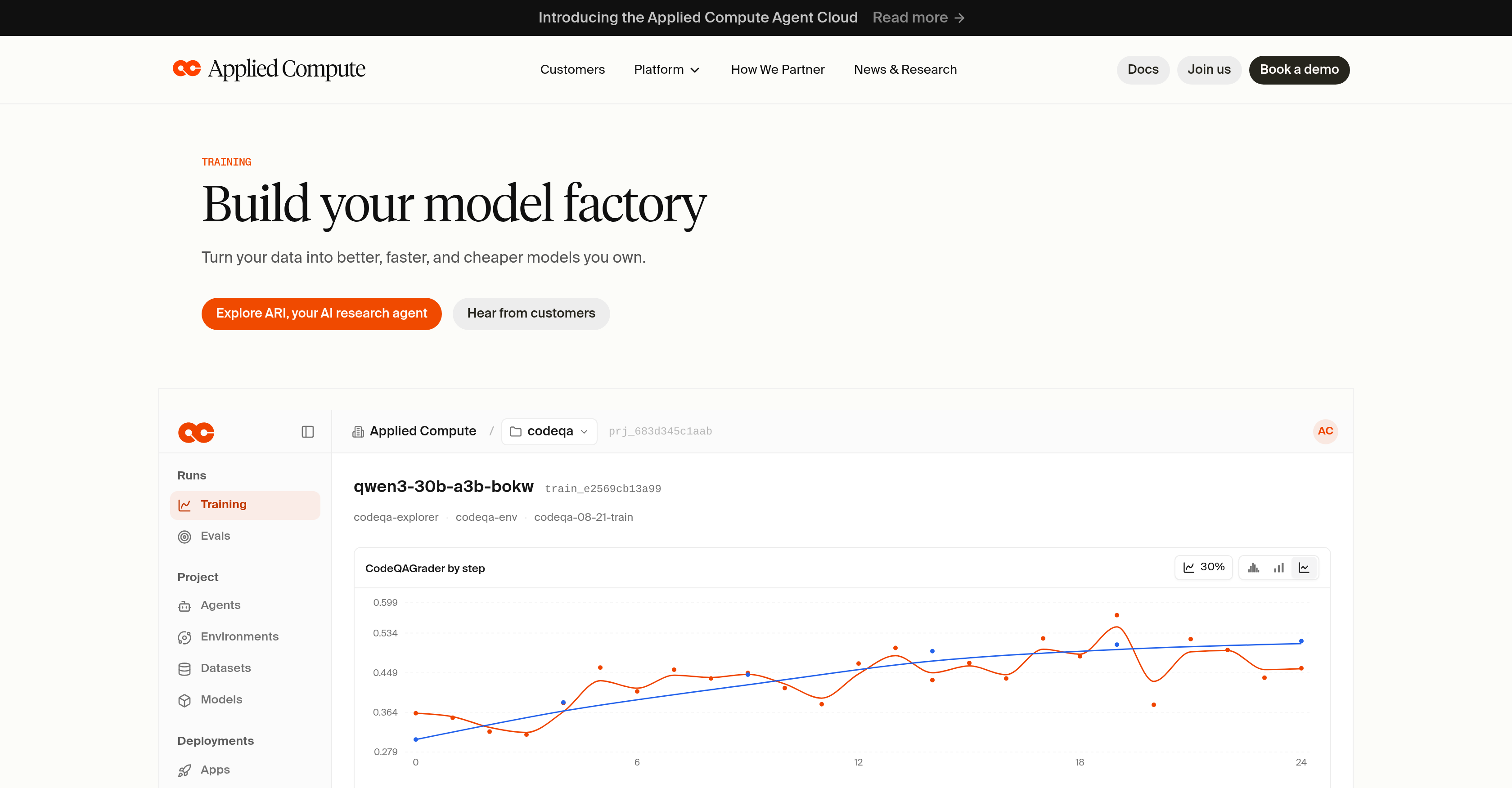
- Ship stronger models from the one you already have: start from an existing model and raise performance through iterative fine-tuning experiments.
- Get faster, more stable training runs: a fully asynchronous reinforcement learning (RL) system pairs high-throughput inference with lower-precision training.
- Train multi-trillion parameter models without managing a cluster: full parameter tuning at scale runs on your own compute resources with little to no setup.
- Turn every production interaction into model improvement: continual learning with self-distillation learns directly from non-replayable production traces, so usage doubles as training signal.
- Cut the hours spent babysitting experiments: Ari, an Applied Research Intelligence agent, monitors each run, flags drift, fixes config issues, relaunches runs, and generates reports.
- Close the gap between training and production behavior: bring your own harness and train inside the framework you already operate, matching your real production context.
- Own models that get better, faster, and cheaper with use: your data and compute become proprietary models that stay under your control.
Pros & Cons
From the listing; not yet checked by our editors.
Pros
- Fine-tunes existing models
- Performs iterative experiments
- Fully asynchronous Reinforcement Learning
- High-throughput inference
- Lower-precision training
- Optimizes model efficiency
- Promotes model stability
- Full parameter tuning capability
- Large scale model training
- Can train multi-trillion parameter models
- No cluster management required
- Utilizes client's computational resources
- Minimal setup complexity
- Continual learning via self-distillation
- Learns from non-replayable traces
- 'Ari' research automation agent
- Automatic drift alerts
- Automated config issue resolution
- Auto-relaunches runs
- Generates operational reports
- Allows custom training harness
- Learning environment mirrors production context
- Models improve with usage
- Data to models transformation
- Matching real-time production context
- Live model run monitoring
- Spot regressions automatically
- Product-specific KPI optimization
- Optimization on less compute
- Models get better with usage
- Frontier post-training
- Faithful training-to-production similarity
- Trains with real production traffic
- Scalable to thousands of GPUs
- Runs efficient, stable experiments
- Efficient share of computational resources
- Automated iterative experiments
- Metric monitoring and alerting
- Analysis of traces at scale
Cons
- Limited precision in training
- Requires substantial computational resources
- Potential bias from self-distillation
- Dependent on 'Ari' agent
- Potential compatibility issues with harness
- Possible overfitting from continual learning
- Setup required for own harness
- Potential data handling concerns
- Depends on iterative learning
- Relies on clients' datasets
Alternatives to Applied Compute Training
Tools that share the most tags with Applied Compute Training.
- LinerAI
Build custom AI models without writing code using a no-code interface for image, text, audio, and video classification
Free
Not listed
Not yet checked
- Thinking Machines Tinker
Focus entirely on your data and algorithms while Tinker manages scheduling, tuning, and reliable infrastructure for you.
Not listed
Not listed
Not yet checked
- AIDE by Weco
Solve complex business problems and academic research challenges by simply describing your goal in natural language, as AIDE designs and optimizes complete Machine Learning pipelines.
Not listed
Not listed
Not yet checked
- Commissioned
Deploy custom AI models for content generation and data classification without hiring a machine learning team, using a platform that requires zero coding or technical expertise.
Freemium · from $25/month
$25/month
Not yet checked
- CoreWeave
Spin up GPU inference in seconds instead of waiting on cluster provisioning with Kubernetes-native GPU compute and automated lifecycle management.
Not listed
Not listed
Not yet checked
- Prime Intellect
Launch AI models without infrastructure delays using Prime Intellect's fully managed service that requires zero setup
Not listed
Not listed
Not yet checked
Reviews
Rate this tool
Loading reviews...
Frequently asked questions
What is Applied Compute Training?
Applied Compute Training is a tool that fine-tunes machine learning models optimally. It enables users to start with an existing model and gradually improve its performance through iterative experiments. The tool offers high-throughput inference and lower-precision training via a fully asynchronous Reinforcement Learning system. It also supports full parameter tuning at a large scale and eases the training of complex models without requiring the user to manage a cluster. A unique feature is the incorporation of Continual Learning with self-distillation, enabling models to learn directly from non-replayable production traces. The platform also introduces 'Ari', an Applied Research Intelligence agent for automating the research loop.
What is the main function of the 'Ari' feature on Applied Compute Training?
'Ari' is a feature of Applied Compute Training named as an Applied Research Intelligence agent. It automates the research loop in the training process. This automation includes monitoring each run, proactively alerting when potential drifts occur, fixing configuration issues, relaunching runs, and generating reports, thereby reducing the operational time involved.
How does Applied Compute Training optimize the efficiency and stability of models?
Applied Compute Training optimizes the efficiency and stability of models through high-throughput inference and low-precision training offered by its fully asynchronous Reinforcement Learning system. This system also eases the process of full parameter tuning on a large scale, helping in model efficiency. The use of the client's computational resources also aids in optimizing efficiencies.
Can Applied Compute Training handle large scale parameter tuning?
Yes, Applied Compute Training can handle large scale parameter tuning. The platform is specifically designed to train multi-trillion parameter models without necessitating the user to manage a cluster. This capability allows for large-scale computing with greater efficiency.
What is the purpose of the fully asynchronous Reinforcement Learning system in Applied Compute Training?
The fully asynchronous Reinforcement Learning system in Applied Compute Training is designed to optimize the training process. It offers high-throughput inference and low-precision training, which boosts model efficiency and stability. This system allows for rapid iterations, supporting continual model improvement.
How does Applied Compute Training implement Continual Learning with self-distillation?
Continual Learning with self-distillation in Applied Compute Training enables models to learn directly from non-replayable production traces. In other words, it facilitates models to adapt and learn from the data generated during production, ensuring model usage doubles as training signal. This approach fosters an environment for continual model improvement.
What does it mean when it says that Applied Compute Training allows clients to bring their own harness?
When referring to clients bringing their own harness, it implies that Applied Compute Training allows clients to use their own frameworks or systems for training within their own operational context. This feature ensures a learning environment that closely matches real-time production context.
How does Applied Compute Training make use of the client's computational resources?
Applied Compute Training utilizes the client's computational resources by allowing the training of complex models within these resources. There's no need for excessive setup or cluster management, and the system uses existing computational capabilities to achieve enhanced results remarkably fast.