
Thinking Machines Tinker
Overview
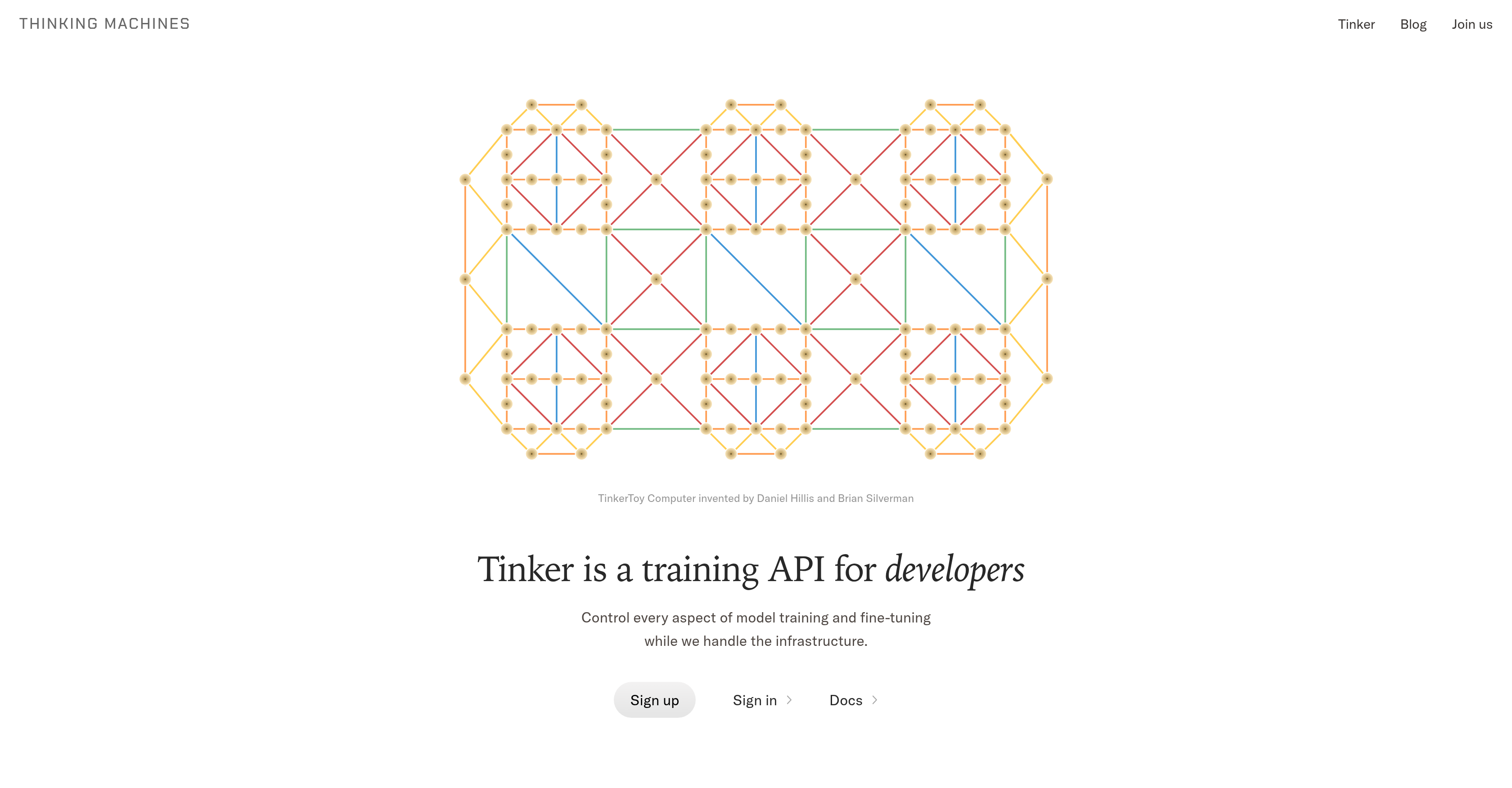
- Focus entirely on your data and algorithms while Tinker manages scheduling, tuning, and reliable infrastructure for you.
- Fine-tune models efficiently with LoRA, matching full fine-tuning performance while using less computational resources.
- Train on powerful GPU clusters with distributed training managed behind the scenes, eliminating hardware management.
- Maintain complete control over training with granular functions for forward/backward passes, weight updates, token sampling, and saving progress.
- Use your data privately with a strict policy ensuring it's only for fine-tuning your own models, not for training ours.
- Accelerate experimentation by supporting a wide range of open-source models, from compact to large-scale architectures.
Pros & Cons
Pros
- Designed for researchers, developers
- Simplifies model training, fine-tuning
- Complete control over training
- Supports forward and backward pass
- Optim_step for weight updates
- Generates tokens for interaction
- Evaluation and RL actions
- Save_state for training progress
- Supports various open-source models
- Utilizes LoRA method
- Less compute requirement
- Efficient scheduling and tuning
- Handles resource management
- Infrastructure reliability
- Distributed training on GPU clusters
- Strict privacy policy
- Concentration on data, algorithms
- No hardware, infrastructure management
- Fine-tunes small add-ons
- More learning flexibility
- Time and compute efficiency
- Algorithm focusing
- Efficient model fine-tuning
- Training state saving
- Open-Source Model Support
- Efficient utilization of resources
- Strict Privacy Policy
- No infrastructure management needed
- Efficiency in model training
- Supports a wide range of models
- No need for hardware handling
- Concrete privacy for user data
- Effective resource management
- Detailed model training process
- Supported Models List
- The tool handles infrastructure complexities
- Allows user control
- Reduces engineering overhead
- Supports distributed training
- Uses GPU clusters for efficiency
- simplified gradient computation
- Efficiently handles weights updating
- Supports token generation
- Optimized for less computational load
- User data strictly for fine-tuning
- Chunked computations
- Handles infrastructure reliability
- Concentrates on datasets and algorithms
- Quick iteration of models
- No hardware fears
- Security for user data
Cons
- Limited to open-source models
- Doesn't modify original weights
- Strict privacy may limit functionality
- No infrastructure management flexibility
- Dependent on LoRA method
- No native GUI
- Pricing ties to compute usage
- Limited model selection
- No explicit multi-platform support
- No information on offline capabilities
Reviews
Rate this tool
Loading reviews...
❓ Frequently Asked Questions
Tinker is a robust training Application Programming Interface (API) developed by Thinking Machines Lab, dedicated to helping researchers and developers work with Artificial Intelligence (AI) models. It handles complex aspects of model training and fine-tuning, thus enabling users to focus on their datasets and algorithms.
Tinker encompasses four primary functions which are 'forward_backward', 'optim_step', 'sample', and 'save_state'. 'forward_backward' performs a forward and backward pass, accumulating the gradient. 'optim_step' updates model weights based on the accumulated gradient. 'sample' is used to generate tokens for interaction, evaluation, or RL actions. Lastly, 'save_state' saves the training progress for resumption.
Tinker offers support for a diverse array of open-source models. Some of the models include QWEN, Dense, MoE, LLAMA, GPT-OSS, DEEPSEEK, and MOONSHOT among others. This support ranges from compact models like Llama-3.2-1B to large models like Qwen3-235B-A22B-Instruct.
Tinker employs LoRA to enhance efficiency during the training process. LoRA stands for Low Rank Adaptation, a unique approach where a small add-on model is trained, rather than modifying the original model weights. It helps to reduce the compute requirements, increase the flexibility of training while matching the learning performance of full fine-tuning.
Tinker handles facets of model training including scheduling, tuning, resource management, and infrastructure reliability. These elements allow users to focus exclusively on their datasets and algorithms.
Tinker's approach to infrastructure management is to handle the complexities so that the users can focus on the data and algorithms. It manages infrastructure aspects such as scheduling, tuning, resource management, and ensures reliability. It also handles distributed training on potent GPU clusters for efficient resource utilization.
Tinker maintains a rigid privacy policy ensuring that user data is solely used for fine-tuning their own models. They do not use client's data to train their models.
In Tinker, distributed training is managed behind the scenes. It is carried out on potent GPU clusters for efficient resource utilization, relieving users from the need to worry about hardware or infrastructure management.
Tinker facilitates model training and fine-tuning by streamlining complex aspects and handling infrastructure. It enables full user control over every aspect of model training and fine-tuning, offers four principal functions for forward and backward pass, updating weights based on gradient, generating tokens, and saving training progress. Tinker also uses LoRA for efficient fine-tuning and supports wide-ranging open-source models for different user needs.
When used by Tinker, LoRA offers several benefits. It helps streamline the fine-tuning process by training a small add-on instead of modifying all original weights. This approach reduces compute requirements and boosts flexibility. Moreover, it matches the learning performance of full fine-tuning, thus striking a balance between efficiency, performance, and flexibility.
Yes, with the help of the 'save_state' function, Tinker enables users to save their training progress at any point, facilitating smooth continuity of the process.
The 'forward_backward' function in Tinker is utilized to perform a forward and a backward pass, thereby accumulating the gradient for the machine learning model.
Tinker's 'optim_step' function works by updating the weights of the models based on the accumulated gradient gathered from the 'forward_backward' function.
The 'sample' function in Tinker is designed for generating tokens for interaction, evaluation, or Reinforcement Learning (RL) actions.
The supported model list on Tinker includes an assortment of open-source models. Some of the models highlighted are: QWEN, Dense, MoE, LLAMA, GPT-OSS, DEEPSEEK, and MOONSHOT.
Tinker provides complete control to users over different aspects of model training and fine-tuning. This includes a high level of control over key functions such as forward and backward pass, updating weights based on gradient, generating tokens, and saving training progress.
GPU clusters in Tinker play a pivotal role in enabling efficient resource utilization during the training process. Behind the scenes, Tinker manages distributed training on these powerful GPU clusters.
Tinker assists in streamlining the process of AI model training by handling intricate aspects related to model infrastructure - tuning, scheduling, resource management. It permits end-to-end control over model training, offers tools for forward and backward pass, updating weights, generating tokens, saving training progress, and efficient use of the LoRA method.
Tinker reduces the computational resources needed for fine-tuning by utilizing the LoRA method. It fine-tunes the models by training a small add-on instead of changing all original weights, which leads to less computational burden.
Tinker manages to balance performance and flexibility in model training by using the LoRA method. This approach modifies only a small add-on model instead of the entire original model weights, allowing increased flexibility, reduced computational requirements, and matching the learning performance of full fine-tuning.
Pricing
Pricing model
Pricing
Paid options from
N/A
Related Videos
Mira Murati’s Thinking Machines Launches Tinker | Can It Redefine AI Fine-Tuning?
AIM Network•9.4K views•Oct 3, 2025