

Bordet
Get competing perspectives on every project question in one pass: assign Claude, GPT, Gemini and Grok distinct roles like Strategist, Maker and Critic, and each model answers in a round-table multi-LLM boardroom.
Listing not yet reviewed by our editors · How we check
Overview
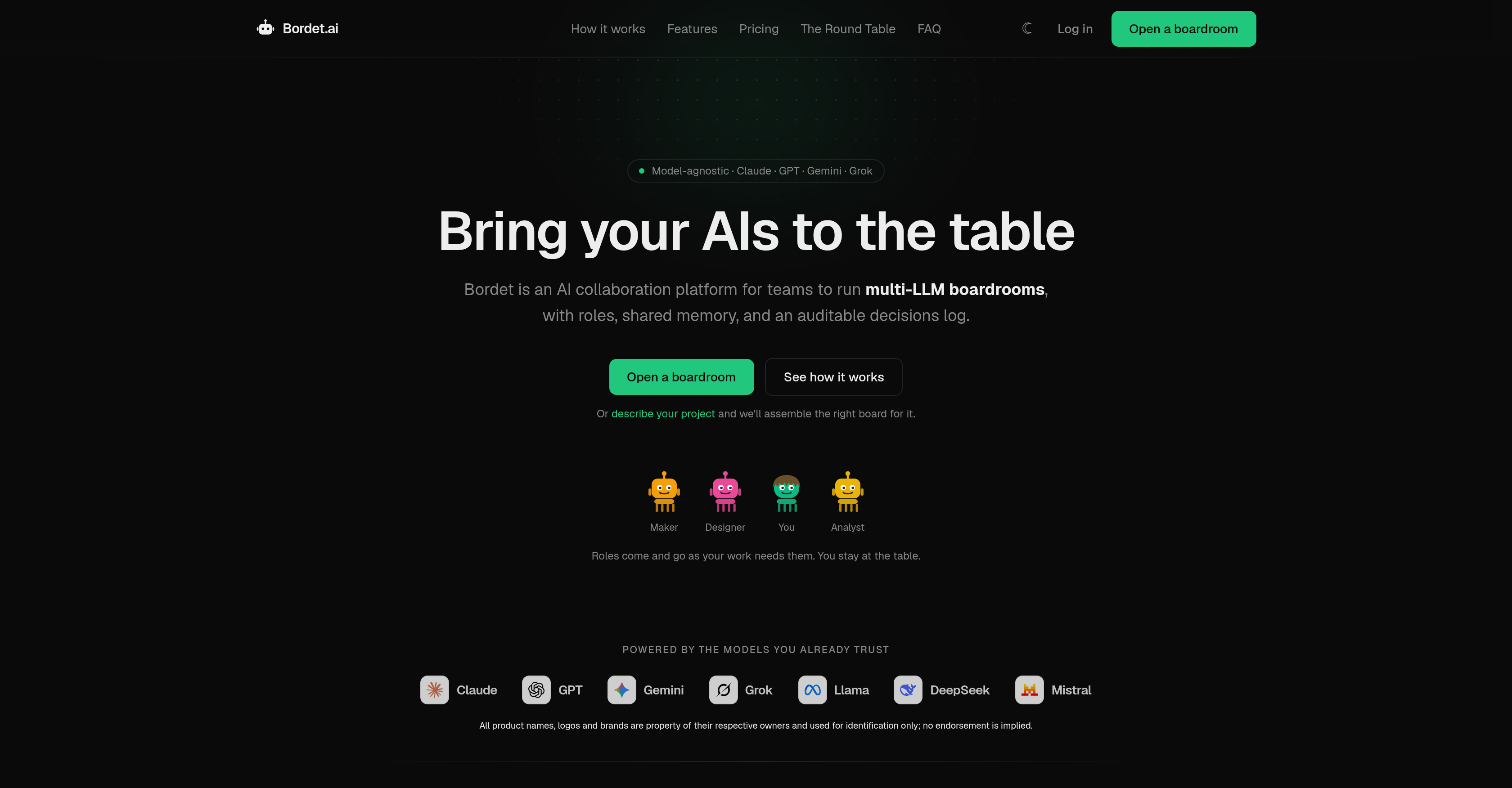
- Get competing perspectives on every project question in one pass: assign Claude, GPT, Gemini and Grok distinct roles like Strategist, Maker and Critic, and each model answers in a round-table multi-LLM boardroom.
- Stop re-briefing AI chatbots at the start of every session: shared, persistent project memory keeps every AI model and teammate aligned on state, constraints and history.
- End relitigated decisions and lost rationale: an append-only decision log records what was decided and why, giving the whole team an auditable record of project planning.
- Bring your human team into the same conversation as the AI: a shared real-time collaboration thread seats people and models together, with final decision-making authority always held by humans.
- Run multiple AI models side by side without juggling API keys or browser tabs: model-agnostic orchestration covers OpenAI, Anthropic, Google and xAI models in a single room.
- Control your AI spend without platform markup: the Bring Your Own Keys plan bills OpenAI, Anthropic or Google directly, prepaid credits start at $5, and a free trial requires no card or API keys.
- Launch a working AI team in minutes and reshape it as the project evolves: pick models or start from a template, receive automatic role assignment, and reassign roles as requirements change.
- Keep strategy discussions confidential: private boardrooms are accessible only to you and the people you invite, with messages processed solely by the AI providers you choose.
Pros & Cons
From the listing; not yet checked by our editors.
Pros
- Multi-LLM boardrooms
- Real-time collaboration
- Ability to combine models
- Subscription model flexibility
- Shared memory feature
- No keys switching
- Persistent memory across sessions
- Logging decisions for transparency
- Human-centric final decision-making
- Supports real-time human collaboration
- Model-agnostic
- Claude language model support
- GPT language model support
- Gemini language model support
- Grok language model support
- Flexible pricing options
- Prepaid credits payment option
- Bring-your-own-keys plan
- Allows role-specific model assignment
- Integrated team collaboration capability
- Project state synchronization
- Models take roles
- Collaborative decision-recording
- Real-time interaction and responses
- Team-based collaborative environment
- Manages multi-LLM boardrooms
- Keeping project consistency
- No redundancy in decisions
- Ensures project planning augmentation
- Auditable decision logs
- Invite teammates feature
- Turn-based interactions
- Bordet memory remembers projects
- Coding agents in-boardroom
- GitHub integration
- Folder sync included
- Role-based addressable members
- Conducive environment for models
- Cross-checked answers from models
- Seamless session transitions
- Transparent markup credits usage
- Free trial available
- Data privacy provisions
Cons
- No mobile app
- Subscription model limits usage
- Interface can get cluttered
- Dependent on external APIs
- Relatively new, unknown reliability
- Data privacy concerns
- Potential latency with multiple models
- Credit-based pricing can be confusing
- No offline mode
- Limited model selection
Alternatives to Bordet
Tools that share the most tags with Bordet.
- Coda AI
Replace scattered tools with one connected workspace that automatically syncs data across your entire operation using connected data
Freemium · from $10/month
$10/month
Not yet checked
- EVY - your AI co-creator
Transform spoken ideas into polished text instantly without typing, using the push-to-talk EVY-Key from within any application
Freemium · from $19/month
$19/month
Not yet checked
- Wild Moose
Identify incident root causes in seconds instead of hours by processing observability data through conversational AI trained specifically on your environment
Paid · from $800/month
$800/month
Not yet checked
- Team Journal
Never lose meeting context again with automatic transcription that converts discussions into searchable text
Freemium · from $11.20/month
$11.20/month
Not yet checked
- illumi
Eliminate switching between AI tools with unified access to ChatGPT, Claude, and custom models in one visual workspace
Free
Not listed
Not yet checked
- Imaranda
Save valuable time by minimizing back-and-forth discussions with a structured platform for modeling questions and answers
Not listed
Not listed
Not yet checked
Reviews
Rate this tool
Loading reviews...
Frequently asked questions
What is Bordet?
Bordet is an AI collaboration platform where teams manage Multi-LLM boardrooms. It integrates AI models with specific roles into a shared workspace and facilitates real-round table interactions with humans. Bordet aims to augment project planning with its shared, persistent memory and collaborative decision recording system.
What features does Bordet provide in its AI collaboration platform?
Bordet provides a host of features for its AI collaboration platform. It allows teams to assemble and manage boardrooms comprising AI models assigned specified roles. It fosters round-table interactions where each member can respond to questions, a shared and persistent memory keeping everyone in sync across a project, and logs to audit decisions. Bordet also enables real-time collaboration between AI and human team members in a single boardroom.
What is a Multi-LLM boardroom?
A Multi-LLM boardroom on Bordet is a shared room where several large language models like Claude, GPT, and Gemini work together with humans on one project. Each AI and human participant has a role, a shared memory, and access to an auditable decisions log. This arrangement eschews the need to copy context between separate chatbots.
How does Bordet accommodate humans and AI in a single boardroom?
Bordet accommodates humans and AI models in the same boardroom by providing a shared thread for real-time collaboration. Every AI model and human participant in the system has a clear role, while the final decision-making power stays with the human part.
What is the basis of role assignment in Bordet?
Role assignment in Bordet is based on the specific requirements of the project. Every AI model and human in the system has a distinct role. For instance, an AI team might include a Strategist on Claude, a Maker on GPT, or a Critic on Gemini.
How does the persistent memory feature work in Bordet?
The persistent memory feature in Bordet works by keeping every member, both AI models and humans, apprised of the project's state, constraints, and history across every session. This shared, persistent memory across projects eliminates the need for context-switching between tabs.
How are decisions logged in Bordet?
Decisions in Bordet are logged as an append-only record of what was decided and why. This log forms an auditable and transparent record that the whole team can view, ensuring that nothing gets lost or needs to be relitigated.
Does Bordet support various language models like Claude, GPT, Gemini and Grok?
Yes, Bordet supports various language models including Claude, GPT, Gemini, and Grok. It allows teams to integrate any of these models into a single boardroom with assigned roles.