

Deepgram
Process massive audio backlogs without bottlenecks — Deepgram's automatic speech recognition (ASR) is built to transcribe large volumes of voice data at scale, with speed and accuracy holding steady as workloads grow.
Listing not yet reviewed by our editors · How we check
Overview
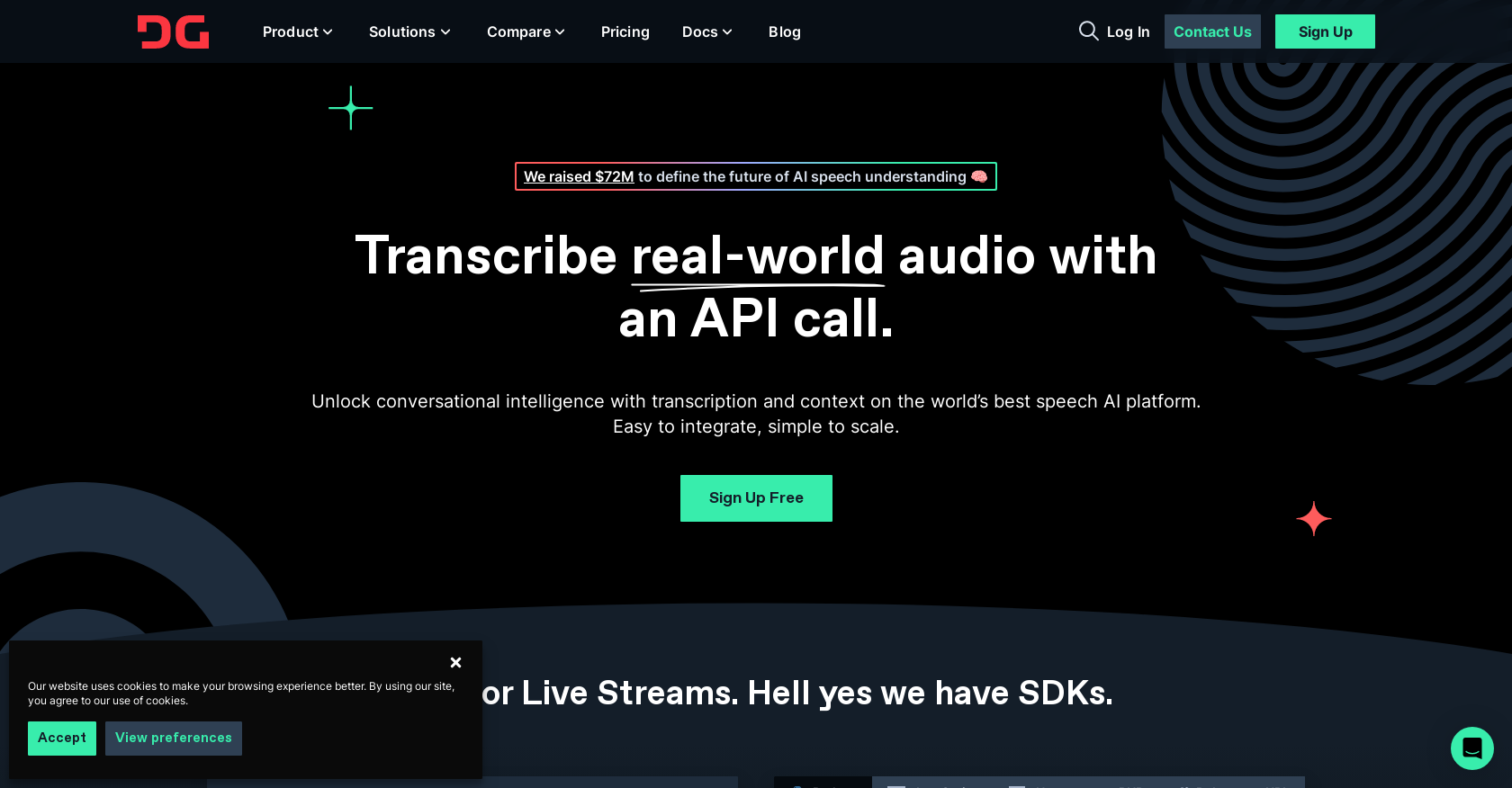
- Process massive audio backlogs without bottlenecks — Deepgram's automatic speech recognition (ASR) is built to transcribe large volumes of voice data at scale, with speed and accuracy holding steady as workloads grow.
- Get usable transcripts from imperfect recordings — deep learning models trained on large, varied audio datasets accurately recognize spoken words in noisy environments and low-quality audio.
- Capture fast talkers and slow speakers equally well — dynamic time-warping adapts to varying speech rates, reducing transcription errors in your speech-to-text output.
- Serve multilingual customers and markets from one transcription pipeline — speech recognition models identify spoken words in any language.
- Match transcription to your industry's terminology and use cases — fine-tuning lets you customize the ASR to your business's specific audio and requirements.
- Act on spoken conversations as they happen — real-time speech-to-text delivers live transcription for streaming voice data.
- Build voice features directly into your products and workflows — the Speech API provides programmatic access to STT transcription and text-to-speech (TTS) in one integration.
- Keep transcription costs under control as volume grows — Deepgram supports economical transcription at scale for businesses of all sizes.
Pros & Cons
From the listing; not yet checked by our editors.
Pros
- Transcribes large volume of data
- High-speed transcription
- Precise transcription
- Transcribes any language
- Handles low-quality audio
- Dynamic time-warping technique
- Customizable for businesses
- Economical transcription
- Helps build voice applications
- Deep learning model
- Trained on large datasets
- Minimal effort required
Cons
- Limited to voice transcriptions
- Might struggle with accents
- Potential transcription errors
- Requires customization for accuracy
- Not suited for low-quality audio
- Limited language recognition
- Highly data dependent
- May struggle with noise interference
Alternatives to Deepgram
Tools that share the most tags with Deepgram.
- Soundwise.ai
Get instant transcriptions without signing up or paying, enabled by a completely free and unlimited-use web tool
Freemium · from $10/month
$10/month
Not yet checked
- AssemblyAI
Achieve up to 23% more accurate call transcription with AI models trained on 12.5M hours of multilingual audio data
Freemium
Not listed
Not yet checked
- Apptek
Convert audio to precise text transcripts across dozens of languages and dialects using neural network speech recognition
Not listed
Not listed
Not yet checked
- Zeemo
Create accurate video captions instantly with AI-powered generation that achieves over 98% accuracy
Free trial
Not listed
Not yet checked
- Voicetype AI
Write emails and documents entirely hands-free using advanced voice dictation that captures your natural speaking style
Free trial · from $13.59/month
$13.59/month
Not yet checked
- Speechy
Instantly create organized to-do lists and action items by speaking instead of typing, eliminating manual note-taking during meetings and brainstorming sessions
Freemium · from $9/month
$9/month
Not yet checked
Reviews
Rate this tool
Loading reviews...
Frequently asked questions
What is Deepgram's Automatic Speech Recognition (ASR)?
Deepgram's Automatic Speech Recognition (ASR) is an artificial intelligence-based tool that aids businesses in transcribing spoken words to text. It is designed to handle large volumes of audio data quickly and accurately.
How does Deepgram's ASR work?
Deepgram's ASR operates through deep learning models that are trained on enormous quantities of audio data. These models facilitate the tool's ability to accurately recognize spoken words in any environment and language, including noisy and low-quality audio. It uses techniques such as dynamic time-warping to increase accuracy and lower transcription errors.
What is meant by 'at scale' in context of Deepgram's ASR?
'At scale' in the context of Deepgram's ASR refers to its ability to efficiently handle and process large volumes of audio data quickly and accurately.
What makes Deepgram's ASR efficient?
Deepgram's ASR is efficient due to its deep learning models that are trained on a large amount of audio data. This capability, combined with techniques like dynamic time-warping, allows it to improve speed and accuracy while reducing transcription errors.
What technology is used in Deepgram's ASR?
Deepgram's ASR uses artificial intelligence technology. More specifically, it utilizes deep learning models trained with extensive amounts of audio data for accurate transcriptions.
Can Deepgram's ASR recognize any language?
Yes, Deepgram's ASR can accurately recognize spoken words in any language.
What techniques does Deepgram's ASR use to improve accuracy?
To improve accuracy, Deepgram's ASR uses a variety of techniques, one of which is dynamic time-warping. This technique helps to reduce transcription errors.
Is it possible to customize Deepgram's ASR?
Yes, it is possible to customize Deepgram's ASR to meet the specific needs of individual businesses.