

Overview
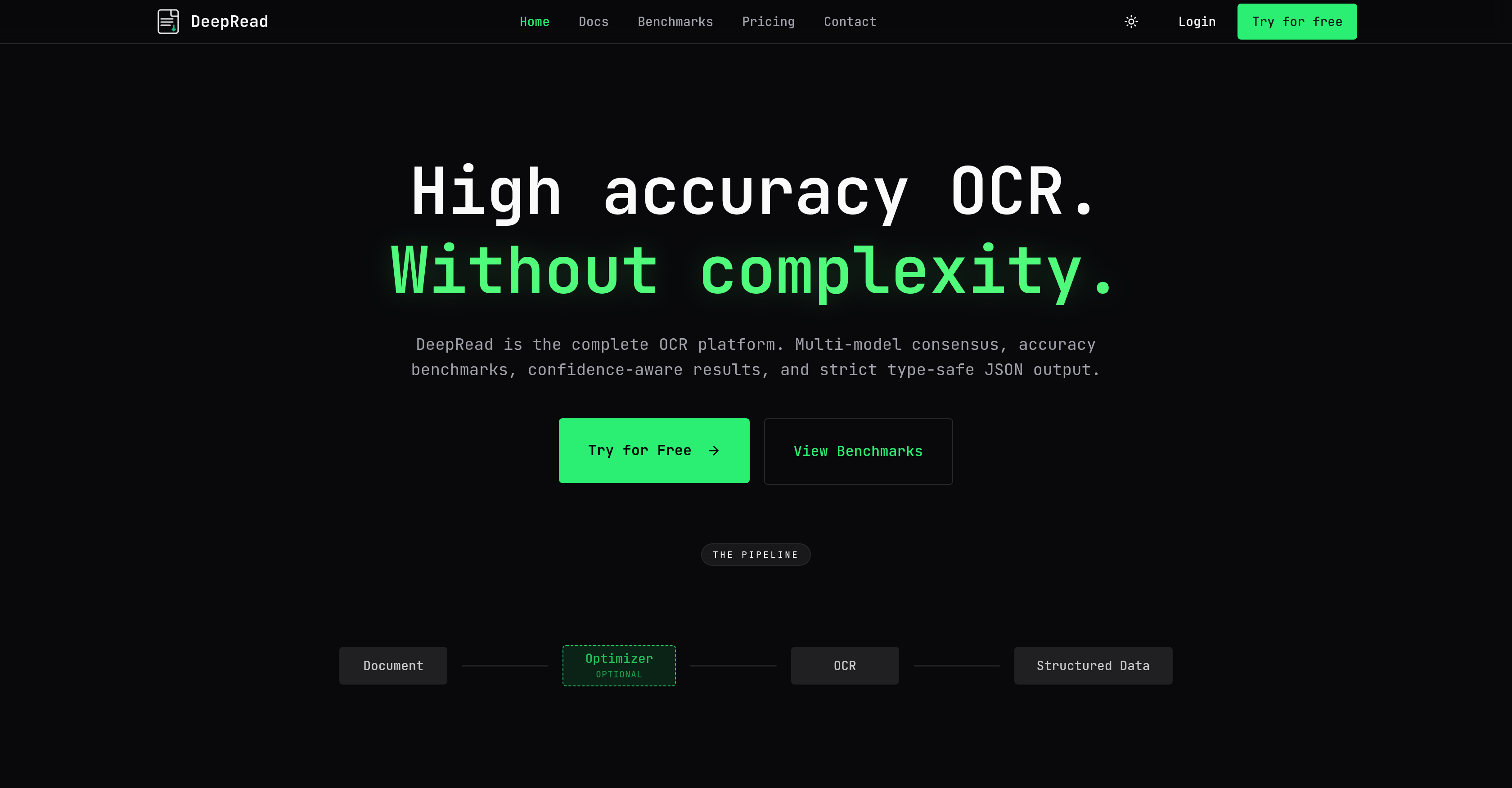
- Eliminate manual prompt engineering and maintenance with a multi-model AI consensus system that automatically optimizes extraction for your defined fields like 'invoice_total' or 'vendor_name'
- Automatically route 5-10% of uncertain data to human review while instantly processing the rest, using a confidence scoring system based on model agreement and character clarity
- Scale from small batches to enterprise volumes without code changes, using a REST API that handles multipart form uploads and returns structured JSON with verification status
- Convert scanned documents, PDFs, and images with human-level precision, using multiple language models that validate each other to achieve higher base accuracy than single-model systems
- Maintain data integrity with a system that never fails silently, flagging problematic files for review instead of overlooking difficult-to-process sections
Pros & Cons
Pros
- Handles a variety of file types
- Replicates human-like content understanding
- Flagged review system
- Notifies of problematic files
- Supports scalable functionalities
- Allows text extraction
- OCR that never fails silently
- Document conversion capability
- PDF conversion capability
- Quality assurance
- Review flagging
- Data conversion
- Output as editable text
- Creates searchable text
- Deciphers text
- Suitable for complex documents
- Prevents data missing
- Delivers human-level accuracy
- Works with various formats
- Robust OCR solution
- Free starting option
- Developer-focused
- Optimized for growth enterprises
- Handles simple and complex documents
Cons
- Lacks detailed pricing plans
- No offline functionality
- Accuracy may vary
- Developer knowledge required
- Integration complexity
Reviews
Rate this tool
Loading reviews...
❓ Frequently Asked Questions
DeepRead is an Optical Character Recognition (OCR) API designed specifically for developers and businesses. It's a tool that transforms digital images into machine-readable text with a high degree of accuracy.
DeepRead OCR API converts a broad range of file types, including scanned documents, PDFs, and images, into machine-readable text. It supports text extraction and data management with a focus on delivering results with human-level precision.
DeepRead distinguishes itself from other OCR technologies with its emphasis on accuracy and reliability. It strives to achieve a human-level understanding and recognition of content and also implements a flagged review system for quality control.
DeepRead supports a variety of file formats for text extraction, including scanned documents, PDFs, and digital images.
DeepRead is beneficial to businesses of all sizes and industries that work with substantial volumes of text data in non-text formats.
'Human-level precision' means that DeepRead aims to match the level of understanding and recognition a human would have when reading a document. In other words, it attempts to convert image files into text with the highest possible accuracy.
The flagged review system in DeepRead is a feature that signals problematic files. If the system has any difficulties processing a file, it doesn't just stop - it flags the file for review to ensure no critical details are missed.
When encountering difficulties in file processing, DeepRead doesn't fail quietly. Instead, it flags these problematic files for review to guarantee all crucial data is handled accurately.
Yes, DeepRead does notify users of problematic files. This is part of their flagged review system which focuses on maintaining quality by identifying any issues with file processing.
Scalable functionalities offered by DeepRead refer to its ability to support operations of varying sizes, from small-scale tasks to larger, growth-oriented business operations.
Yes, DeepRead is designed to support both small-scale and larger, growth-oriented operations. Its scalable functionalities make it a versatile tool for businesses.
With DeepRead, you can convert a wide range of documents to text, including scanned documents, PDFs, and digital images.
DeepRead strives to provide text conversion with human-level precision. This signifies high accuracy in the conversion process, aiming to replicate human-like understanding and recognition to the greatest extent possible.
Yes, DeepRead does support PDF conversion. It can process PDFs along with scanned documents and digital images, transforming them into machine-readable text.
'Not silently failing' in DeepRead signifies a commitment to processing all files, including problematic ones. Instead of stopping when faced with a problem, the system flags these files for review. The goal is to ensure no valuable details are missed due to processing difficulties.
DeepRead provides an advanced level of quality control through its flagged review system. If it encounters any issues while processing a file, it flags it instead of failing silently, fostering robust quality control.
DeepRead handles error flagging through its flagged review system. If there are difficulties in file processing, it doesn't fail silently, but marks these files for review ensuring all data is adequately treated.
Yes, DeepRead is equipped to process substantial amounts of text data. It's crafted for businesses dealing with high volumes of text in non-text file formats, offering a comprehensive solution to convert these into machine-readable text.
AI-assisted processing in DeepRead helps enhance precision and efficiency. It contributes to the tool's ability to provide human-level accuracy in conversions and supports the flagged review system for optimal quality control.
DeepRead offers effective data management capabilities by converting non-textual information into machine-readable text. This way, it allows businesses to conveniently manage and leverage their text data, irrespective of the original file's format.
DeepRead differentiates itself from other OCR APIs by offering a flagged review system. If DeepRead encounters any issues during the file processing, it flags these files for review rather than failing silently. This feature ensures not a single crucial detail is overlooked, thereby offering better quality control compared to other OCR solutions. It is also known for its human level accuracy and scalable functionalities.
DeepRead is equipped to handle various file types including scanned documents, PDFs, and images. The software accurately converts these files into machine-readable text, regardless of the source format. The versatile OCR capabilities equip it to process text data from multiple sources and formats with high precision.
DeepRead boasts of delivering results with human-level accuracy. This implies that the OCR conversion quality emulates the understanding and text recognition capabilities akin to a human, resulting in potentially lower rates of manual review and correction.
The flagged review system in DeepRead is a quality control feature. If the OCR system encounters difficulties or issues with the file processing, it flags these files for review rather than ignoring problematic files or failing without notification, ensuring that no crucial details are overlooked.
DeepRead offers scalability by being built to support both small-scale and larger, growth-oriented operations. This means the software’s functionality can be dialed up or down to meet the specific volume and complexity requirements of the user, thus making it an adaptable tool for businesses of all sizes.
Yes, DeepRead can handle both simple and complex documents. It showcases versatility in recognizing and converting text from a variety of sources and formats, whether the document is simple in nature or has complex layouts and structures.
DeepRead ensures that no crucial details are overlooked through its distinct flagged review system. When the OCR application encounters a section it can't decipher, instead of overlooking the problem, it flags these sections for review. This allows users to address potential issues directly rather than having to deal with missing data later on.
DeepRead contributes to quality assurance via its flagged review system. Any problematic file or sections that the OCR struggles to process are flagged for review, rather than the software failing silently. This method ensures that all content is rigorously examined, and potential inconsistencies are flagged for attention, thereby securing a high standard of output quality.
Yes, testing DeepRead's functionality before making a commitment is possible as the API offers a free starting option. However, detailed specifics of this option are not provided.
Yes, DeepRead is designed to recognize content from various sources and formats. This includes scanned documents, PDFs, and images, indicating a high level of adaptability to diverse file formats and sources.
'DeepRead never fails silently' refers to its distinct quality assurance feature - the flagged review system. When the OCR application encounters a section it can't decipher it flags these sections for review rather than failing silently. This ensures that users are always aware of issues that arise during the processing of files.
Developers can incorporate DeepRead into their applications by integrating the OCR API. This flexibility allows developers to harness DeepRead’s capabilities where OCR functionality is required, for applications like document archiving, data extraction, and more.
Industries that deal with substantial amounts of text data in non-text file formats, such as the healthcare, legal, financial, and research sectors, would find DeepRead particularly beneficial. It can streamline their document conversion and management process, while maintaining high quality and accuracy.
DeepRead's OCR technology replicates human-like understanding via its high-accuracy text recognition. This means the software is capable of producing output that is similar to a human converting the document, resulting in potentially lower rates of errors, and less need for manual review and correction.
Yes, DeepRead can handle large volumes of text data in non-text file formats. The API is scalable, meaning it can manage expanding usage needs over time. This makes it a suitable tool for businesses that deal with considerable volumes of non-text textual data.
DeepRead enhances the document management process by converting scans, PDFs, and images into editable and searchable text data. Not only does it handle a wide variety of documents, but it also flags any difficult-to-process sections for review, effectively reducing data losses and enhancing data accuracy and completeness.
Yes, DeepRead is suitable for operations of all sizes. Its scalable functionalities mean that it can accommodate both small-scale operations and larger, growth-oriented businesses equally well.
DeepRead offers support to growth-minded enterprises with its scalable functionalities. As businesses grow and their need to process more digital image files increases, DeepRead can scale up its capacity to match these expanding needs, making it a suitable and robust OCR solution for growth-oriented businesses.
Pricing
Pricing model
Freemium
Paid options from
$99/month
Billing frequency
Monthly