

DrugCard Simple Search
Overview
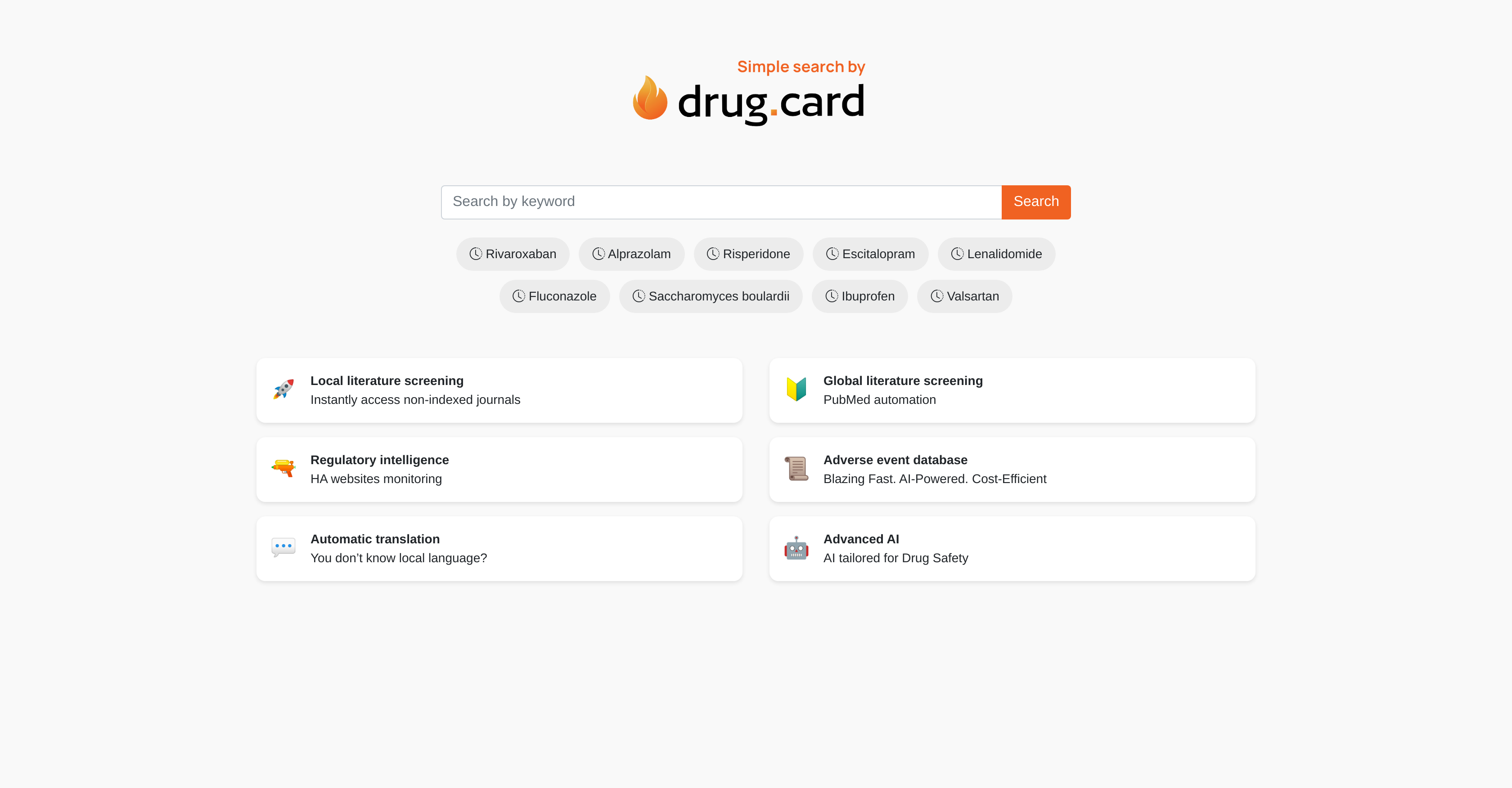
- Detect drug safety signals faster with AI-powered screening of both indexed and non-indexed journals
- Stay compliant with automatic monitoring of Health Authority websites for regulatory changes and new approvals
- Access critical adverse effect data instantly through the AI-driven Adverse Event Database for informed decisions
- Overcome language barriers in global pharmacovigilance with automatic translation of international literature
- Accelerate market entry by identifying new opportunities and adapting to regulatory changes early
Pros & Cons
Pros
- Comprehensive drug data availability
- Local and global literature screening
- Includes non-indexed journals
- Automated PubMed searches
- Regulatory intelligence feature
- Monitoring of Health Authority websites
- Real-time regulation updates
- Speeds market entry
- Cost-efficient data access
- Underpins patient care
- Multilingual translation feature
- Tailored for drug safety
- Automated drug safety monitoring
- Pharmaceutical domain focused
- Streamlined pharmacovigilance
- Better-informed decisions support
- Universally accessible system
- Flexible usage
Cons
- No specified user interface
- Possibly inaccurate automatic translations
- Data source variety undefined
- Unstated update frequency
- No API access mentioned
- Lack of customer support
- Undefined security measures
- Unmentioned pricing model
- Limited to text data
Reviews
Rate this tool
Loading reviews...
❓ Frequently Asked Questions
AI in DrugCard plays a substantial role in facilitating various tasks, such as automated literature screening, analyzing and monitoring data, and rendering the Adverse Event Database. It enables the system to swiftly and cost-efficiently provide vital information about potential drug side effects.
In DrugCard, the local literature screening feature utilizes AI to instantly access a plethora of relevant information sources. It scans a wide range of journals, including both indexed and non-indexed ones, to offer a comprehensive view on drugs and their impact.
Yes, DrugCard does work with non-indexed journals. It taps into this wide-ranging literature to provide exhaustive data on drugs, pharmaceutical substances, and their implications.
DrugCard gathers global literature through automated PubMed searches. This feature enables the system to aggregate an extensive array of literature available worldwide, thereby enhancing its knowledge base.
The 'Adverse Event Database' in DrugCard is an AI-driven function that swiftly offers cost-efficient access to critical data about possible adverse effects of drugs. This information is crucial for ensuring drug safety and promoting better patient care by informing well-guided decisions.
DrugCard assists with regulatory intelligence by scrupulously tracking Health Authority websites. This active monitoring allows the system to keep users up-to-date with alterations in regulations, new approvals, and shifting market trends.
DrugCard ensures compliance and accelerates market entry by maintaining a vigilant watch over Health Authority websites, thereby keeping its users informed about regulatory changes, new drug approvals, and market trends. Early adaption to changing rules and recognition of new market opportunities significantly aids compliance and fast-tracks market entry.
Yes, DrugCard can indeed facilitate users with different language competencies. It does so by providing an automatic translation feature, thereby ensuring the system is globally accessible.
The importance of the automatic translation feature in DrugCard lies in its role of overcoming language barriers, frequently a major obstacle in efficient global data exchange. By automatically translating content, DrugCard assures that the system is usable and comprehensive for all users regardless of their native language.
Yes, DrugCard is capable of rigorously monitoring Health Authority websites. This active surveillance enables it to consistently provide users with the latest and most relevant data, ensuring regulatory compliance and expediting market entry.
Yes, DrugCard does provide data on potential adverse effects of drugs. This information comes from the AI-powered 'Adverse Event Database', which enables quick and cost-efficient access to crucial drug safety data.
DrugCard enhances drug safety and patient care by offering access to critical information about possible adverse effects of drugs through its 'Adverse Event Database'. This information propels better-informed decisions, ultimately underpinning drug safety and patient care.
DrugCard becomes a flexible tool for drug safety measures because of its advanced AI which is specifically tailored for drug safety. This makes the system adaptable and useful for users interested in drug safety actions.
Yes, DrugCard provides access to data gathered from a wide range of sources. It uses automation tools and AI-based methods to screen, analyze, and monitor this data, facilitating comprehensive intelligence within the pharmaceutical domain.
DrugCard taps into a broad spectrum of journals, including both indexed and non-indexed ones. It accesses essential information related to drugs, pharmaceutical substances, and their impact from these diverse sources.
The accuracy of the PubMed search by DrugCard is high due to the automated nature of this feature. It allows for a comprehensive aggregation of globally available literature, enhancing the system's knowledge base substantially.
Yes, DrugCard does provide updates concerning changes in regulations, approvals, and market trends. It achieves this by actively monitoring Health Authority websites, ensuring users are always updated and compliant.
DrugCard is tailored for drug safety through its advanced AI which is specifically designed for this function. Features like the AI-powered Adverse Event Database contribute greatly to drug safety by providing swift, cost-efficient access to vital data about possible adverse effects of drugs.
DrugCard contributes to efficient global data exchange by providing an automatic translation feature. This ensures the system overcomes language barriers and is universally accessible, leading to an efficient exchange of information irrespective of the user's language.
Yes, the AI in DrugCard is specifically designed and tailored for drug safety. It helps in various areas such as automated literature screening, analyzing and monitoring essential drug data, and driving the Adverse Event Database, all, in turn, enhancing drug safety.
Pricing
Pricing model
Free
Paid options from
Free