

Overview
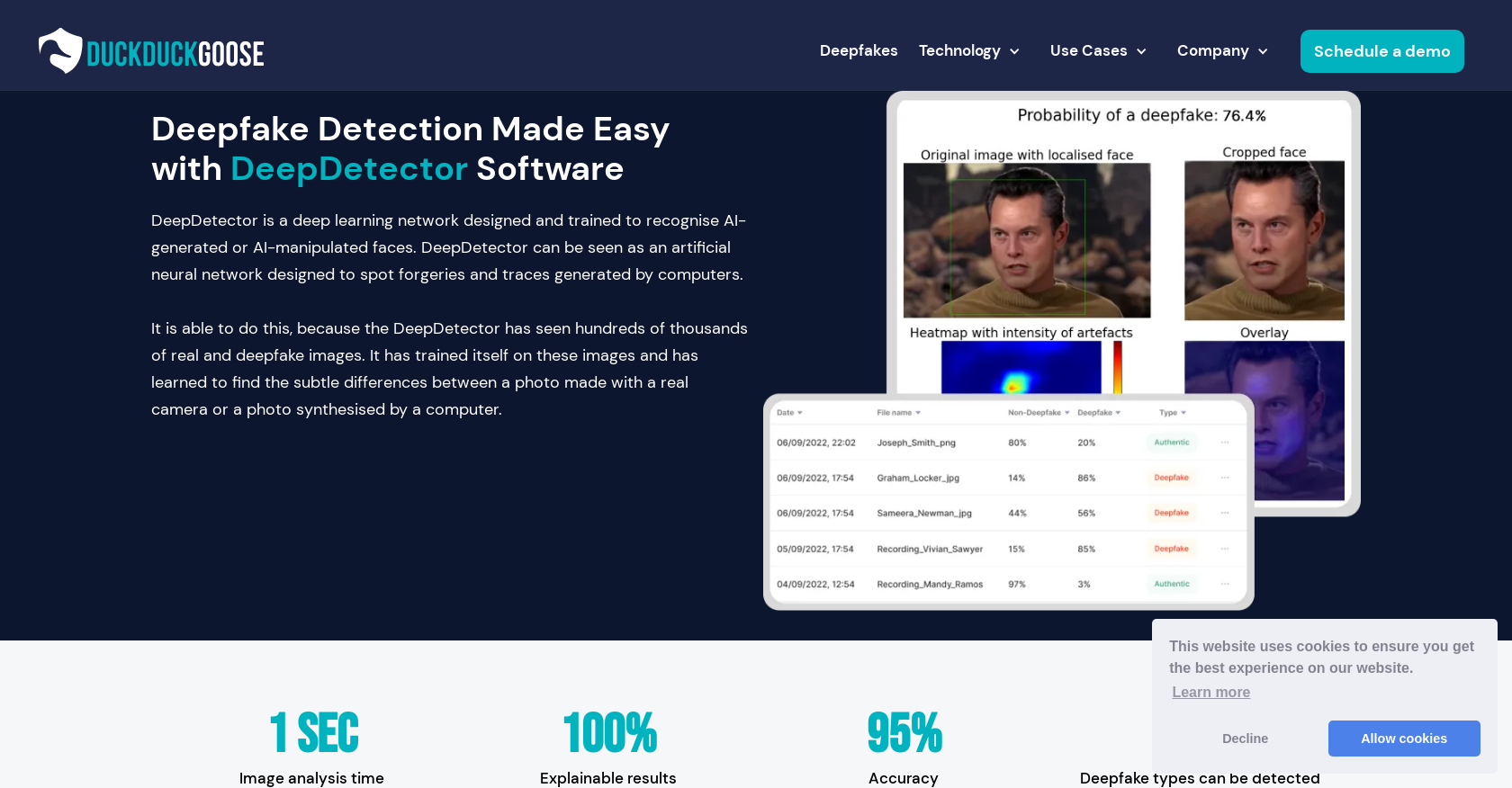
- Verify image and video authenticity in 1 second with 93% accurate deepfake detection
- Understand exactly why content was flagged with visual Activation Map explanations
- Detect over 10 manipulation types including FaceSwaps and AI-generated synthetic media
- Integrate seamlessly into compliance workflows with customizable cloud APIs
- Maintain data privacy and regulatory compliance with European data protection standards
- Receive trustworthy results with 84.37% precision on fake content classifications
Pros & Cons
Pros
- Detects manipulated faces
- Analyzes thousands of images
- 93% accuracy rate
- Cloud-based access
- Customizable APIs
- Compliance with European laws
- Data protection and privacy
- Useful for compliance purposes
- Useful for video conferencing
- Useful for journalism
- Useful for penetration testing
- Explains results
- Detects 10+ deepfake types
- Image analysis in 1 second
- Trained on representative datasets
- 93% correct predictions
- 84.37% precision in fake classifications
- 92.57% recall in fake predictions
- Detects synthetic media
Cons
- Accuracy rate inconsistency
- Detection limited to faces
- Limited deepfake types detection
- No offline capabilities
- Requires API integration
- Reliant on European regulations
- User interface not mentioned
- No performance on video content
- Long term efficacy unproven
- No information on speed
Reviews
Rate this tool
Loading reviews...
❓ Frequently Asked Questions
DeepDetector's main function is detecting deepfakes and other AI-manipulations in images and videos. This involves scanning visible faces in an image or video, analyzing them, and detecting whether or not they have been altered or completely generated by AI.
DeepDetector detects fake images or videos in three steps. First, it extracts all visible faces in the picture or video. It then activates its deep learning network to analyze the faces to find deepfake or AI-manipulated traces. Finally, it provides the output of the analysis which includes the probability of the input being a deepfake, as well as an Activation Map that explains the classification.
The accuracy rate of DeepDetector is approximately 93%.
The Activation Map in DeepDetector is a feature that substantiates the AI's decision on whether an input is a deepfake or not. It's a form of explanatory evidence that backs up the software's classification of an image or video.
Yes, DeepDetector offers cloud-based access to customizable APIs for integration into user workflows.
The image analysis time for DeepDetector is 1 second.
DeepDetector can identify and detect over 10 types of deepfakes. This includes faceswaps, other types of AI-manipulation, and characteristics of AI-generated content like synthetic media.
DeepDetector ensures data protection and privacy through compliance with European laws and regulations regarding data protection, privacy, and responsible AI. This means all forms of analyses are performed in accordance with these laws and regulations.
Yes, DeepDetector is capable of analysing characteristics of AI-generated content in order to detect synthetic media and AI-generated deepfakes.
While it's not specifically detailed, DeepDetector's ability to accurately detect and analyze deepfakes in images and videos can contribute to KYC (Know Your Customer) compliance. The tool could potentially be used to verify the authenticity of customer-submitted visuals, mitigating the risk of identity fraud.
The Activation Map feature in DeepDetector offers an explanation behind the software's decision by substantiating the classification. This helps users understand why an image or video was classified as a deepfake.
Yes, DeepDetector can be integrated into existing workflows through its customizable APIs, which provide cloud-based access.
The precision percentage of DeepDetector, which pertains to the percentage of fake classifications that were actually fake, is 84.37%
DeepDetector substantiates its classifications through the use of what they call an Activation Map. This map offers correlations between specific features or regions in the input and the model's output, providing a clear explanation for its detection of a deepfake or AI-manipulated image or video.
Yes, DeepDetector complies with European data protection laws. All forms of analyses take place in accordance with European laws and regulations regarding data protection, privacy, and responsible AI.
DeepDetector's 'Explainable Results' feature refers to the software's ability to provide clear and understandable reasoning behind its decisions. This is achieved through the activation map, a feature that substantiates the classification of an image or visual as genuine or deepfake.
Yes, DeepDetector can detect FaceSwaps and other AI-manipulations by looking for traces of alterations in existing (camera-made) pictures and videos.
DeepDetector uses a three-step process to detect deepfakes. Step one is extracting all visible faces in the image or video. Next, it analyzes the faces to find traces of deepfakes. In the final step, it presents the analysis result, including the input's probability of being a deepfake and an Activation Map that substantiates the classification.
After DeepDetector has extracted the faces from a picture or video, it activates its deepfake detection technology. This technology analyzes the faces and investigates them for deepfake traces.
Pricing
Pricing model
No Pricing