

Optimus by Iacon Autonomics
Go from a goal to a trained agent without hand-running reinforcement learning experiments: hand over an agent or model with a target, and Optimus researches algorithms, designs experiments, evaluates results, and iterates through an automated practice-observe-improve loop.
Listing not yet reviewed by our editors · How we check
Overview
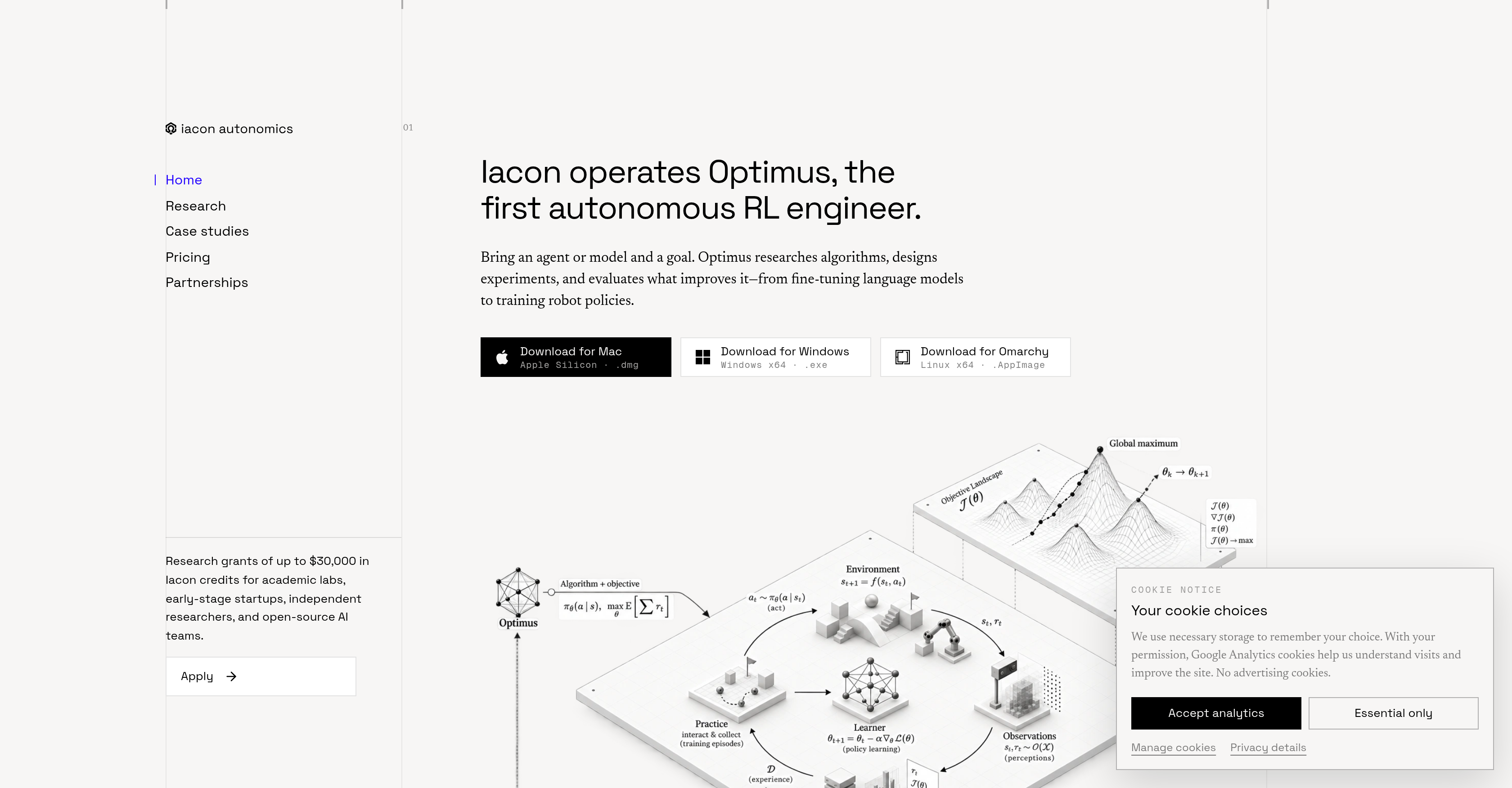
- Go from a goal to a trained agent without hand-running reinforcement learning experiments: hand over an agent or model with a target, and Optimus researches algorithms, designs experiments, evaluates results, and iterates through an automated practice-observe-improve loop.
- Use training methods that go past published RL research: Optimus implements state-of-the-art techniques or synthesizes new methods when existing ones fall short of your objective.
- Ship policies that generalize beyond their training runs: Optimus filters high-signal trajectories from raw environment interactions and uses them to drive parameter updates and the next round of research.
- Keep model training inside your own infrastructure: the full autonomous RL loop runs directly within your existing tech stack and your chosen environment.
- Decide exactly what success means while the engineering runs on its own: you define the environments, reward functions, and success criteria, and Optimus optimizes toward them.
- Cover LLM fine-tuning, robotics, and beyond with a single RL engineer: train language models, AI agents, robot policies, diffusion models, non-player characters, biological systems, and custom policies.
- Improve the agents and robot policies you already have: Optimus tunes and retrains pre-existing models and policies as well as building new ones from scratch.
- Add reinforcement learning capacity regardless of team size: academic labs, early-stage startups, independent research facilities, and open-source AI teams already rely on Optimus for RL research and training.
Pros & Cons
From the listing; not yet checked by our editors.
Pros
- Autonomous RL engineering
- Automated RL processes
- Fine-tuning language models
- Robotic training orchestration
- Generates high-signal trajectories
- Generates generalizable policies
- Integrated tech stack operation
- Defining environments capability
- Defining rewards system
- Defining success criteria
- Diversified application field
- Handles language learning models
- Handles diffusion models
- Handles robotics models
- Handles biological systems
- Handles custom policies
- Research-focused
- Trusted in academia
- Trusted in professional settings
- Offers research grants
- Rigorous scientific experimentation
- Applies state-of-the-art research
- Develops novel methods
- Works in user's stack
- Experiments design capability
- Result evaluation capability
- Guides further research
- Improves given objectives
- Applicable to domain-specific models
- Network of domain-specific models
- Facility to set direction
- Runs loop inside stack
- Capability to define objectives
- Delivers trained agents
- Operates at scale
- Partners with technology providers
- Integrated into partner tech
- Proven research efficiency
- Case studies available
- Continuous training loops
- Integrated infrastructure shipping
Cons
- No API mentioned
- Platform-specific downloads
- No multi-agent support
- No customizability mentioned
- Unclear update mechanisms
- No mobile version
- Specific tech stack integration
- No live support mentioned
- Unclear testing procedures
- No user tutorial documented
Alternatives to Optimus by Iacon Autonomics
Tools that share the most tags with Optimus by Iacon Autonomics.
- LinerAI
Build custom AI models without writing code using a no-code interface for image, text, audio, and video classification
Free
Not listed
Not yet checked
- Thinking Machines Tinker
Focus entirely on your data and algorithms while Tinker manages scheduling, tuning, and reliable infrastructure for you.
Not listed
Not listed
Not yet checked
- AIDE by Weco
Solve complex business problems and academic research challenges by simply describing your goal in natural language, as AIDE designs and optimizes complete Machine Learning pipelines.
Not listed
Not listed
Not yet checked
- Commissioned
Deploy custom AI models for content generation and data classification without hiring a machine learning team, using a platform that requires zero coding or technical expertise.
Freemium · from $25/month
$25/month
Not yet checked
- CoreWeave
Spin up GPU inference in seconds instead of waiting on cluster provisioning with Kubernetes-native GPU compute and automated lifecycle management.
Not listed
Not listed
Not yet checked
- Prime Intellect
Launch AI models without infrastructure delays using Prime Intellect's fully managed service that requires zero setup
Not listed
Not listed
Not yet checked
Reviews
Rate this tool
Loading reviews...
Frequently asked questions
What exactly is Optimus by Iacon Autonomics?
Optimus by Iacon Autonomics is an autonomous reinforcement learning (RL) engineer. It's designed to carry out research, run experiments, and train different forms of AI like language models, AI agents, and robot policies. It can operate within various tech stacks, allowing the direction to be set by defining environments, rewards, and success criteria.
What is the main function of Optimus in AI?
The foremost function of Optimus is to automate reinforcement learning processes in AI. It works on researching algorithms, designing experiments, and training various AI entities towards a predefined goal, continuously going through a cycle of practice, observation, and improvement.
Can you explain the process of how Optimus trains AI entities?
Optimus begins the process by receiving a specific goal from the user along with an agent or model. It then autonomously researches algorithms, designs experiments, and evaluates what enhances it. High-signal trajectories are derived from raw environment interactions, which help to train more general policies. This cycle of practice, observe, and improve is automated and perpetuated within a defined environment.
What makes Optimus different from other similar AI tools?
Optimus stands apart due to its focus on automating RL processes. While fine-tuning language models orchestrate robot policies' training in different contexts. It doesn't just implement existing research, but can develop brand new methods for better results, enabling it to deliver a trained agent given a goal.
How does Optimus implement new research or methods?
Optimus implements new research or methods by conducting rigorous scientific experimentation. It uses state-of-the-art research or synthesizes entirely new methods to achieve its goal, modifying its methods based on observation and evaluation to filter high-signal trajectories from interactions with the environment.
How does Optimus handle high-signal trajectories from environment interactions?
Optimus handles high-signal trajectories by filtering them from raw environment interactions. These high-signal trajectories are pivotal to train more generalizable policies. Optimus uses them to guide further research and to make critical parameter updates for more successful outcomes.
What kind of AI entities can Optimus train?
Optimus can train a multitude of AI entities. These range from language learning models to AI agents and robot policies. It can also be used on diffusion models, robotics, non-player characters, biological systems, or custom policies.
What is required from a user to utilize Optimus?
Users need to provide Optimus with an agent or model and a specific goal. Optimus then takes over the process from there, setting into motion its loop of research, design, evaluation, and refinements to achieve the user-defined goal.