

Overview
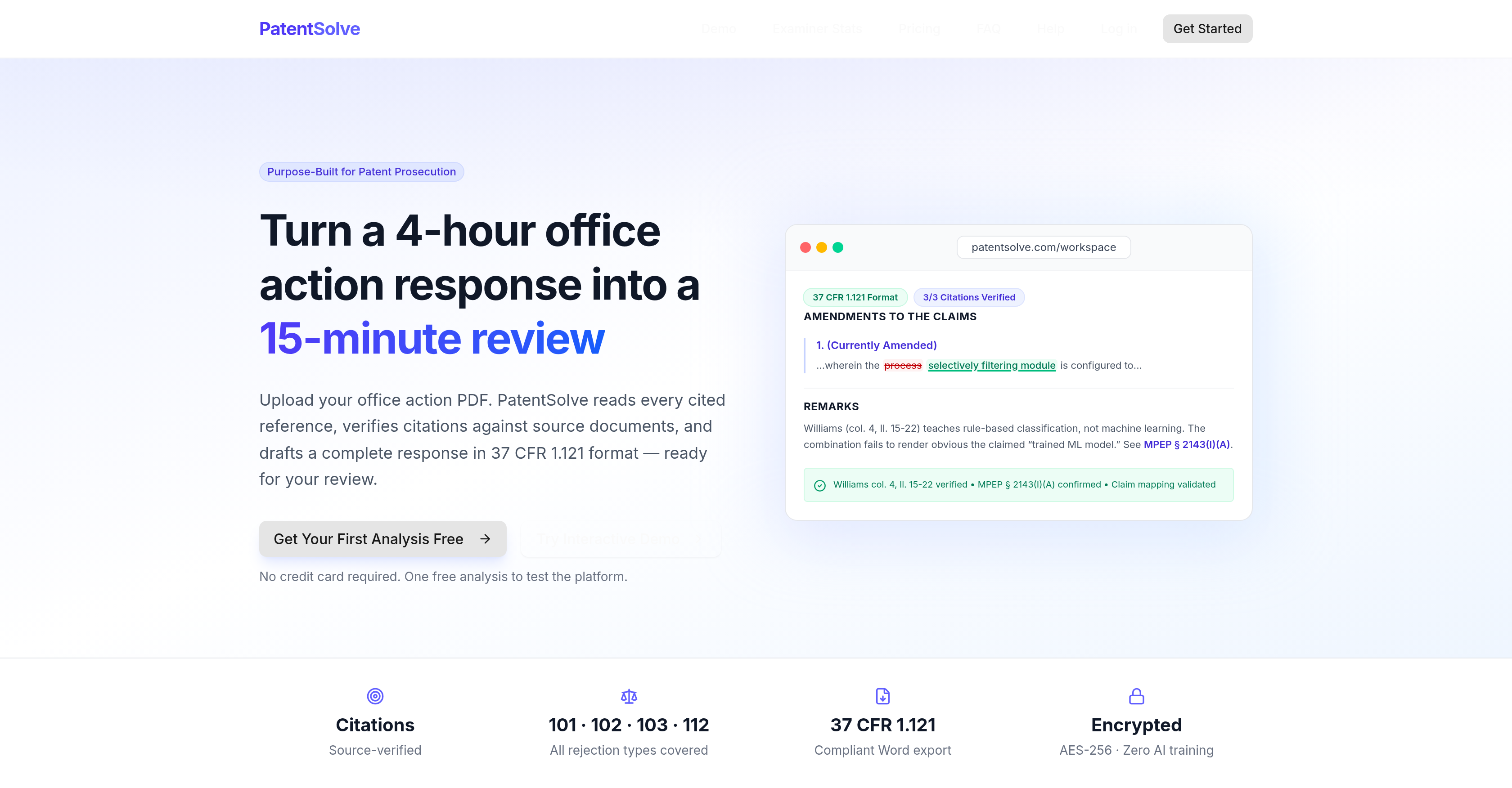
- Draft a complete, compliant office action response in minutes instead of hours by uploading your PDF for automated analysis, citation verification, and 37 CFR 1.121 formatting.
- Eliminate citation errors and build stronger arguments with AI that verifies every reference against actual source documents and maps prior art element-by-element.
- Tailor your strategy to each examiner with data-driven profiles revealing their allowance rates, interview patterns, and past case strategies.
- Generate precise, rejection-specific arguments for 101, 102, 103, 112, and double patenting rejections with AI analysis of the office action.
- Ensure format compliance automatically with claim amendments drafted using correct strikethrough deletions, underline additions, and claim status identifiers.
Pros & Cons
Pros
- Transforms drafting responses
- Upload and read PDFs
- Verifies and cites references
- Complies with 37 CFR 1.121
- Verifies and maps prior art
- Pulls examiner prosecution histories
- Generates rejection-specific arguments
- Checks citations against source documents
- Drafts claim amendments
- Generates examiner profiles
- Data-driven strategies
- Significant Time Saving
- Handles various rejection forms
- Amendments in 37 CFR 1.121 format
- Data-Driven Strategies
- Automatically OCR's scanned documents
- Classifies each rejection
- Cited prior art mapping
- Generates rejection-specific arguments
- Downloadable response document
- Automatically applies correct arguments
- Source verifies citations
- Verifies unreachable citations
- Offers recommended strategies
- AES-256 Encryption
- TLS 1.3 Encryption
- Automatic OCR for scanned documents
- SOC 2 certified cloud hosting
- Real-time citation verification
- Argument modifications before exporting
- Edits preserved in export
- Free trial includes analysis
- Real USPTO data integration
- Supports anticipation with element-by-element mapping
- Follows motivation-to-combine analysis
- Alice/Mayo analysis for 101
- Support for written description/definiteness
- Handles final and non-final actions
- Support for restriction requirements
Cons
- Only supports English
- No cited reference storage
- Doesn't cater to global patents
- Needs manual review
- Does not support mobile
- Limited citation verification
- No integrated editing
- Dependent on PDF upload
- Examiner profiles lack detail
- Limited strategies recommendation
Reviews
Rate this tool
Loading reviews...
❓ Frequently Asked Questions
PatentSolve simplifies office actions in patent prosecution by automating the response drafting. The user uploads the office action PDF, and PatentSolve reads, verifies, and cites every reference in the document. This leads to a complete response drafting, maintaining compliance with legal export requirements. PatentSolve further simplifies the task by identifying, verifying, and mapping cited prior art element-by-element, generating rejection-specific arguments, and drafting claim amendments.
Key features of PatentSolve include the ability to read and verify each reference from the uploaded document, automatic drafting of complete responses, compliance assurance with 37 CFR 1.121 exports, verification and mapping of cited prior art, generation of rejection-specific arguments, citation checking against source documents to prevent inaccuracies, amendment drafting in correct formats, and provision of data-driven examiner profiles with valuable insights.
PatentSolve ensures 37 CFR 1.121 export compliance through its automated system. It drafts claim amendments using correct formats, including strikethrough deletions, underline additions, and claim status identifiers. Upon review, the responses are ready for export and compliance with 37 CFR 1.121.
PatentSolve verifies and maps cited prior art on an element-by-element basis. Each piece of prior art cited in the office action is fetched, read, and verified. The AI checks this against the actual references. This system prevents potential inaccuracies and ensures that each citation is accurate and verifiable.
To generate rejection-specific arguments, PatentSolve uses its built-in tools to analyze the type of rejection, whether it's 101, 102, 103, 112, or double patenting. It then tailors the argument to go along with the specifics of the rejection, ensuring a focused and effective response strategy.
For handling different forms of rejections, PatentSolve generates specific arguments that are in line with the respective rejections, automatically applying the correct framework for 101, 102, 103, 112 cases, and double patenting.
PatentSolve ensures accuracy in cited resources by checking citations against actual source documents. Before citations are integrated into any draft response, they are checked, verified, and validated, preventing the inclusion of incorrect or unverifiable citations that may complicate proceedings.
PatentSolve aids attorneys with data-driven examiner profiles detailing examiner-specific allowance rates, interview success patterns, and strategies. These insights enable attorneys to make informed strategies and decisions for future proceedings.
PatentSolve qualifies examiner’s prosecution histories by integrating real USPTO data. It pulls this data and uses it to draft a complete and verified response.
Claim amendments drafted via PatentSolve follow the 37 CFR 1.121 format. It implements strikethrough deletions, underline additions, and the correct claim status identifiers to ensure compliance and accuracy.
PatentSolve provides data-driven examiner profiles by collecting and analyzing data about each examiner. This data includes allowance rates, interview success patterns, and examiner-specific strategies, providing insights into examiner behavior and response strategies.
PatentSolve is an AI-assisted tool because it utilizes artificial intelligence for reading and verifying each reference in the office action PDF, drafting of complete responses, mapping cited prior art, generating tailored arguments for different rejections, ensuring compliance with legal exports, and creating data-driven examiner profiles.
PatentSolve can transform a 4-hour office action response into a 15-minute review. This is achieved by automating the reading, verifying, citing, and drafting process that would typically be done manually by the patent practitioner.
After an office action PDF is uploaded to PatentSolve, the tool reads each cited reference, verifies citations against source documents, and then drafts a complete response while ensuring compliance with 37 CFR 1.121 format.
PatentSolve uses AI to check each citation against the actual source documents. This ensures that no incorrect or unverifiable citations are contained within the drafted response, preventing complications in subsequent proceedings.
Yes, PatentSolve has special algorithms to handle and craft specific arguments for all types of patent rejections, including 101 (subject matter eligibility with Alice/Mayo analysis), 102 (anticipation with element-by-element mapping), 103 (obviousness with motivation-to-combine analysis), 112(a) and 112(b), and double patenting.
PatentSolve streamlines patent office responses by reading, verifying, and citing each reference from the office action PDF. It then drafts a complete response that includes all necessary parts such as citation verification, prior art mapping, rejection-specific arguments, and claim amendments.
Using PatentSolve leads to significant time-efficiency. A process that typically takes 3-5 billable hours manually, can be completed in 15 minutes with PatentSolve. This savings in time can translate directly into cost savings and increased productivity for the users.
Indeed, PatentSolve can handle both final and non-final office actions. It classifies each rejection whether it is 101, 102, 103, 112, or double patenting and drafts an appropriate response for each situation.
PatentSolve adheres to high-standard security measures to ensure data safety. It uses AES-256 encryption at rest and TLS 1.3 in transit. The user data is hosted on enterprise-grade, SOC 2 certified cloud providers and is never used for training AI models. Also, users can export or delete all their data at any time from account settings.
PatentSolve is an AI-assisted tool designed to simplify the process of responding to office actions in patent prosecution. It offers tools to generate rejection-specific arguments tailored to handle various forms of rejections, ensure compliance with 37 CFR 1.121 exports, and even cross-reference citations against actual source documents to avoid any inaccuracies. It uses data-driven examiner profiles to provide deep insights to help attorneys better prepare.
PatentSolve works by requiring users to upload their office action PDFs. It reads every cited reference, verifies the citations against source documents and drafts a streamlined response ready for review. It also creates detailed examiner profiles, based on their history and other data, offering recommendations for specific strategies.
PatentSolve is designed to work with PDF files. Users are asked to upload their office action responses in PDF format; these files can be either text based or scanned and automatically processed through OCR.
Yes, PatentSolve verifies citations against actual source documents. This capability is instrumental in avoiding any incorrections or false inclusions that may derail proceedings by disrupting the credibility of the response.
37 CFR 1.121 refers to the rules for writing and amending claims in the United States Patent Law. PatentSolve ensures compliance with these rules by automating the drafting process, incorporating strikethrough deletions, underline additions, and accurate claim status identifiers.
Yes, PatentSolve is equipped to provide tailored responses to handle various forms of rejections including 101, 102, 103, 112, and double patenting.
PatentSolve helps in drafting claim amendments in compliance with the 37 CFR 1.121 format. It automatically includes strikethrough deletions, underline additions, and adds correct claim status identifiers.
Yes, PatentSolve can generate rejection-specific arguments. These arguments correspond to different rejection types such as 101, 102, 103, 112, and double patenting.
PatentSolve streamlines the response process by reading and verifying all references listed in the office action document, mapping the cited references element-by-element against the actual source documents, drafting a complete response, and providing data-driven insights on the examiner's prosecution history.
PatentSolve offers in-depth examiner profiles with data-driven insights. These profiles uncover patterns in allowance rates, interview success rates, and preferred strategies from each examiner's past cases. This knife-edge insight could provide a significant edge in crafting a successful response strategy.
PatentSolve's data analysis feature culminates in the generation of data-driven examiner profiles. It leverages historic data, patterns in allowance rates, interview success rates, and the examiner's unique strategies to compile insights which can guide the drafting of a response.
PatentSolve suggests strategies that are specifically tailored to your examiner, based on their past behaviours, success rates, and preferred tactics. These insights can be effectively leveraged to design a response that resonates with the standpoints and inclinations of the specific examiner.
PatentSolve creates an environment where responses can be generated effectively. It does this by citing every reference listed in the office action document, verifying it and then using the data to draft a thorough response compliant with the regulations stated in 37 CFR 1.121.
Yes, PatentSolve can check your responses for compliance with patent law. It achieves this by spotting any deviations from 37 CFR 1.121, as well as cross-checking citations against the actual source documents.
PatentSolve's citation verification feature is highly accurate, as it meticulously verifies every citation against state-of-the-art legal databases and primary source material, minimising the risk of inaccuracies.
Yes, PatentSolve does offer a trial period. You get one free analysis to test its capacity on a real office action with full OA analysis, rejection identification, and examiner overview stats.
PatentSolve employs AI in two primary dimensions. Firstly, in citation verification, the AI cross-references each citation against actual source documents to thwart inaccuracies. Secondly, in drafting responses, the AI streamlines this process, making it efficient and effective with pre-configured, rule-based responses for various rejection types.
Pricing
Pricing model
Free Trial
Paid options from
$75/month
Billing frequency
Monthly