

RelayLink
Skip writing summaries and status messages: say "Send Jim the plan" in your AI chat, and RelayLink drafts a structured handoff note with the decision, rationale, question, constraints, options, and open issues.
Listing not yet reviewed by our editors · How we check
Overview
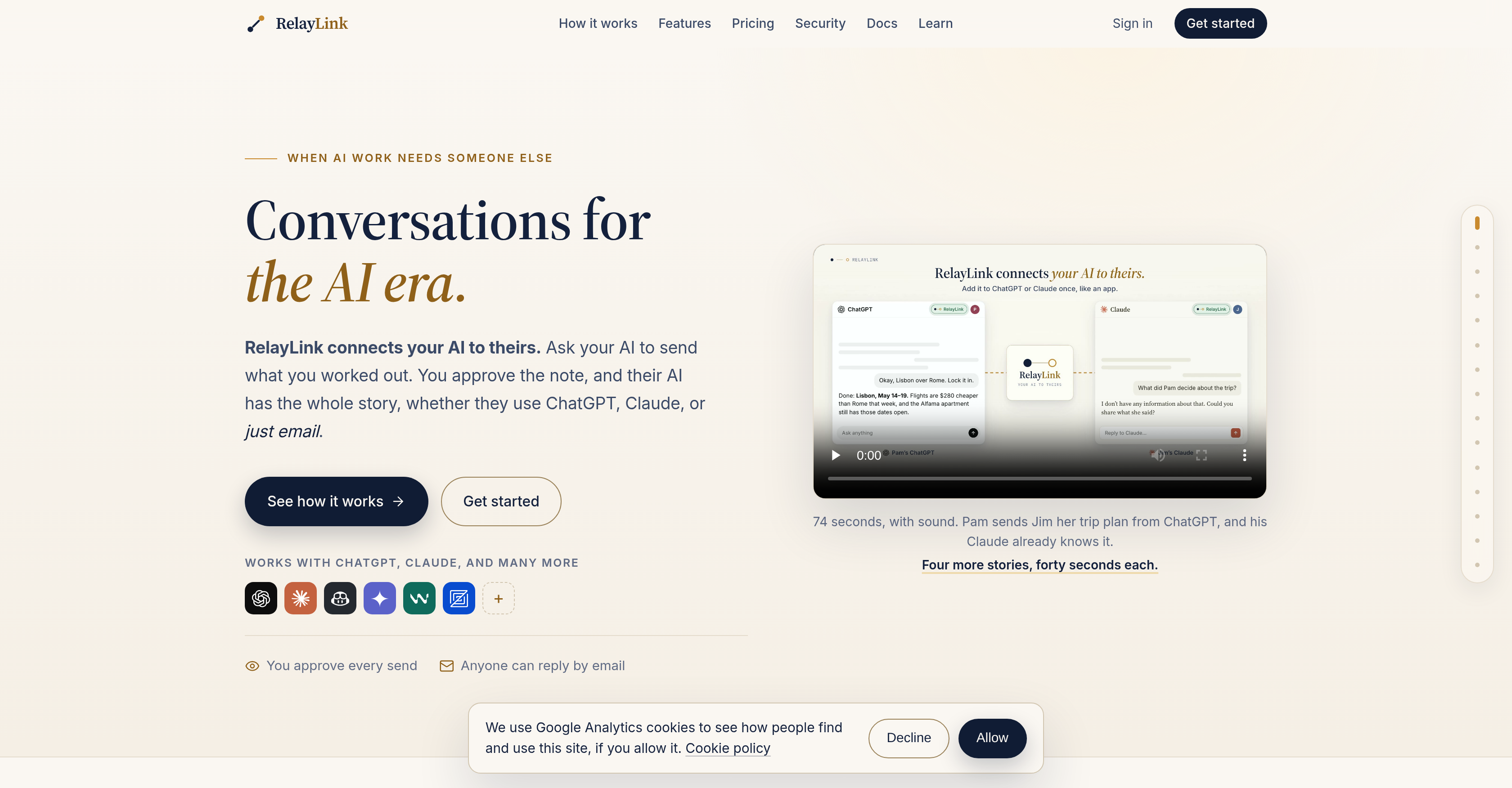
- Skip writing summaries and status messages: say "Send Jim the plan" in your AI chat, and RelayLink drafts a structured handoff note with the decision, rationale, question, constraints, options, and open issues.
- Get useful replies on the first exchange: recipients open the note in their own assistant, such as ChatGPT, Claude, or another supported AI, and start with the full background already loaded.
- Reach people who don't use RelayLink: the same note arrives by plain email with no account or installation needed, and their email replies flow back into your AI workflow.
- Share only what you choose: every note waits for your review and explicit approval before it is sent, and anything you don't select from your private notebook stays private.
- Keep long-running collaboration on track: each handoff links to a persistent thread, so follow-ups build on earlier context instead of re-explaining the project.
- See exactly how a proposal evolved: shared proposals stay provisional until accepted, and every revision is kept with a record of what changed, why, and who wrote each line.
- Close every loose end: unresolved questions become tracked fields with reminders that reappear in later handoffs, and deadlines like "book the apartment by Friday" are passed on word for word.
- Cut AI token costs on shared context: a 500 to 1,500 token briefing replaces full chat transcripts that run 20,000 to 60,000 tokens.
- Align clients, teammates, and family without flattening anyone's view: multi-participant threads let each person reply through their own AI or email while keeping their own priorities.
- Find any past decision quickly: a searchable history keeps every handoff note and its thread available for later reference.
Pros & Cons
From the listing; not yet checked by our editors.
Pros
- Humanapproved outbound notes
- Selective context extraction
- Crossassistant interoperability
- Email fallback without account
- Versioned proposal tracking
- Threadpreserving handoffs
- Explicit decision capture
- Rationale and constraint annotation
- Unresolved issue tagging
- Notebookstyle saved snippets
- Consentdriven transfer
- No automatic content copying
- Assistantagnostic payload format
- Secure context encryption
- Integrated approval workflow
- Multichannel recipient support
- Thread continuity across handoffs
- Provisional proposal state
- Automatic email reply ingestion
- Contextual email integration
- Assistant handshake protocol
- Granular field inclusion control
- Persistent version history
- Context sync without SDK
- Zeroinstall recipient experience
- Humanintheloop safeguard
- Finegrained option listing
- Contextual action prompts
- Crossplatform thread linking
- Secure relay server architecture
- Auditready transfer logs
- Dynamic field mapping
- Selective privacy masking
- Customizable note templates
- Oneclick send command
- Threaded feedback loop
- Contextual email threading
- Scalable multiuser handoffs
- Assistantagnostic API
- Encrypted handoff payloads
- Granular permission settings
- Persistent proposal identifiers
- Automatic context stitching
- Multiassistant compatibility layer
Cons
- Manual approval adds latency
- Supports only select assistants
- No real-time synchronization
- Email fallback strips metadata
- No end-to-end encryption
- Version history inflates storage
- Service downtime blocks handoffs
- Fixed note template limits flexibility
- No mobile app
- No public API/SDK
Alternatives to RelayLink
Tools that share the most tags with RelayLink.
- Alma by Olivares.AI
Eliminate repetitive explanations as your AI remembers your facts, decisions, and preferences across all conversations using automatic knowledge extraction from every dialogue.
Freemium · from $19/month
$19/month
Not yet checked
- MemoriPy
Eliminate repetitive queries and redundant processing through semantic memory clustering that identifies and recalls similar past interactions
Not listed
Not listed
Not yet checked
- Knowledge Plane
Eliminate AI tool silos and maintain a single source of truth across Cursor, Claude, and other agents via the Model Context Protocol (MCP) without custom integrations
Freemium · from $19/month
$19/month
Not yet checked
- Aiqbee
Eliminate AI knowledge silos by building a single, persistent source of truth that any AI tool can access, powered by centralized AI-ready databases called Brains.
Free trial · from $15/month
$15/month
Not yet checked
- Octopoda
Maintain perfect continuity for complex AI operations with a persistent memory bank that retains knowledge across sessions and system reboots.
Free
Not listed
Not yet checked
- Memdex
Maintain perfect context across every AI tool by automatically transforming all your chats into a reusable, unified memory bank that works with ChatGPT, Claude, and Gemini.
Freemium · from $7/month
$7/month
Not yet checked
Reviews
Rate this tool
Loading reviews...
Frequently asked questions
How does RelayLink let me send a note from ChatGPT to someone using Claude?
You ask your ChatGPT instance to “Send Jim the plan.” ChatGPT generates a RelayLink note that captures the decision, rationale, question, constraints, options and any open issues. After you explicitly approve the note, RelayLink transmits it and Jim’s Claude assistant can open the note, importing the full context into Claude’s workspace.
What parts of my conversation can I choose to include in a RelayLink note?
RelayLink lets you pick any of the following elements from the source conversation: the decision, the reasoning behind it, the specific question you need answered, any constraints or deadlines, the set of options considered, and any unresolved issues or open questions.
Do I have to approve the RelayLink note before it’s sent?
Yes. No content leaves your workspace until you manually approve the generated note; the service states that nothing is copied or sent automatically.
Can the recipient receive the handoff if they don’t use RelayLink?
Yes. If the recipient does not have RelayLink, the same note is delivered via plain email, requiring no account or installation on the recipient’s side.
How does RelayLink keep the conversation thread continuous across handoffs?
RelayLink attaches each handoff to a persistent thread identifier. Every subsequent note is linked to the previous one, preserving earlier versions and allowing the recipient’s AI to continue the conversation without re‑summarising the background.
Is any of my private notebook data shared automatically?
No. Only the elements you deliberately include in the note are transmitted. All other notebook entries remain private and are never shared without your explicit selection.
How are versions and revisions tracked in RelayLink?
RelayLink records every version of a note. The original note is kept, and any revisions create linked records that show what changed, why it changed, and who authored each line. You can view the full revision history at any time.
What token savings does RelayLink provide compared to sending full transcripts?
A full transcript typically runs 20 000‑60 000 tokens (≈$0.09 per read at mid‑tier rates). A RelayLink briefing is only 500‑1 500 tokens (≈$0.45 per read). In the example on their site the annual cost drops from $173 for full transcripts to $9 for briefings, a savings of about $164.