
Knowledge Plane
Overview
- Eliminate AI tool silos and maintain a single source of truth across Cursor, Claude, and other agents via the Model Context Protocol (MCP) without custom integrations
- Automatically keep knowledge current with scheduled autonomous jobs that detect drift and update facts from GitHub, Google Drive, and docs hourly or daily
- Enable AI agents to reason like a senior team member by traversing chains of decisions using a graph memory with typed edges (depends_on, owned_by)
- Retrieve precise answers under tight context windows using hybrid retrieval that combines semantic vector search with structured graph traversal
- Preserve data sovereignty and keep proprietary context secure with self-hosting options and workspace isolation, without storing raw file copies
- Maintain full governance and traceability with comprehensive audit logs that back every fact to its source and use scoped API keys
Pros & Cons
Pros
- Consolidates team's code, documentation, chats
- Prevents context exhaustion
- Exceptional long-term memory
- Ability to auto-ingest
- Auto extraction from documents, codebases
- Knowledge cards creation
- Combines Graph and Vector embeddings
- Understands dependencies beyond keywords
- Built on Model Context Protocol
- Query with standard MCP protocol
- No need for custom integrations
- Offers data sovereignty
- Self-hosted option available
- Enhanced governance with audit logs
- Provided workspace isolation
- Scoped API keys for security
- Trails for every query, update
- Automated Github data extraction, cleaning
- Integrates across platforms
- Workflow management system
- Facilitates inter-agent communication
- Offers semantic understanding
- Structured intelligence provision
- Prevents fragmentation in team memory
- Enables understanding of relationships and semantics
- Service-dependency comprehension
- Turns files to knowledge cards
- Autonomous update of knowledge base
- Interprets ownership, timelines in codebases
- extracts, cleans data from documents
- Transforms amnesic chatbots to knowledgeable agents
- Automatic data from document ingestion
- Combines vector store with Graph memory
- Relationship modeling with semantic search
- Combines graph memory with vector embeddings
- Features workspace isolation
- Full audit logs available
- Automatically scans docs, codebases
- Understands team dynamics
- Structured hybrid engine for modeling relationships
- Self-organizing structure
- Provides team-wide synchronized knowledge
- Persistent shared memory layer
Cons
- Complex Graph and Vector Model
- Dependent on Model Context Protocol
- No clear pricing information
- Requires regular source updating
- Potential learning curve
- Risk of information overload
- Limited Workspace Isolation
- Self-hosting may be complex
- Limited early access availability
Reviews
Rate this tool
Loading reviews...
❓ Frequently Asked Questions
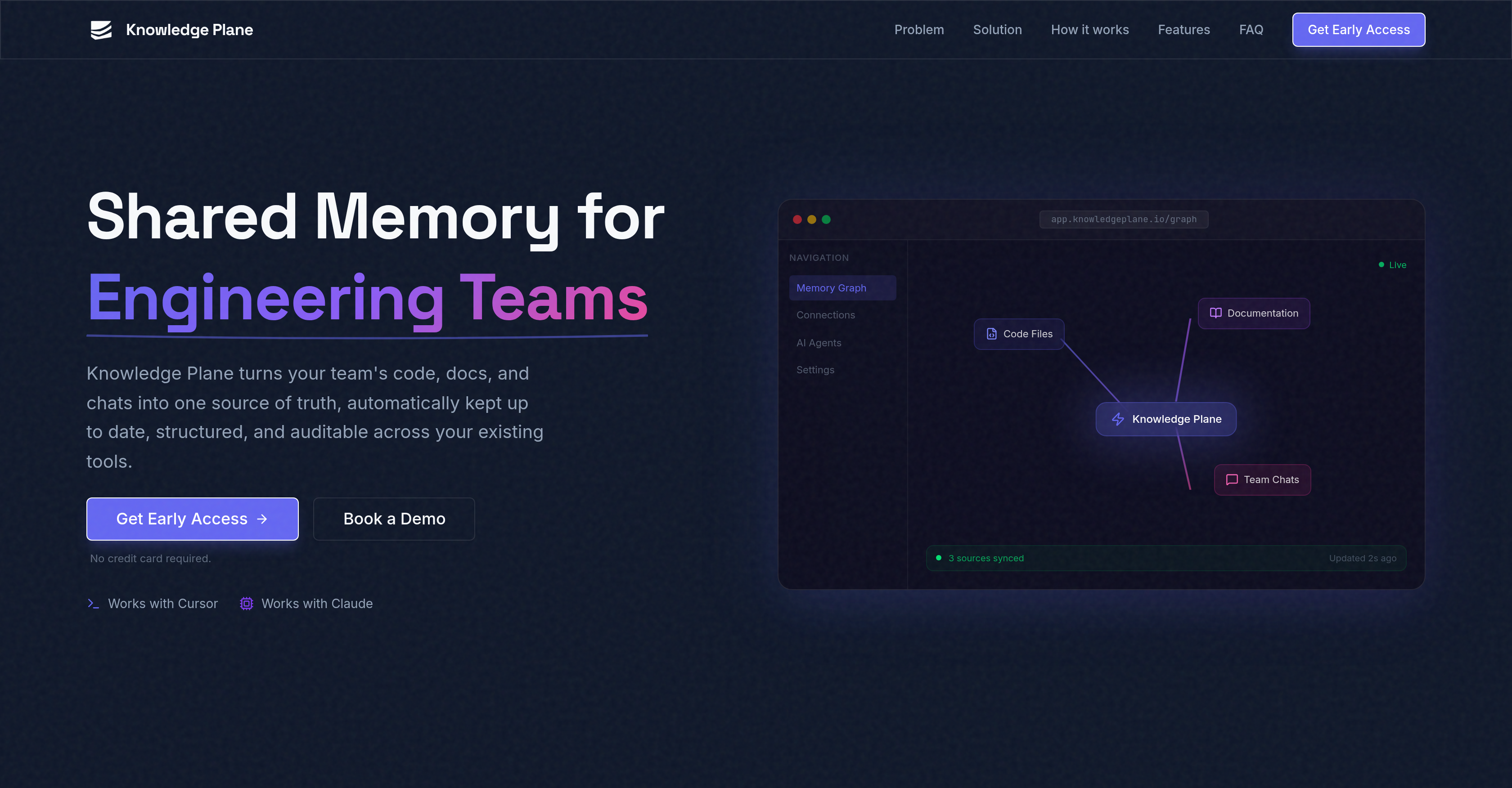
Knowledge Plane is an AI-based shared memory tool designed for engineering teams. It consolidates a team's code, documentation, and chats into a unified, updated source of information to ensure consistent quality from AI tools. It bridges the infrastructural gap of fragmented memory among different AI tools, transforming amnesic chatbots into agents with long-term memory.
The functionality of Knowledge Plane is based on automatically scanning documents and codes, extracting raw facts, cleaning data, and creating knowledge cards. It combines Graph capabilities to understand dependencies with vector embeddings to locate keywords. AI agents connect to Knowledge Plane via the Model Context Protocol (MCP), eliminating the need for custom integrations. It also features workspace isolation, scoped API keys, and maintains audit trails for all queries and updates for added security.
The purpose of Knowledge Plane's auto-ingestion feature is to automatically scan documents and codebases, extract raw facts and clean data, and create knowledge cards. This functionality enables an efficient and automatic consolidation and organization of information, obviating manual effort.
Knowledge Plane's Graph capabilities and vector embeddings facilitate a profound understanding of dependencies, not just keywords. Graph capabilities model relationships between elements, while vector embeddings assist with semantic understanding. Thereby, it enables AI agents to reason about dependencies, ownership, and timelines instead of simply keyword matching.
The Model Context Protocol (MCP) is a standard protocol that AI agents like Claude and Cursor can leverage to query Knowledge Plane. It is designed to eliminate the need for custom integrations.
Knowledge Plane uses the Model Context Protocol (MCP) to allow compatible AI agents like Claude and Cursor to query the plane directly. This simplifies and streamlines its integration into existing AI ecosystems without the need for custom implementations.
To ensure data sovereignty, Knowledge Plane provides a self-hosted option, enabling organizations to keep proprietary information within their infrastructure. The tool extracts structured facts and relationships but does not store raw copies of files, ensuring that original documents remain in place while providing a structured and governed extraction of knowledge.
The self-hosted option in Knowledge Plane allows organizations to keep their proprietary information within their infrastructure by deploying Knowledge Plane within their own enterprise environment. This preserves data sovereignty as the data does not leave the safe confines of their network and remains fully under their control.
Knowledge Plane handles audit logs by logging every query and update. It tracks who made the request, when it was made, and backs every fact to its source, providing a comprehensive audit trail. This enhances governance and ensures transparency and accountability within the system.
In Knowledge Plane, knowledge cards are created by the system's automatic ingestion and structuring of data. The system scans documents and codebases, extracts raw facts, cleans the data, and consolidates the information into high-density knowledge cards. These knowledge cards encapsulate atomic facts and a large view of context within a structured format, facilitating better comprehension and utilization for AI agents.
Knowledge Plane assists in workflow management by acting as a unified memory tool for the entire team. It consolidates all code, documentation, and chat data into a single up-to-date and auditable source of truth across various tools. This ensures a more streamlined workflow as teams don't have to switch between tools or lose context when transitioning.
Knowledge Plane can seamlessly integrate with AI tools like Cursor and Claude via the Model Context Protocol (MCP). This allows an undisturbed workflow in teams' preferred AI tools without the need to create new silos or perform custom integrations.
Knowledge Plane facilitates inter-agent communication by providing a shared memory layer that persists beyond individual sessions. This feature allows one agent's learning to be instantly accessible to the entire team's agents, thus smoothing communication and knowledge transfer.
To secure data, Knowledge Plane employs workspace isolation and scoped API keys, providing secure and specific access to data for agents. It also ensures traceability with audit logs that track every query and update. Additionally, the self-hosted option provides data sovereignty, keeping sensitive information within the organization's infrastructure.
Knowledge Plane assists with data extraction and cleaning through its auto-ingestion feature. This feature auto-scans, extracts raw facts from documents and codebases, and cleans the data into a refined and usable format. The cleaned data is then structured into knowledge cards accessible by AI agents.
Knowledge Plane can consolidate various types of data including a team's code, documentation, and chat transcripts. It transforms these sources into a unified, up-to-date, and auditable source of knowledge.
Knowledge Plane uses GitHub integration to sync repository data, extract valuable facts, and create knowledge cards from the ingested code. This ensures that the data used for building knowledge is always up-to-date with the latest codebase.
Yes, Knowledge Plane can read and understand context. Its combination of Graph capabilities and Vector embeddings allows it to process dependencies and semantics, rather than mere keywords. This feature ensures that interactions and knowledge are contextually aware, offering a nuanced and meaningful understanding and interaction with AI tools.
Knowledge Plane offers several benefits for teams using AI tools. It consolidates different types of team data into a structured, current, and auditable information source. It facilitates seamless integration with AI tools such as Claude and Cursor via the Model Context Protocol (MCP), thereby avoiding custom integration hassles. The shared, persisting memory layer enhances inter-agent communication, while the robust security and self-hosting option safeguard data privacy and sovereignty.
Knowledge Plane stands out from other shared memory tools because of its hybrid engine which combines vector embeddings with Graph capabilities. This unique feature allows it to understand not just keywords but dependencies among elements. Also, its provision for a self-hosting option ensures data sovereignty unlike most shared memory tools. Furthermore, it promotes workspace isolation, full audit logs, and scoped API keys, ensuring security and control over data access.
Pricing
Pricing model
Freemium
Paid options from
$19/month
Billing frequency
Monthly
Refund policy
No Refunds