Overview
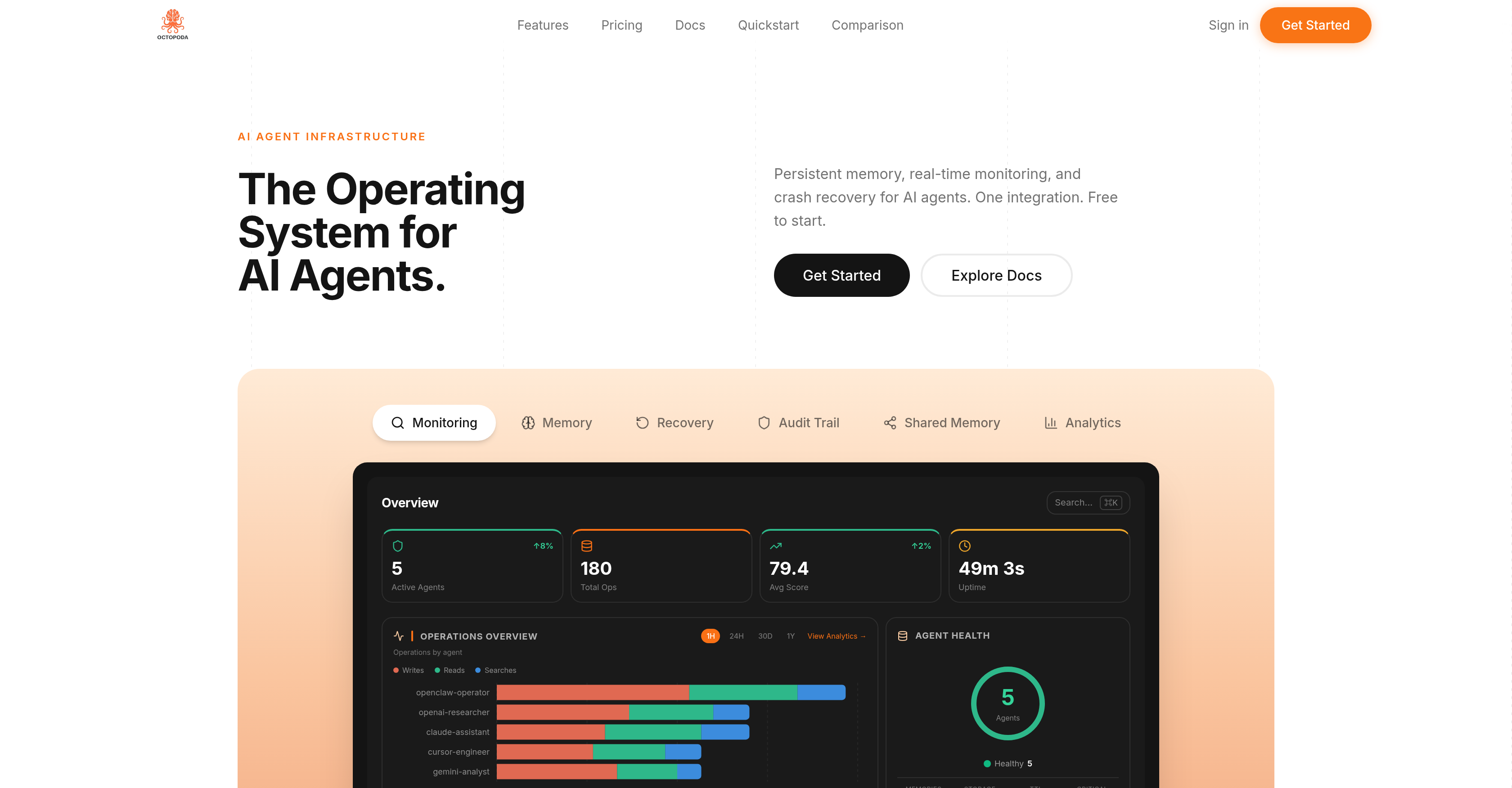
- Maintain perfect continuity for complex AI operations with a persistent memory bank that retains knowledge across sessions and system reboots.
- Retrieve precise, contextually relevant data instantly using semantic search that understands the intent behind natural language queries.
- Ensure full accountability and meet regulatory requirements with detailed audit trails that chronologically track every AI agent operation.
- Prevent catastrophic data loss and resume operations immediately after a crash with automatic state recovery and snapshot restoration.
- Coordinate multiple AI agents seamlessly through a shared memory hub that allows efficient knowledge exchange and access.
Pros & Cons
Pros
- Persistent memory capabilities
- Knowledge retention feature
- Offers recall functions
- Proficient in semantic search
- Understands contextual meaning
- Comprehends natural language queries
- Enhances decision-making process
- Audit trails support
- Chronological sequence of operations
- Reliable traceability pattern
- Promotes accountability
- Promotes transparency
- Crash recovery function
- Enhances system's resilience
- Improves inter-agent coordination
- Enhances data retrieval accuracy
- Increases system reliability
- Enhances data recovery
- Can satisfy regulatory compliance
Cons
- Early Phase, No one is perfect! :)
- Long Term Testing
- No llm debugging, yet!
- Data retrieval delay of 10 seconds
- Sign Up Issues, due to Amount of Sign ups
Reviews
Rate this tool
Loading reviews...
❓ Frequently Asked Questions
Octopoda is artificial intelligence infrastructure designed to deliver persistent memory capabilities for AI agents. It enhances data retrieval accuracy, promotes system accountability, increases system resilience, and improves inter-agent coordination.
Octopoda serves as a memory bank for AI by providing a platform where AI agents store and coordinate knowledge. It also ensures the retention of this knowledge, allowing for efficient access and retrieval when needed.
Octopoda's recall functions allow AI agents to retrieve stored information when required. This enhances the speed and efficiency of data retrieval.
Semantic search pertains to the understanding of the intent and contextual meaning of a term. Octopoda excels in facilitating this by increasing the precision of search results through comprehension of natural language queries.
Octopoda enhances the precision of search results through semantic search. This method understands the intent and contextual meaning of a term, enabling AI agents to deliver more accurate and contextually relevant results.
Octopoda facilitates understanding of natural language queries through semantic search. It deciphers the intent and contextual meaning within natural language queries, ensuring AI agents can comprehend and respond effectively.
Octopoda supports audit trails by tracking and recording the chronological sequence of operations performed by AI agents. This promotes transparency and accountability in AI-driven processes.
Octopoda's audit trails for AI activities provide benefits such as reliable traceability patterns, enhanced security, greater transparency and increased accountability.
Octopoda's crash recovery function serves to reinstate an application's state following a system malfunction. It's an essential tool for preventing total loss of data or in-process operations.
Octopoda's crash recovery function improves system resilience by ensuring that a system failure doesn't result in total data loss, allowing for quick recovery and continuation of in-process operations.
Octopoda contributes to transparency in AI processes through its audit trail feature. This records the chronological sequence of operations, providing a clear and accountable trail of AI activities.
Octopoda plays a key role in improving inter-agent coordination by serving as a grand memory bank. It allows for efficient storage, access and exchange of knowledge between different AI entities.
Octopoda improves data retrieval accuracy through its semantic search function. It understands the intent and contextual meaning of a term, leading to the extraction of more accurate and relevant data.
Octopoda ensures the retention of knowledge between different AI entities through its robust memory bank infrastructure. By allowing for efficient storage and recall, it ensures knowledge is retained and easily accessible when needed.
Octopoda aids in comprehending the intent and contextual meaning of a term through its semantic search function. This leads to more accurate search results and more effective decision-making by AI agents.
Octopoda offers a reliable traceability pattern through its audit trail feature. This tracks and records all operations in a chronological sequence, giving a clear and traceable history of AI actions.
'Persistent memory capabilities' in Octopoda refers to its ability to store and retain information over an extended period, remaining accessible even after system reboots or crashes.
Octopoda distinguishes itself from other AI infrastructure through its comprehensive features including persistent memory, semantic search, audit trails, and crash recovery functions. These contribute to enhancing data retrieval, promoting accountability, increasing system resilience and improving inter-agent coordination.
Octopoda facilitates extraction of contextually relevant data through its semantic search function. By understanding the intent and contextual meaning of a term, it ensures AI agents can extract meaningful data for decision making.
In the event of a malfunction, Octopoda prevents total data loss through its crash recovery function. This is designed to reinstate an application's state following a crash, ensuring no total loss of data or in-process operations.
Octopoda enhances the memory capabilities of AI agents by providing persistent memory infrastructure. This enables long-term storage and retention of knowledge and data. Plus, its recall function allows agents to access this stored information as needed, preserving the continuity of AI operations and decision-making.
Yes, the recall function of Octopoda can be accessed by all AI agents. This functionality enables the AI agents to retrieve stored information or knowledge when required, enhancing their decision-making capabilities.
Octopoda distinguishes itself from other AI infrastructures with its comprehensive feature set. It not only provides storage and recall functionalities but also excels in semantic search, which increases the precision of search results by understanding natural language queries. Additionally, Octopoda supports audit trails for monitoring AI activities and crash recovery functions, improving accountability, traceability, and system resilience.
Octopoda's semantic search function facilitates a better understanding of the intent and contextual meaning of a term. It utilizes natural language processing to comprehend queries, thereby improving the accuracy of search results and enabling AI agents to extract meaningful and contextually relevant data.
Octopoda's semantic search function improves decision-making processes in AI by providing a better understanding of natural language queries. This comprehension allows AI agents to extract more accurate and contextually appropriate data when making decisions, thus enhancing the precision and effectiveness of their responses and actions.
Audit trails in Octopoda's context represent a record of operations performed by an AI. They provide a chronological sequence of AI activities, enhancing accountability and transparency of its operations.
Audit trails in Octopoda can help monitor AI activities by providing a chronological track of operations done by AI agents. This traceability pattern is beneficial in reviewing and analyzing AI behavior, identifying issues, and thus improving system reliability and accountability.
The information stored in Octopoda's audit trails typically includes a chronological sequence of operations performed by the AI. This sequenced data can help monitor AI activities, identify patterns or anomalies, and maintain a level of operational transparency.
Octopoda's crash recovery function reinstates an application's state following a system crash. This ensures that a system malfunction doesn't result in a total data loss or halt in-process operations, improving the system's resilience.
Yes, Octopoda's crash recovery ensures effective data recovery following a system crash. It reinstates the application's state, preserving the data and operations that were in-process at the time of crash.
Any system, application, or process that involves AI can benefit from Octopoda's crash recovery feature. This is crucial for applications where data integrity and operational continuity are vital, as it safeguards against total loss of data or disruption of ongoing processes due to system crashes.
Yes, Octopoda is designed to cater to complex AI systems. Its features, such as persistent memory, semantic search, audit trail, and crash recovery, contribute to handling the multifaceted interactional processes and memory challenges that are associated with complex AI systems.
Octopoda facilitates interaction between different AI agents through its persistent memory capabilities. By acting as a storage hub, it enables different AI agents to share and recall stored knowledge and data, thus fostering efficient coordination and interaction.
Yes, Octopoda does support regulatory compliance. The audit trail feature provides a trackable record of AI operations, which can be crucial in meeting regulatory compliance requirements related to transparency and accountability of AI applications.
Octopoda can comprehend a wide variety of natural language queries. Its semantic search functionality interprets the intent and contextual meaning of a term, thereby increasing the accuracy of search results by understanding queries in natural, human language.
Octopoda is highly efficient in knowledge retention and recall processes. It acts as a grand memory bank for the storage of information, and its recall function allows AI agents to retrieve this stored information as needed, ensuring seamless continuity in operations and decision-making.
Octopoda enhances the performance and reliability of AI systems by ensuring long-term memory retention, improving search result precision via semantic search, enhancing accountability through audit trails, and promoting system resilience with crash recovery features. These all contribute to a more reliable, efficient, and robust AI system.
Octopoda plays a critical role in AI strategy development as it enhances inter-agent coordination, improves data retrieval accuracy, promotes accountability, and increases system resilience. These capabilities make it an invaluable tool when architecting and implementing comprehensive and reliable AI strategies.
Yes, Octopoda interacts with human language through its semantic search feature. This functionality helps in comprehending queries in natural language, which essentially creates a cognitive bridge between human language and machine-processed data.
Pricing
Pricing model
Free
Paid options from
Free