

Overview
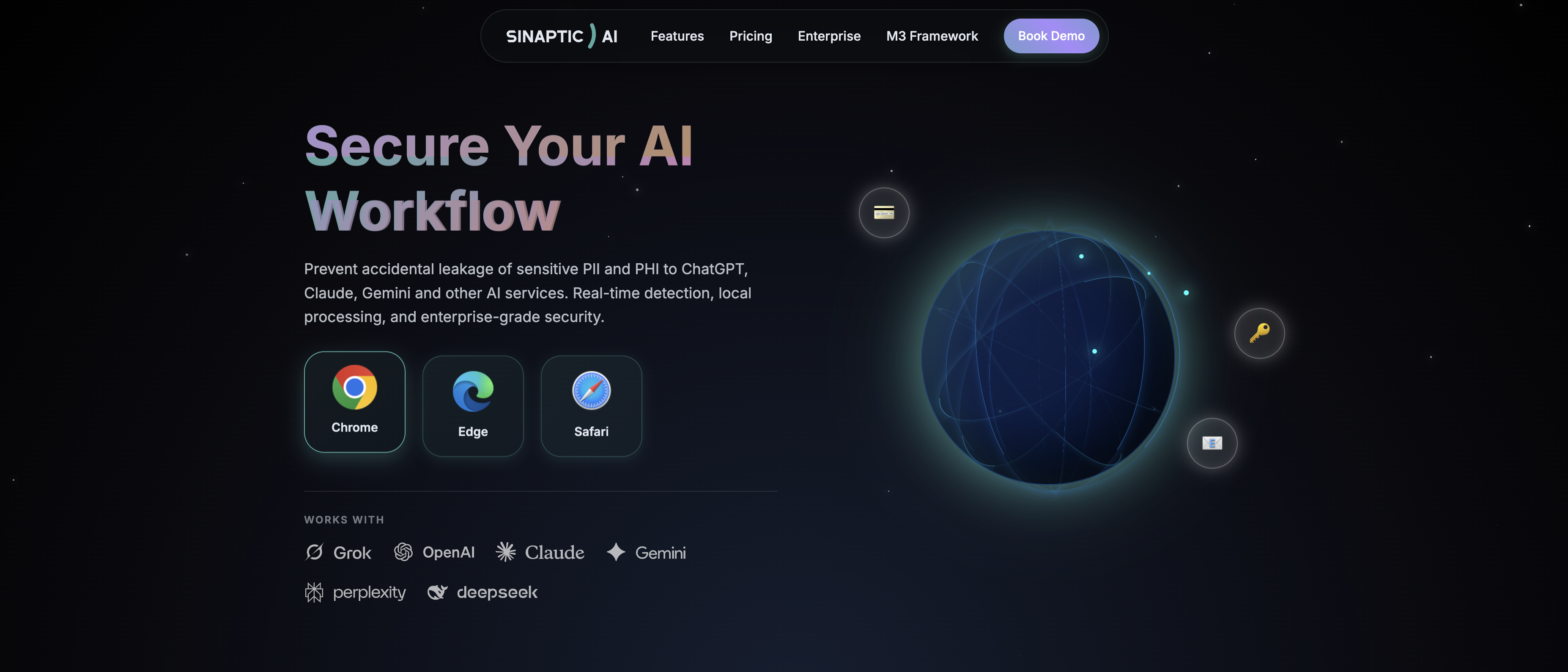
- Prevent accidental data leaks to AI tools by blocking sensitive information like credit cards, emails, and API keys before they leave your browser, using real-time detection that intercepts network requests at the source.
- Eliminate workflow interruptions from false alarms with smart validation that uses the Luhn algorithm and context awareness to distinguish real PII/PHI from random numbers.
- Keep all your data private with local-only processing that ensures sensitive information never leaves your device or gets sent to external servers.
- Learn to identify sensitive data in your own workflows through non-intrusive visual cues and tooltips that highlight PII/PHI directly in text areas as you type.
- Tailor protection to your specific needs by configuring custom exclusion rules for certain URLs or values, giving you full control over what gets monitored or blocked.
- Meet enterprise compliance requirements with M3 Framework compatibility and features like centralized policy management, SIEM integration, and SSO for organization-wide deployment.
Pros & Cons
Pros
- Prevents PII and PHI leakage
- Real-time detection feature
- Network request interception
- Data Transmission Blocking
- Sensitive Data Highlighting
- Local data processing
- Enterprise-grade security
- Regex scanning
- Natural Language Processing
- Minimizes false positives
- Luhn Algorithm for credit cards
- Context-awareness design
- Custom rule configuration
- URL Targeting
- Value Targeting
- Browser compatibility
- Compliance Assurance
- M3 Framework compatibility
- Community and enterprise versions
- Visual cues for education
- Block data transmission at source
- Local device logging
- Data is carefully hashed
- Different user groups compatibility
- Real-time sensitive data detection
- Short-term local log retention
- Advanced logic validation
- Highlights sensitive data in text
- Configurable exclusion rules
- Locally-stored user data
- Privacy-first design
- Compatible with M3 Framework
- User-friendly tooltips
- Promotes user education
- Non-intrusive data indications
- Incident Reporting Dashboard
- Centralized Policy Management
- SIEM Integration (Splunk, Datadog)
- SSO & Directory Sync
- Silent Install (MSI / GPO)
- Flexible control features
- Unique device fingerprinting
- Prevents data exfiltration
- Masked value in logs
- Privacy-preserving features
- Source Code Audit Rights
- Manifest V3 Architecture
Cons
- No Firefox compatibility
- No mobile app
- Local logs only 7-day
- No automatic updates
- No multi-language support
- Potential Regex limitations
- False positives possible
- Needs manual configuration
- No offline working mode
Reviews
Rate this tool
Loading reviews...
❓ Frequently Asked Questions
Sinaptic.AI - Data Protection Extension is a tool created to prevent the unintentional sharing of sensitive Personal Identifiable Information (PII) and Personal Health Information (PHI) to AI tools. The extension offers real-time detection of sensitive information using a blend of regular expressions and Natural Language Processing (NLP). It can identify credit cards, emails, and API keys before they leave the user's browser. Furthermore, it's designed as a privacy-first tool, doing all data processing locally, storing logs on the local device and has a hashed security system for protection.
Sinaptic.AI safeguards workflows by utilizing a dual-engine of regular expressions and Natural Language Processing (NLP) for real-time detection of personally identifiable information (PII) and personal health information (PHI). It intercepts network requests directly from the page context, blocking at-source data transmission of sensitive information and enabling users to retain maximum control. It's smart validation feature reduces the occurrence of false positives using advanced logic techniques.
Sinaptic.AI is capable of recognizing various types of sensitive information including, but not limited to, credit card details, email ids, and API keys.
Sinaptic.AI leverages a hybrid engine of Natural Language Processing (NLP) and regular expressions to detect sensitive data in real time. NLP is used to understand and analyze human language while regular expressions help in pattern matching and identifying specific data types like credit card numbers, email addresses and API keys.
Sinaptic.AI's smart validation features help in reducing false positives by utilizing advanced logic techniques. These techniques include the Luhn algorithm for validating credit card details and context awareness to identify actual PII and PHI as distinct from random numbers.
The Luhn algorithm is used by Sinaptic.AI for validating credit card details. This is a simple checksum formula that's used to validate a variety of identification numbers, but most notably credit card numbers. It reduces false positives by accurately validating whether a series of numbers could constitute a real credit card number.
Sinaptic.AI incorporates visual cues in text areas to highlight sensitive data in real-time, providing an educational experience for users by teaching them to identify sensitive data within their workflows. This aids in creating awareness and allows immediate reaction to any potential data breach.
Yes, Sinaptic.AI can be customized to match specific requirements. It allows for configuration of exclusion rules tied to either certain URLs or specific values. Users have the flexibility to set 'Monitor All' mode or whitelist certain domains according to their needs.
With Sinaptic.AI, users can configure exclusion rules for specific URLs or values. This gives them full control over what data should be considered sensitive and potentially blocked. Users can whitelist specific domains or switch to a 'Monitor All' mode as per their needs.
Sinaptic.AI is designed with a privacy-first approach. All data processing is handled locally on the user's device and no data is ever transmitted to the servers. Incident logs are stored locally on the user's device and are carefully hashed for additional security measures.
Sinaptic.AI processes and stores data locally on the user's device. It adheres to a strict privacy-first protocol, ensuring that no user data ever leaves the machine or is sent to any server.
Sinaptic.AI is highly secure and maintains enterprise-grade safety. It keeps logs on the user's local device and hashes them to ensure data security. Moreover, all the processing is done locally, meaning no data is transferred to external servers, thereby keeping the user's information secure.
Yes, Sinaptic.AI is suitable for enterprise-level compliance teams. It offers functionality such as centralized policy management, SIEM integration, SSO and Directory Sync, silent install, incident reporting dashboard, source code audit rights, and M3 audit assistance, which cater to the complex needs of larger organizations.
Sinaptic.AI is compatible with multiple AI tools such as ChatGPT, Claude, Gemini, and many others. It helps to prevent the leakage of sensitive information to these tools.
Yes, Sinaptic.AI is designed to be compatible with the M3 Framework, facilitating secure AI adoption and providing added assurance and compliance to companies.
Sinaptic.AI prevents PII and PHI leakage to AI tools by scanning and detecting sensitive information such as credit card details, emails, and API keys in real-time, before they leave the user's browser. It incorporates an advanced logic system including algorithms like the Luhn method for validation, and is capable of blocking network requests, thereby stopping the transmission of sensitive data at its source.
Visual cues in Sinaptic.AI assist users by indicating the presence of sensitive data within their text areas, thereby educating them in real-time. Sensitive data is highlighted directly in the text area with non-intrusive wavy underlines and tooltips that provide immediate feedback.
No, Sinaptic.AI does not require user data transmission to servers. It is designed with a privacy-first approach, processing all data locally on the user's device.
Sinaptic.AI hashes logs stored on the local device for security. Hashing is a process that transforms data into a fixed length value, which is nearly impossible to reverse. This ensures that the logs, even if accessed, will not compromise sensitive information.
Sinaptic.AI intercepts network requests straight from the page context. It injects into the page context to detect and block the transmission of sensitive information at the source level, giving full control to the users.
Sinaptic.AI safeguards PII and PHI by providing real-time detection of sensitive information, block transmission of data at the source, and highlighting sensitive data in the text area instantly. It uses a hybrid engine of regular expressions and Natural Language Processing to scan user input as soon as it is typed, directly intercepting network requests from the page context and blocking any sensitive data before it leaves the user's browser.
Sinaptic.AI's hybrid engine of regular expressions and Natural Language Processing can detect and identify sensitive data such as credit card numbers, emails, and API keys before they are transferred from the user's browser.
Sinaptic.AI reduces false positives by employing a smart validation feature that uses advanced logic techniques including the Luhn algorithm, specifically for credit card data, and context awareness. These techniques help differentiate actual PII and PHI from random or unrelated numbers, minimizing chances of unintentionally blocking valuable information.
When Sinaptic.AI mentions 'real-time detection', it's referring to its capability to detect sensitive personal and health information as soon as the user inputs it. This immediate detection leverages a hybrid engine of regular expressions and Natural Language Processing which scans and identifies sensitive data like credit card details, emails, and API keys before they leave the user's browser.
Yes, Sinaptic.AI is equipped to block the transmission of sensitive data at its source. The tool injects into the page context and intercepts network requests, thereby blocking the departure of sensitive data from the user's browser, giving users maximum control.
Sinaptic.AI provides visual cues to users by highlighting sensitive data directly in the text area. This is done with the help of non-intrusive wavy underlines and tooltips, thereby educating users in real-time about the presence and identification of potential PII or PHI within their input.
Sinaptic.AI is highly customizable. It allows users to configure exclusion rules for specific URLs or values. It also caters to different user groups, ranging from developers and freelancers to enterprise-level compliance teams, providing them with the flexibility and control to match their specific operational requirements.
Yes, Sinaptic.AI can be configured to exclude specific URLs or values according to user preferences. This flexibility allows users to set rules for the tool to ignore certain domains or information types based on their unique needs.
No, Sinaptic.AI does not send user data to external servers. It is designed as a privacy-first tool and ensures that all data processing occurs locally on the user's device. The logs of this process are also stored on the local device and are hashed for enhanced security.
Sinaptic.AI implements a range of security measures to protect the user's data. It provides enterprise-grade security, ensuring processing of all data take place locally on the device, without sending it to external servers. It stores logs locally and hashes them for added security. Also, Sinaptic.AI uses unique, privacy-preserving device fingerprinting to track incidents across the fleet without collecting personal data.
Sinaptic.AI is designed to cater to a variety of user groups. This includes developers, freelancers, employees, as well as compliance teams at an enterprise level. It comprehends the different functionality needs of these groups, thereby offering a tailored solution.
Yes, Sinaptic.AI is compatible with the M3 Framework. It has been built with the compliance requirements of the M3 Framework in mind, facilitating secure AI adoption.
The difference between the community version and the enterprise-grade version of Sinaptic.AI lies in functionality and user control. The community version is primarily designed for local protection and offers features such as unlimited PII/PHI scanning, real-time alerts & blocking, custom exclusion rules, and M3 Framework compatibility. The enterprise-grade version, on the other hand, offers centralized control and includes features of the community version, along with centralized policy management, SIEM integration, SSO & Directory Sync, incident reporting dashboard, source code audit rights, and M3 audit assistance.
Sinaptic.AI supports multiple browsers including Chrome, Edge, and Safari. Thus, users can implement this privacy-first tool across several platforms for seamless operation.
Sinaptic.AI is compatible with multiple AI services such as ChatGPT, Claude, Gemini, Grok, OpenAI, Perplexity, and DeepSeek. This enables versatile application of the command across different AI platforms.
Sinaptic.AI incorporates the Luhn algorithm in its operation for credit card number validation. The tool uses it as a part of its smart validation feature to reduce false positives by ensuring the highlighted credit card numbers follow the valid number pattern.
Sinaptic.AI enables secure AI adoption by intercepting and blocking the transmission of sensitive data at the source, thereby preventing accidental leakage to AI tools. It is compatible with the M3 Framework, a standard for secure AI adoption, embodying best practices for data protection and privacy.
Sinaptic.AI is primarily a browser extension. Its design and features focus on operating within a browser context to provide real-time, local data protection, without the need for an external web platform.
Sinaptic.AI embodies a privacy-first approach through its local data processing mechanism. It prevents the transmission of user data to external servers and ensures all data processing and logs are kept on the local device. These logs are also hashed for increased security. Apart from this, it offers visual cues and proactive defense against sensitive data exposure, allowing users to have maximum control over their data within the platform.
Pricing
Pricing model
No Pricing