Overview
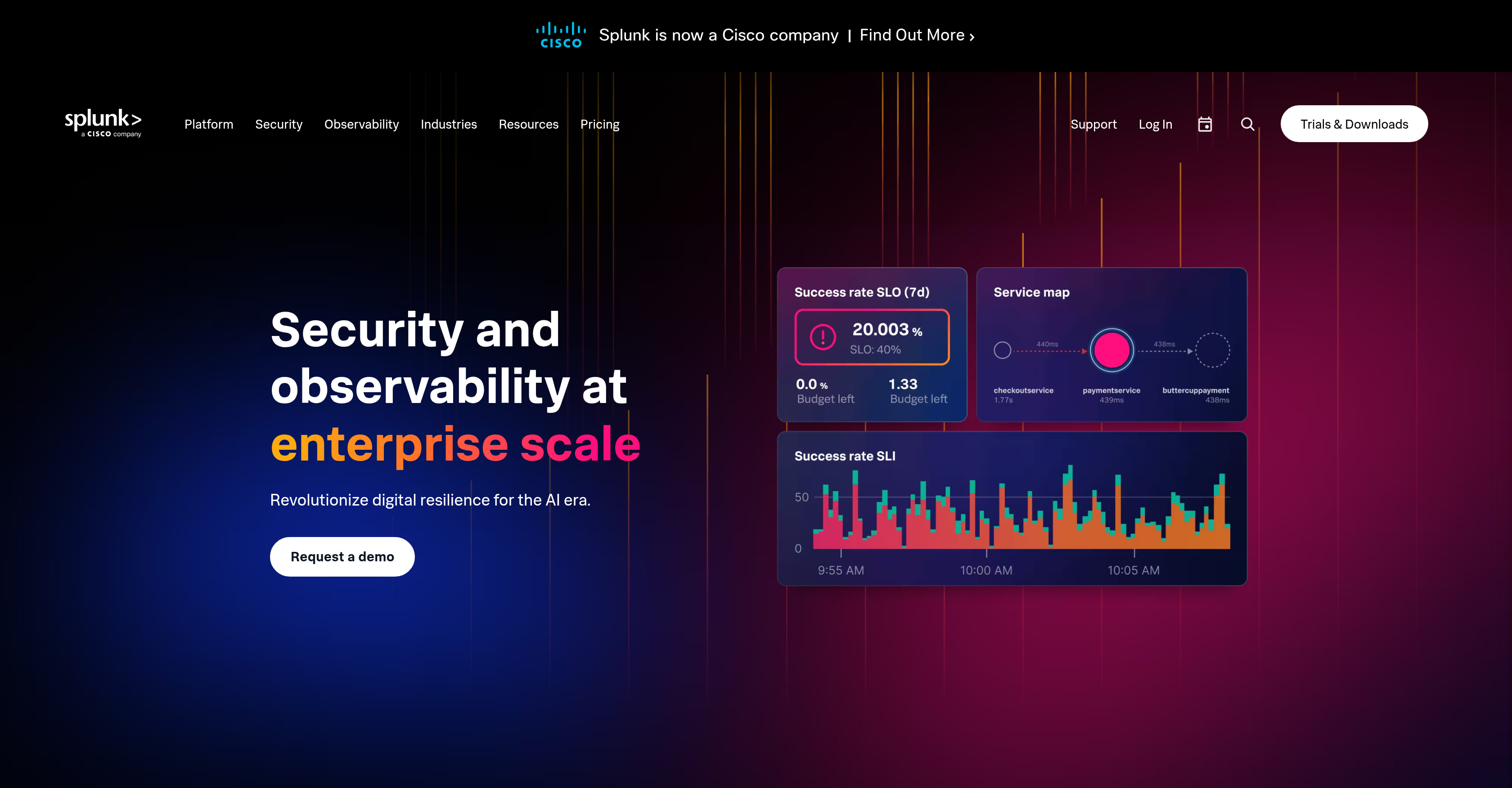
- Accelerate digital transformation and enhance enterprise resilience by unifying security, IT, and business data on a single, flexible cloud platform.
- Detect and respond to threats faster with an integrated AI-powered SecOps platform featuring SIEM, SOAR, and UEBA for automated threat analysis.
- Gain real-time, unified visibility across applications, infrastructure, and microservices to troubleshoot issues and diagnose root causes before users are impacted.
- Modernize IT operations and improve service health using AIOps to automate routine tasks, prioritize alerts, and reduce mean time to resolution (MTTR).
- Control critical data management and storage costs with a scalable cloud data platform designed for enterprise-scale security and observability.
Pros & Cons
Pros
- Flexible data service
- Manages critical data
- Helps control storage costs
- Facilitates IT modernization
- Holistic IT Service Health
- Integrates Threat and Incident Detection
- Offers SIEM system
- Offers SOAR capabilities
- Provides UEBA
- Automated threat analysis
- Asset discovery
- Risk discovery
- Real-time visibility across environments
- Services performance enhancement
- Application optimization
- Alert prioritization
- Faster issue troubleshooting
- Prevents user-impacting issues
- Microservices root cause diagnosis
- Cross-industry application
- Flexible platform
- Maximizes network resilience
- Unified Security and Observability
- Reduction of alert noise
- Automate threat analysis
- Enhance service forensics
- Continuous asset discovery
- Uncover sophisticated threats
- Automate response workflows
- Advanced threat detection capabilities
- Reduces manual tasks
- Streamline security workflows
- Data pipeline governance
- Real-time insights
- Unify TDIR with SecOps
- Uncover deep data insights
- Natural language processing
- Access to 2,000+ Splunk apps and add-ons
- Supports OpenTelemetry
- SDKs and agents support
- Full-stack insight with AppDynamics
- Automates compliance monitoring
- Streamlines audits
- Real-time security visibility
- Massive scale data handling
Cons
- Complex initial setup
- Costly in large scale
- Limited support documentation
- Performance issues with high data volumes
- Difficult customization
- Intensive hardware requirements
- No pre-built data visualization
- Inability to handle unformatted log data
- Slower indexed searches
- Indirect tech support system
Reviews
Rate this tool
Loading reviews...
❓ Frequently Asked Questions
Splunk provides an AI-powered SecOps platform that integrates Threat and Incident Detection and Response (TDIR). It has a variety of capabilities, including a Security Information and Event Management system (SIEM), Security Orchestration, Automation, and Response (SOAR), User and Entity Behavior Analytics (UEBA), automated threat analysis, and asset and risk discovery.
Splunk's Cloud Platform offers a flexible data service, which assists in managing critical data and controlling storage costs. Additionally, it facilitates IT modernization through AI operations and allows for a comprehensive view of IT Service Health.
Splunk aids in IT modernization through its AI operations (AIOps) capabilities embedded in its Cloud Platform. It offers a modern approach to IT operations management, leveraging artificial intelligence for automating routine tasks, improving efficiency, and reducing response times.
Splunk's Observability tools offer real-time visibility across various environments, enhancing service performance with AI operations, and optimizing applications with comprehensive insights. These tools assist in prioritizing alerts, troubleshooting issues faster, preventing user-impacting issues, and diagnosing root causes in microservices.
Splunk assists in managing critical data and controlling storage costs through its Cloud Platform. This flexible data platform is designed to handle critical data, offering a robust solution to streamline data management processes, improve data availability and security, and efficiently control storage costs.
Splunk takes an integrated approach to threat and incident detection and response (TDIR). This involves using an AI-powered SecOps platform that provides capabilities such as Security Orchestration, Automation, and Response (SOAR), User and Entity Behavior Analytics (UEBA), automated threat analysis, and asset and risk discovery to rapidly identity and respond to threats.
Splunk incorporates artificial intelligence in its Security Operations platform, which uses AI-based processes to enhance enterprise security. AI is utilized to automate threat analysis, offering more efficient and accurate risk discovery. Furthermore, Splunk's AI assists in User and Entity Behavior Analytics (UEBA), providing effective anomaly detection and response.
Splunk's tools and capabilities can be used by a wide range of industries to enhance security and observability at an enterprise level. Industries such as Aerospace and Defense, Communications and Media, Energy and Utilities, Financial Services, Healthcare, Higher Education, Manufacturing, Nonprofits, Online Services, Public Sector, Retail, and Technology can benefit from Splunk's diverse services.
Splunk plays a pivotal role in supporting network resilience and optimal AI implementation. By offering a versatile platform and a range of tools that enhance IT service health, modernize IT, and address security threats, Splunk assists organizations in strengthening their network resilience. For AI implementation, Splunk offers a strategic approach that includes AI-powered data analytics, AI-driven security tools, and AI operations (AIOps).
Splunk provides comprehensive insights for application optimization through its Observability tools. These insights facilitate the detection of anomalies and performance bottlenecks in applications, making it easier to optimize application performance. The insights also aid in prioritizing alerts and diagnosing root causes in microservices.
Splunk plays a significant role in digital transformation by enhancing enterprise resilience. Through its AI-powered data analytics and flexible data platform, Splunk facilitates the management of critical data, modernization of IT practices, and accelerated digital transformation initiatives.
Splunk's Security Information and Event Management (SIEM) system is part of its security tools. The SIEM system allows organizations to gain a comprehensive view of their security data and events. It offers real-time analysis of security alerts generated by applications and network hardware, thereby enhancing their ability to quickly identify and respond to threats.
Splunk assists in asset discovery and risk assessment through its AI-powered SecOps platform. By integrating automated threat analysis with asset and risk discovery, Splunk effectively helps organizations to identify security vulnerabilities, understand their risk exposure, and prioritize remedial actions based on risk levels.
In Splunk, User and Entity Behavior Analytics (UEBA) is a key component of the AI-powered SecOps platform. UEBA utilizes machine learning algorithms to understand normal behavior patterns for users and entities within a system, and alerts security teams of abnormal or potentially malicious activities that deviate from these patterns.
The significance of AI operations (AIOps) in Splunk's services lies in its ability to leverage artificial intelligence and machine learning for automating routine tasks and improving efficiency in IT operations. AIOps is a key component of Splunk's Cloud Platform, playing a crucial role in IT modernization efforts.
Splunk aids in troubleshooting issues and diagnosing root causes in microservices through its Observability tools. These tools provide real-time visibility across different environments, allowing for faster issue troubleshooting and root cause analysis. They also help in preventing user-impacting issues.
Splunk enhances service performance using AI through its Observability tools. These tools provide a combination of real-time visibility, AI operations, application optimization, and comprehensive insights to ensure high-level service performance across various environments.
Splunk Observability tools offer real-time visibility across diverse environments. This encompasses a variety of system components including applications, services, infrastructure, and network, presenting a unified view of system performance and operations, and enabling faster detection and resolution of issues.
Splunk is considered key to enterprise resilience due to its robust platform that accelerates digital transformation and mitigates major issues in organizations. By offering AI-powered data analytics, security tools, and observability tools, Splunk helps organizations enhance their resilience and tackle potential challenges more efficiently.
The components of Splunk's AI-powered SecOps platform include a Security Information and Event Management system (SIEM), Security Orchestration, Automation, and Response (SOAR), User and Entity Behavior Analytics (UEBA), automated threat analysis, and asset and risk discovery.
Pricing
Pricing model
Pricing
Paid options from
N/A
Related Videos
SOAR in Seconds - SIEM and SOAR Unified Workloads
Splunk•307 views•Oct 31, 2024