

Overview
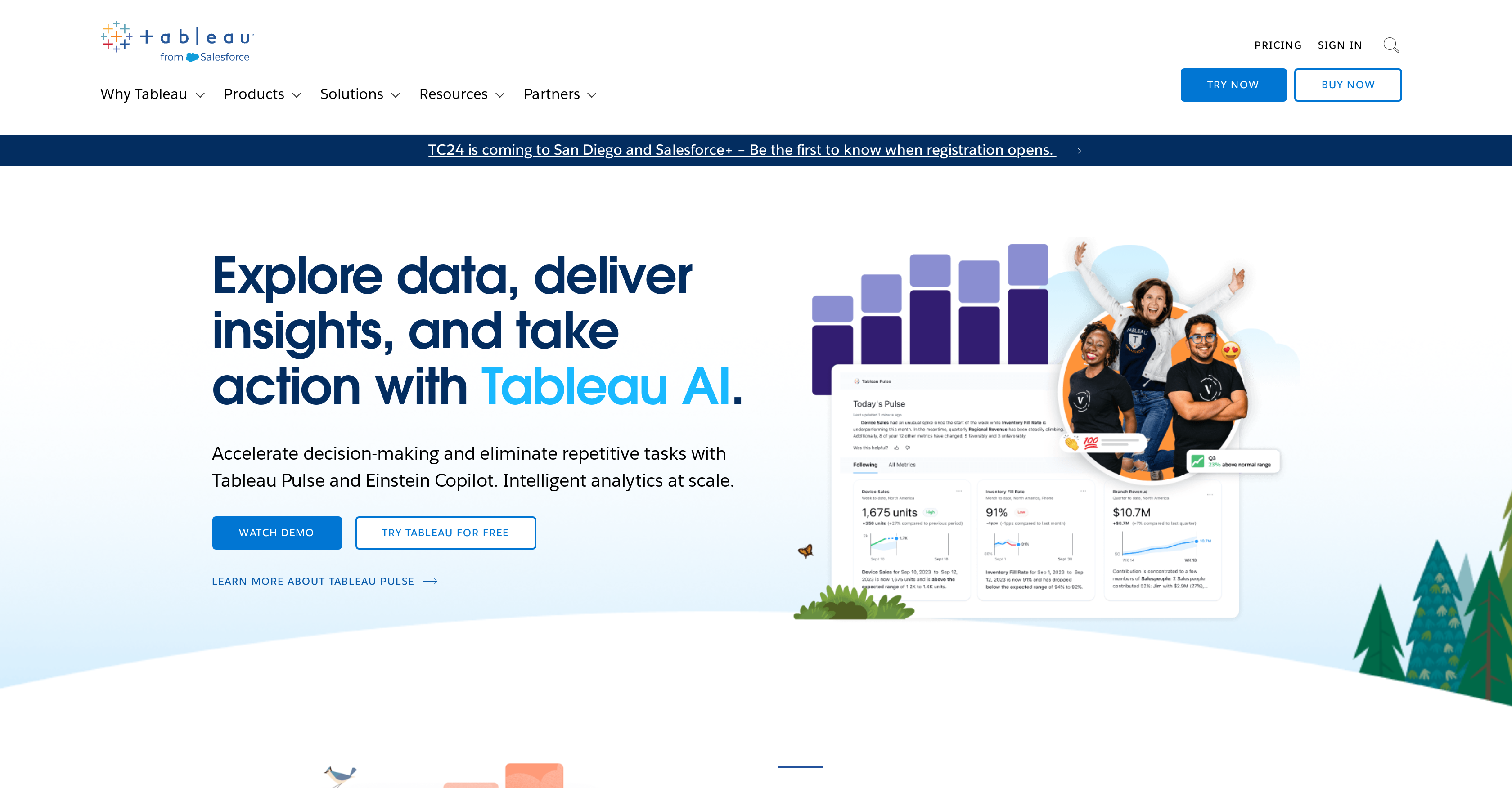
- Create interactive visualizations without coding using an intuitive drag-and-drop interface that simplifies complex data analysis
- Connect to virtually any database or data source with flexible deployment options for cloud, on-premises, or native installation
- Automate repetitive analysis tasks and accelerate decision-making with AI-powered features like Tableau Pulse and Einstein Copilot
- Stay current with evolving data trends through continuous platform updates, training resources, and updated research materials
- Access immediate guidance and inspiration from a global community of over one million data professionals and analysts
- Scale analytics across your entire organization while maintaining data-driven decision making at any company size
Pros & Cons
Pros
- Connect to any database
- Intuitive drag-and-drop interface
- Supports cloud, on-premises, native deployment
- Strong community aspect
- Decision-making tools
- Task automation features
- Continuous development and innovation
- Comprehensive training resources
- Wide applicability, various contexts
- Features Tableau Pulse and Einstein Copilot
- Community with over a million members
- Intelligent analytics at scale
- Business intelligence and Analytics Software
- Offers Database connectivity
- Promotes data-driven decision making
- Access to new features and resources
- Trusted by diverse organizations
- Focused on user understanding of data
- Enables data actionability
- Visual storytelling capabilities
- Embeddable analytics
- Supports CRM analytics
- Data management features
- Offers advanced management tools
- Easy sharing of visualizations
- Supports diverse deployment preferences
- Active customer success community
- Includes educational data literacy resources
- Partner integrations
- Offers Data Management
- Adaptable to industry-specific needs
- Free Training Resources
- Tools for creating a data culture
Cons
- License cost can be high
- Learning curve for beginners
- Limited customization options
- Complexity increases with data
- Can be slow with large datasets
- Limited data cleaning capabilities
- Limited integration capabilities
- Dependent on Salesforce ecosystem
- Premium support costs additional
- Lacks real-time analytics capabilities
Reviews
Rate this tool
Loading reviews...
❓ Frequently Asked Questions
Tableau is used for business intelligence and analytics. It enables users to visualize, understand, and act on the data they have collected. This involves creating visualizations, making data-driven decisions, and engaging with large scale analytics.
Key features of Tableau include the ability to connect to almost any database, an intuitive drag-and-drop interface to create visualizations, options for cloud, on-premises, or native deployment, a strong community platform, advanced AI capabilities like Tableau Pulse and Einstein Copilot, and continuous development and innovation.
Tableau's drag-and-drop interface simplifies the process of creating visualizations by allowing users to easily select and arrange data elements without needing to write code.
Yes, Tableau can connect to almost any database, as per their website, it provides the users with the ability to establish connections with a variety of databases.
Tableau supports deployment on cloud, on-premises, or natively. This flexibility allows for different organizational deployment preferences, catering to diverse needs.
The community aspect in Tableau is significant because it brings together over a million members worldwide, providing a platform for users to connect, learn, and be inspired by like-minded individuals.
Tableau incorporates advanced AI capabilities to accentuate intelligent analytics at scale. This includes tools like Tableau Pulse and Einstein Copilot for expedited decision-making processes and automation of repetitive tasks.
Tableau Pulse and Einstein Copilot are part of Tableau's AI capabilities. They are designed to fast-track decision-making processes and automate repetitive tasks. However, specific details of their functionalities were not provided on their website.
Tableau keeps up with continuous development and innovation through regular introduction of new features and offering of various resources like training, support, and updated research materials. This ensures that users are always updated with data management and analytics trends, techniques, and best practices.
Tableau helps users become more data-driven by providing an analytics platform that enables a deeper understanding of data. This makes it possible for users to make decisions based on data analysis, furthering the adoption of data-driven strategies in their organizations.
Tableau offers various resources for training and support. This includes materials and programmes such as free training videos, courses for building data literacy, Tableau Certification, instructor-led training, Tableau eLearning and other academic programmes.
Tableau assists in large scale analytics by incorporating advanced AI capabilities that make it possible to handle and analyze large datasets. It also enables rapid data visualization, which helps in deriving meaningful insights from large scale data.
Tableau's approach towards data visualization is to provide an intuitive, drag-and-drop interface that simplifies the process of creating visualizations. It aims to help users see and understand their data more effectively.
Tableau is trusted by a wide range of organizations of various sizes and types. While specific names or types of organizations were not listed, the widespread applicability and value of Tableau is evidenced by its wide usage in diverse contexts.
Units included in Tableau's analytics platform weren't specified on their website.
Yes, Tableau is a part of Salesforce. Specific details on how it is integrated or aligned with Salesforce's offerings were not provided on their website. However, being part of Salesforce, an international leader in CRM, likely augments Tableau's functionality and reach.
Tableau supports three types of deployment - on the cloud, on-premises, or natively. This caters to a wide range of organizational deployment preferences depending on a variety of factors such as security, accessibility and the nature of the organization itself.
Yes, Tableau can be used for automating repetitive tasks. This is made possible by the AI capabilities integrated into Tableau, particularly through features like Tableau Pulse and Einstein Copilot.
Users can stay at the forefront of data management with Tableau through its continuous development and innovation measures. Tableau regularly introduces new features and offers various resources like training, support, and updated research materials, ensuring users are always updated with the latest in data management and analytics trends, techniques, and best practices.
Tableau ensures updated research materials are available for users in the form of resources present on their website. These include training modules, programmes, updated research materials, and other academic programmes to enhance users' understanding and efficient usage of Tableau.
Pricing
Pricing model
Paid
Paid options from
$35/month
Billing frequency
Monthly
Related Videos
Learn Tableau in Under 2 hours | Dashboards, Relationships, Visualizations + Mini Project
Alex The Analyst•244.9K views•Nov 5, 2024