

Overview
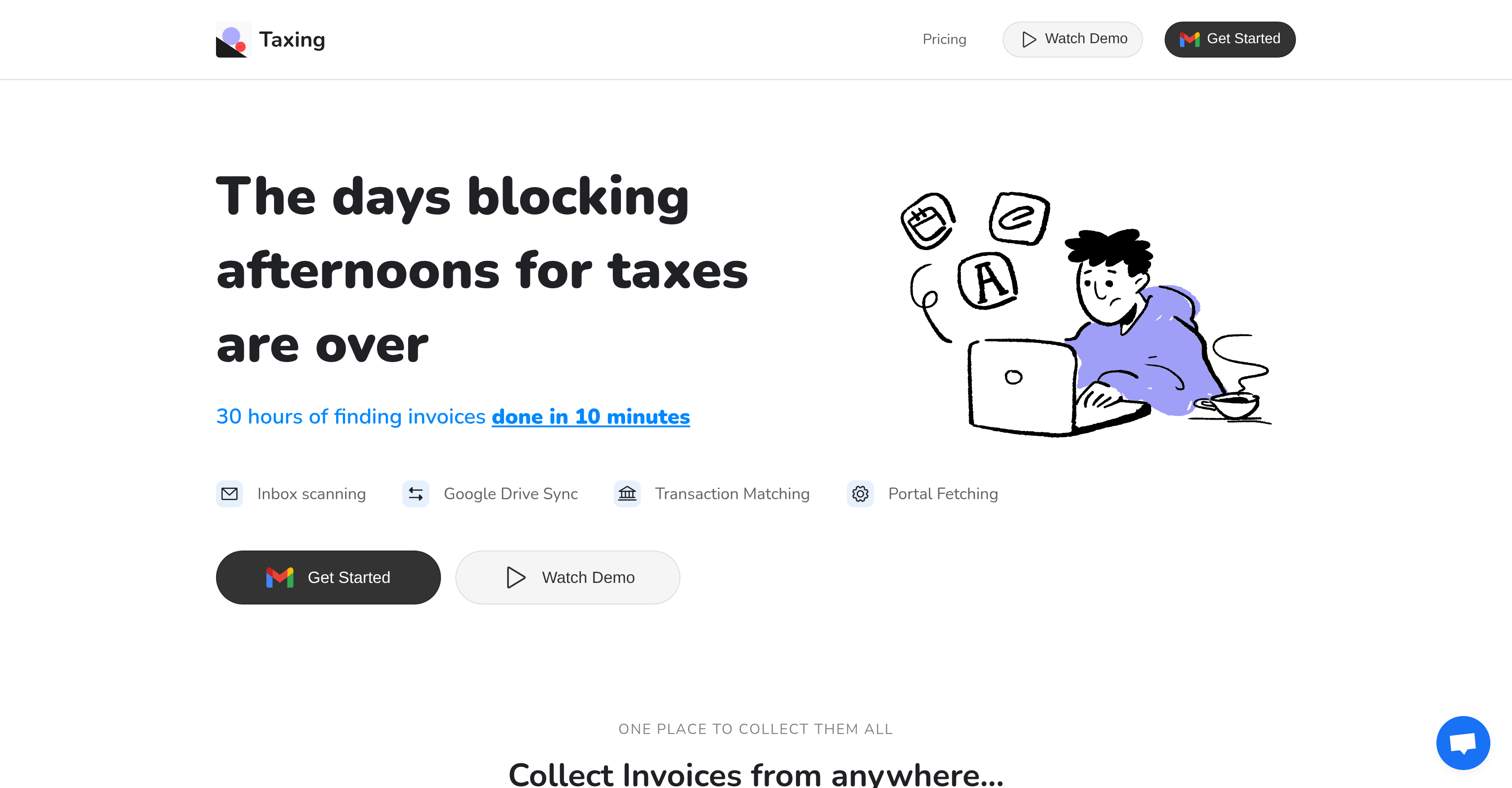
- Complete your tax preparation in 10 minutes instead of 30+ hours with automated invoice scanning from Gmail and online portals
- Eliminate manual data entry errors and ensure financial accuracy through AI-powered extraction and interpretation of invoice data
- Automatically categorize expenses and allocate them to correct accounts with intelligent transaction classification
- Stay compliant with evolving tax regulations across jurisdictions through adaptive AI that learns from tax law changes
- Reconcile company books effortlessly by automatically matching bank transactions to find missing invoices
- Gain valuable business intelligence about spending patterns and revenue cycles from automated invoice analytics
- Integrate seamlessly with existing financial systems including Google Drive and upcoming accounting software connectors
Pros & Cons
Pros
- Pay-as-you-go pricing. No subscription needed.
- Cheapest provider (by far) to whats on the market
- Portals connections can be extended by yourself with a chat-based recipe-editor to automate agent flows
- Auto-Matches Bank Transactions
- Supports multiple bank accounts and email inboxes at no extra charge
- Export of all invoices & matched transactions to Google Drive and Sheets
- Privacy focused. Most emails never touched, much processing happens client side
- Supports all currencies
Cons
- Is in Beta (as of Nov 2025)
- Does not support other email providers than Gmail (right now)
- Portal scanning is very early stage and needs more portals (can be added by yourself though)
- No mobile app
- Only export to CSV, no accounting tools (yet)
Reviews
Rate this tool
Loading reviews...
❓ Frequently Asked Questions
Taxing is an AI-driven tool that is designed to streamline and automate invoice processing tasks. It helps businesses efficiently handle incoming invoices, reducing the need for manual input. A key feature includes the ability to readily adapt to evolving tax regulations, helping businesses navigate tax compliance across multiple jurisdictions.
Taxing uses AI to automate a broad spectrum of invoice processing tasks. It's capable of extracting, interpreting, and sorting invoice data, and it also performs attribute mapping and expense account allocations. This automatic processing lowers the requirement for manual intervention, thus enhancing efficiency.
Yes, Taxing does reduce the prospect of errors in invoice processing. By automating the extraction, interpretation, allocation, and sorting of invoice data, manual intervention is kept to a minimum, thereby reducing the chance for human error.
A unique feature of Taxing is its ability to learn and improve its performance over time, adapting to the specific demands of business finance departments. This adaptive learning capability enables the software to provide increasingly efficient and effective invoice processing, based on historical and evolving data patterns.
Taxing readily adapts to changing tax regulations. The tool is designed to keep up with evolving tax laws, saving businesses from the burden of researching, understanding, and adhering to complexities in tax compliance across different jurisdictions.
Certainly, Taxing can assist with tax compliance issues. It's constructed to adapt to changing tax norms, effectively taking over the task of navigating these complex issues and reducing the burden on businesses.
Taxing automatically extracts the information embedded within invoices. The AI processing capacities allows the software to interpret and sort the invoice data, handling multiple formats and structures, thereby making data extraction more efficient and accurate.
In finance management, Taxing is used to automate and streamline the handling of invoices. By extracting, interpreting, and stratifying invoice data, Taxing optimizes the payment process, reduces the chances of human error and, in turn, enhances the overall effectiveness of finance departments.
Taxing enhances bookkeeping tasks by allocating invoice data to the correct expense accounts, significantly decreasing the need for manual data recording. With its automated data extraction and interpretation, bookkeepers can spend less time managing invoice data and more time focusing on strategic activities.
Yes, Taxing can improve business efficiency by automating the manual, often complex, tasks of invoice processing. Consequently, allowing businesses to allocate these saved resources to other critical areas.
Yes, Taxing can automatically track and allocate expenses to the correct accounts based on the interpreted invoice data. The allocation process is automated, which eliminates manual error and streamlines accounting processes.
Yes, Taxing provides valuable insights and analytics that can be leveraged to enhance invoice management and bookkeeping. The insights can help businesses understand and control their expenditure, revenue cycles, invoicing patterns, and more.
Yes, Taxing's performance improves over time. It learns from past data and adapts to deliver improved results, making it increasingly effective at processing invoices and managing taxation issues.
Yes, Taxing adapts to the specific needs of a business. Its learning and adaptive capabilities allow it to conform to the particular demands of a business's finance department, thereby streamlining its performance and results.
Taxing ensures accuracy in all transactions by leveraging AI to handle all invoice processing tasks, thereby minimizing chances of human error. It allocates data to the correct expense accounts and interprets invoice data automatically, ensuring every transaction is accurately captured and processed.
Taxing - AI Invoice Automation is an advanced tool powered by artificial intelligence that is designed to simplify and automate invoice processing and tax preparation tasks to optimize business efficiency.
Taxing streamlines invoice processing by leveraging artificial intelligence capabilities to handle incoming invoices efficiently, thereby reducing manual entries and errors. It does so by extracting, interpreting, and sorting invoice data automatically and allocating it to the correct expense accounts for seamless invoice management.
Artificial Intelligence plays a pivotal role in Taxing by automating invoice processing, classifying expenses, matching transactions and synchronizing data. It removes the need for manual intervention, enhances accuracy, and efficiency in tax compliance and invoice management.
Yes, Taxing is capable of automatically extracting, interpreting, and sorting invoice data, eliminating the need for manual intervention and thereby streamline the process of invoice management.
Absolutely, Taxing offers attribute mapping and helps in allocating information to the correct expense accounts. This attribute mapping and expense account allocation capability significantly enhances bookkeeping accuracy and efficiency.
Taxing utilizes AI capabilities to extract and interpret invoice data, which it then processes to generate valuable business analytics and insights. These insights can be utilized to improve invoice management, bookkeeping, and overall business performance.
Taxing uses machine learning algorithms to learn from data patterns and improve its performance over time. This allows it to adapt to the specific needs of a business' finance department, improving its functionality and value with each use.
Yes, Taxing is designed to be program-agnostic and user-friendly, allowing it to easily integrate with existing finance department systems and processes.
Yes, Taxing is built to automate tax preparation - it can find invoices in emails and online portals, synchronize them to Google Drive, auto-classify expenses, and match transactions, condensing over 30+ hours of work into just 10 minutes.
Taxing uses artificial intelligence to find invoices within emails and online portals. This automated search capability ensures a thorough and efficient process, without manual effort.
Taxing has an automatic synchronization feature that copies invoices found within emails and online portals to Google Drive. This assists businesses in achieving a more efficient and centralized storage for their invoices.
Yes, Taxing offers an auto-classification feature for business expenses. This automates the otherwise tedious task of categorizing expenses manually and increases the efficiency of expense management.
Yes, Taxing is designed to assist in transaction matching. This is extremely beneficial in reconciling company books and financial statements by accurately aligning records.
Taxing automates several tasks including invoice handling, expense classification, transaction matching, and data synchronization. This automation decreases the chances of human error, optimizes the entire invoice and tax preparation process, thus saving significant time and resources.
Taxing is designed to be user-friendly, as such, it's easy to navigate and understand making it very accessible for users regardless of technical knowledge or experience.
Yes, the design of Taxing allows it to be seamlessly integrated into existing financial ecosystems with ease, adding value to businesses by optimizing their financial workflows.
Yes, Taxing is capable of automating the entire financial workflow from finding invoices in emails and online portals to achieving tax compliance. This simplifies complex financial tasks, saving businesses significant time and resources.
Through its transaction matching capability, Taxing can align records accurately, thereby playing a crucial role in reconciling company books and financial statements in a notably time-efficient manner.
Taxing is program-agnostic, implying that it won't encounter compatibility issues with various systems or programs. It is adaptable and flexible, allowing it to integrate into existing business processes and systems irrespective of their software configuration.
Pricing
Pricing model
Freemium
Paid options from
$50
Billing frequency
One-time