

Thrive Financial
Overview
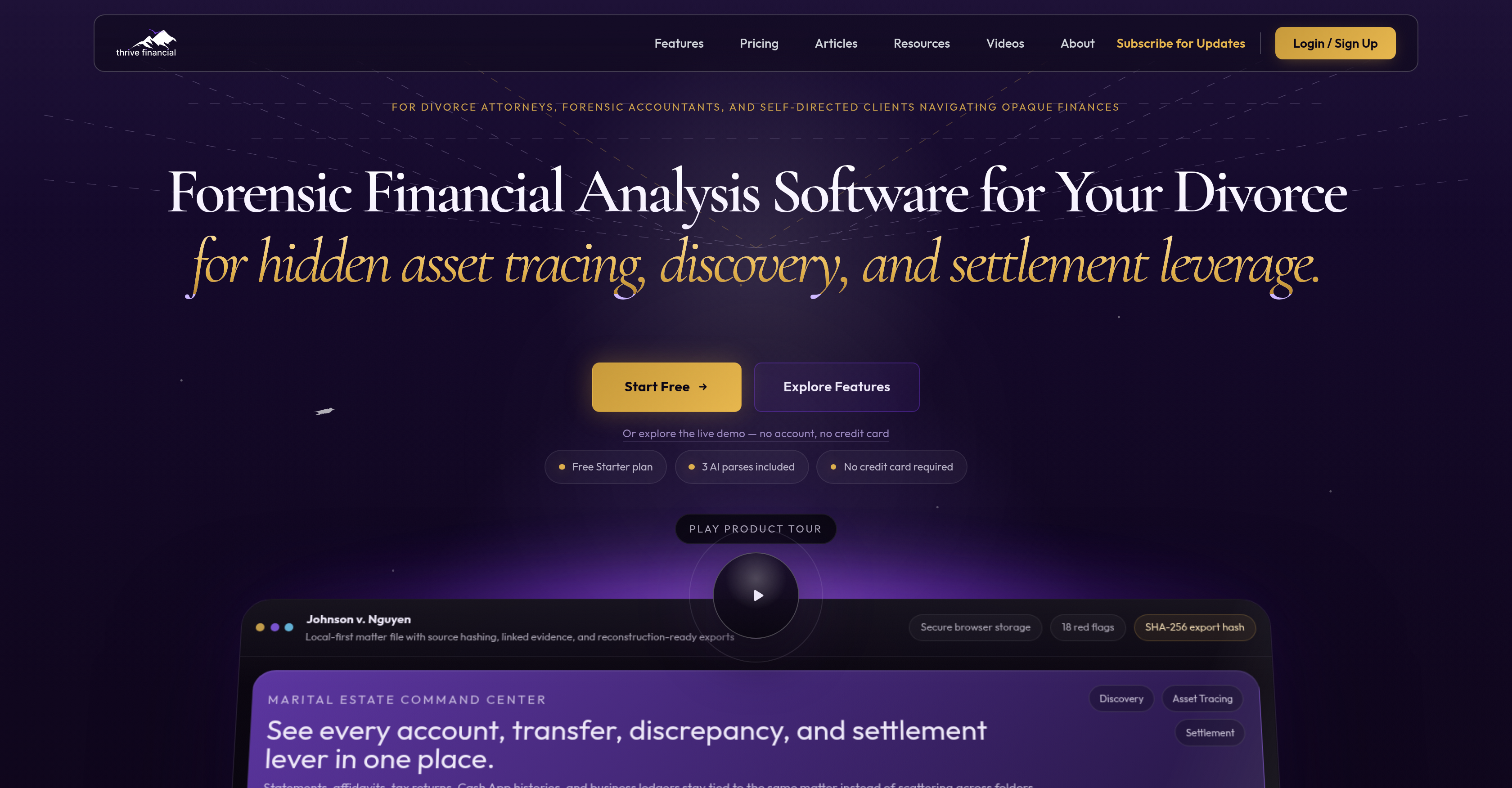
- Surface hidden accounts and undisclosed income by comparing declared versus observed income across bank deposits, peer-to-peer inflows, and tax filings using AI-driven discrepancy detection.
- Convert missing evidence into negotiation leverage by tracking production gaps, parsed deficiency notices, and settlement outcomes in one consolidated view during discovery management.
- Model fair settlements with precision by using the same asset and debt inventory to test equalization, support assumptions, and review agreement fairness against state and federal law.
- Maintain complete control over sensitive case data with locally stored files that never leave your device until you choose to export, analyzed with SHA-256 integrity hashes for a tamper-evident audit trail.
- Export court-ready evidence directly from the platform as source-linked exhibits, PDFs, and tamper-evident case files that retain metadata, timestamps, and original documentation for admissibility.
- Eliminate scattered financial information by consolidating all accounts, transfers, discrepancies, and settlement data into a single Marital Estate Command Center linked to statements, affidavits, and business ledgers.
- Identify lifestyle analysis gaps and suspicious transfers through native forensic analysis that scrutinizes transactions against declared incomes to flag unexplained expenses and potential dissipation.
Pros & Cons
Pros
- Advanced financial analysis
- Document parsing capabilities
- Assets tracing function
- Discovery management feature
- Settlement planning tool
- Court-ready evidence exporting
- Consolidated financial data view
- Income inconsistency tracking
- Conversion of missing evidence
- Negotiation leverage generation
- Forensic analysis capabilities
- Data remains locally stored
- Strong data provenance retention
- Tracks hidden/undisclosed income
- Suspicious transactions investigating
- Statements, tax returns parsing
- Secure audit trail creation
- No hosted case-data database
- Observes discrepancies in income
- Traces money transfers
- Outgoing, incoming requests tracking
- Production status management
- Supports assumptions modelling
- Review fairness feature
- Private data control
- Supports forensic accountants
- Local data storage
- Asset and debt inventory
- Assists in settlement modelling
- Review fairness of uploads
- SHA-256 integrity hash
- Self-dissipation identifying
- Hidden assets tracing
- Metadata, timestamp retention
- Local-first design approach
- Strong E-E-A-T, trust signals
- Tamper-evident exports
- Hash storing for provenance
- Downloadable source files
- Original file downloads with certificates
- Key case actions documenting
- User controlled data export
- Intuitive user interface
- Novice, advanced workflow support
- Discovery tracking feature
- Litigation preparation features
- For attorneys, accountants, individuals
- Forensic-level financial analysis
- Automated reporting capabilities
Cons
- No hosted database
- Local data storage
- Relies on user exports
- Limited parsing capabilities
- No real-time syncing
- Focused only on divorce
- No team collaboration feature
- No integrations mentioned
- Dependent on user device
- Doesn't provide legal advice
Reviews
Rate this tool
Loading reviews...
❓ Frequently Asked Questions
Thrive Financial assists in divorce financial analysis by using its AI technology to parse documents, trace assets, manage discovery, plan settlements, track undisclosed assets and incomes, and export court-ready evidence. The software allows users to observe discrepancies in declared income versus observed
The main features of Thrive Financial include document parsing, asset tracing, discovery management, settlement planning, and export of court-ready evidence. It also includes a 'Marital Estate Command Center' which consolidates all account, transfers, discrepancies, and settlement information, and links statements, affidavits, tax returns, and business ledgers.
The 'Marital Estate Command Center' in Thrive Financial works by consolidating all accounts, transfers, discrepancies, and settlement information in one place. This includes linking statements, affidavits, tax returns, and business ledgers, thereby eliminating scattered information and making it easier to manage and understand the financial situation at hand.
Thrive Financial aids in asset tracing by using its advanced AI algorithms to track potentially hidden or undisclosed assets. The software examines discrepancies in declared income versus observed income, which can help surface hidden accounts or undisclosed income. It also keeps track of suspicious transfer activity and facilitates the investigation of these situations.
The Discovery and Settlement features in Thrive Financial are designed to convert missing evidence into negotiation leverage. These functionalities keep all production gaps, parsed deficiency notices, and modelled settlement outcomes in one consolidated view, making it easier to navigate and negotiate settlements in divorce financial proceedings.
Thrive Financial maintains data privacy by allowing all data to remain locally on the user's device until chosen to be exported, analyzed, or shared. The software does not maintain a hosted case-data database which adds another level of privacy protection to the users.
Thrive Financial surfaces hidden accounts or undisclosed income by analyzing any discrepancies in declared income versus observed income. The software uses AI to track these discrepancies, which can indicate the existence of hidden accounts or additional, undisclosed sources of income.
Thrive Financial can detect various financial discrepancies such as those between declared and observed income, discrepancies in bank deposits and person-to-person inflows, and between observed and declared incomes. Its AI algorithms are designed to surface these inconsistencies and provide relevant evidence for forensic financial analysis.
Thrive Financial's forensic analysis capabilities function by facilitating the investigation of suspicious transfers and lifestyle analysis gaps. The built-in AI algorithms aid in tracking potentially hidden or undisclosed assets, detecting financial discrepancies, and identifying lifestyle expenses which don't correlate with declared incomes or assets.
Thrive Financial creates a record of data provenance by retaining the source files used in its analysis. The origin and movement of these files are tracked to create a strong evidence chain, ensuring that the resulting analysis and conclusions are reliable and can withstand scrutiny.
Thrive Financial offers functionalities for settlement planning including asset and debt inventory modeling, support assumptions, AI proposal drafts, and fairness reviews of uploaded agreements. The discovery and settlement features convert missing evidence to negotiation leverage, keeping all production gaps, parsed deficiency notices, and modelled settlement outcomes in one consolidated view.
Thrive Financial's document parsing works by normalizing bank and credit card statements, financial affidavits, tax returns, Cash App histories, and business financials with owner metadata, coverage review, and export-ready structure. The AI is designed to understand and analyze these documents in the context of forensic financial analysis.
Thrive Financial can indeed aid in negotiation leverage. Its Discovery and Settlement features enable users to convert missing evidence into negotiation leverage. This involves keeping all production gaps, parsed deficiency notices, and modelled settlement outcomes in one consolidated, accessible view.
The target users of Thrive Financial are attorneys, forensic accountants, and individuals undergoing a divorce. The software offers advanced features and functionalities that cater to the specific needs of these users in terms of financial analysis for divorce cases.
Thrive Financial helps in the management of marital estate by consolidating all account, transfers, discrepancies, and settlement information in a single, easy-to-navigate command center. It links statements, affidavits, tax returns, and business ledgers, thereby providing a complete and holistic picture of the marital estate.
Thrive Financial aids in the discovery management process by keeping track of outgoing requests, incoming requests, missing items, parsed 201(k) notices, and production status. The evidence workflow stays connected to the financial record, facilitating a smooth and organized process.
Thrive Financial assists attorneys in legal cases by providing a comprehensive platform for financial analysis and evidence organization. It generates court-ready discovery responses, asset tracing reports, and settlement proposals. It also allows for effective tracking of hidden assets and evidence in one searchable record.
Thrive Financial is useful in forensic accounting by offering AI-assisted document parsing, pattern recognition, lifestyle analysis review, and automated reporting. This is useful for tracking potentially hidden or undisclosed assets, detecting financial discrepancies, and identifying lifestyle expenses that do not correlate with declared incomes or assets.
Lifestyle analysis gaps are discrepancies between the transaction activities and the declared lifestyle expense. Thrive Financial identifies these gaps through its native forensic analysis capabilities that scrutinize transactions and detect inconsistencies related to lifestyle expenses as compared to the declared income or assets.
Thrive Financial stores user data locally on the user's device. This data remains in local storage in the browser until the user chooses to export, analyze, or share it. This design supports stronger E-E-A-T and trust signals around sensitive financial records.
Thrive Financial is an advanced AI-assisted software engineered for attorneys, forensic accountants, and individuals involved in divorce proceedings. This software serves as a tool for financial analysis and tracking potentially undisclosed or hidden assets. It provides functionalities such as document parsing, asset tracing, discovery management, settlement planning, and the export of court-ready evidence.
Thrive Financial employs artificial intelligence to parse various financial documents including bank and credit card statements, tax returns, cash app histories, and business financials. It automatically recognizes patterns, conducts lifestyle analysis reviews, and generates automated reports. Its AI features also facilitate the tracing of hidden assets and suspicious financial transactions.
Thrive Financial is capable of parsing a range of financial documents. These include bank and credit card statements, tax returns, cash app histories, business ledgers, and financial affidavits.
Yes, Thrive Financial can indeed trace hidden assets. It has a robust feature that allows the software to analyze parsed statements, tax returns, business records, cash app activity, and other prior reports to identify hidden assets and suspicious transfers.
The 'Marital Estate Command Center' of Thrive Financial is designed to provide a consolidated view of all account, transfer, discrepancy, and settlement information. It ties together statements, affidavits, tax returns, cash app histories, and business ledgers, eliminating the risk of information scatter across multiple sources.
Thrive Financial offers a unique feature allowing users to observe discrepancies between declared and observed income. This is done by comparing deposits, peer-to-peer inflows, business benefits, and disclosed filings on the same timeline, which can highlight potential gaps and discrepancies.
Yes, Thrive Financial's unique feature of declaring versus observing income can indeed assist in revealing potentially hidden or undisclosed income. This is achieved by comparing the declared income with the observed income, shedding light on any potential hidden accounts.
Thrive Financial's Discovery and Settlement features work by turning missing evidence into negotiation leverage. All production gaps, parsed deficiency notices, and modelled settlement outcomes are maintained in one consolidated view, making the negotiation process more manageable and efficient.
Users can export data from Thrive Financial by creating a tamper-evident '.thrive' case file, exporting PDFs and exhibits, or downloading original source files with certificates. This provides a clean audit trail for court proceedings or other requirements.
Yes, all case data in Thrive Financial is stored locally on the user’s device. It does not maintain a hosted case-data database, thereby giving users exclusive control of their data until chosen to be exported or shared.
Yes, data security is a prime focus of Thrive Financial. They do not maintain a hosted database for case data. User data remains local, and only leaves the user's device upon their choice for analysis, exportation, or sharing. They also use SHA-256 integrity hash for data, ensuring a secure audit trail.
Thrive Financial maintains data integrity by storing metadata, timestamps, and using SHA-256 integrity hashes on all data. This ensures a secure audit trail and verifies the data's authenticity and integrity at each stage of processing.
Thrive Financial's native forensic analysis capabilities offer in-depth investigation into suspicious transfers. By parsing statements, tax returns, cash app histories, business financials, and other data sources, it can track and trace suspicious transactions while flagging potential discrepancies for further investigation.
Yes, Thrive Financial prioritizes data privacy. All case data remains on the user's device and leaves the device only when the user chooses to export, analyze, or share it. Thrive Financial also doesn't keep a hosted case-data database, signaling its commitment to data privacy.
The main features of Thrive Financial's forensic analysis capabilities include document parsing, asset tracing, and settlement modeling. The software excels at investigating suspicious transactions by recognizing patterns in data and examining lifestyle analysis gaps. It also offers users a way to parse statements, trace money transfers, and export court-ready evidence.
Thrive Financial aids in settlement planning by using the same asset and debt inventory to model equalization, support assumptions, and review the fairness of uploaded agreements. This allows users to pressure-test their settlement options within the same case file.
Thrive Financial aims to serve professionals like attorneys and forensic accountants, as well as self-reliant clients undergoing divorce proceedings involving complex financial matters.
Yes, Thrive Financial is designed to provide litigation support in divorce cases. It assists in generating court-ready discovery responses, asset tracing reports, and settlement proposals, as well as tracking production gaps and compiling source-linked evidence in searchable records.
The Thrive Financial's parser normalizes bank and credit card statements, tax returns, cash app histories, and business financials with owner metadata, coverage review, and an export-ready structure. The parser, discovery manager, asset tracer, and settlement tools reuse case data to ensure anomalies and missing proof stay connected.
Thrive Financial's process starts with loading financial records into the system, followed by case building where the parser, dashboard, and discovery manager review the documents. After the review, the system helps trace hidden assets, manage discovery, and test settlement options inside the same matter file. The final step is exporting the proof, which is a set of source-linked exhibits and narratives in a PDF that's ready for court.
Pricing
Pricing model
Freemium
Paid options from
$29/month
Billing frequency
Monthly
Related Videos
Thrive Financial Dashboards Explained | Forensic Divorce Financial Analysis & Hidden Asset Tracing
Thrive Financial•24 views•May 7, 2026