

tny.dev
Overview
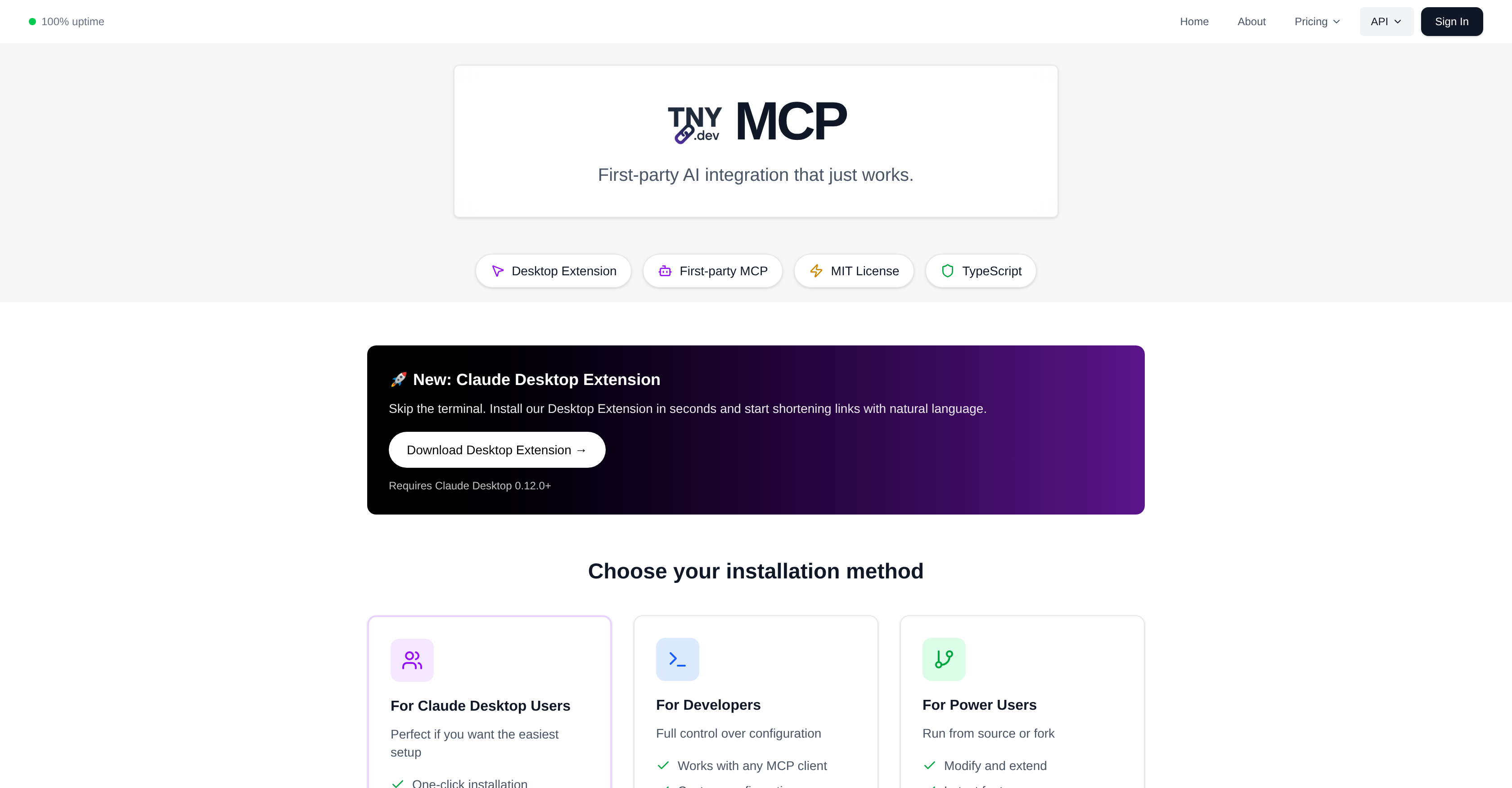
- Shorten URLs instantly without leaving your AI workflow using natural language commands through Claude and Cursor MCP integration
- Track link performance in real-time with built-in click analytics that appear directly within your AI conversation
- Maintain brand consistency across all shortened links using custom domains and personalized slugs
- Process hundreds of URLs simultaneously for documentation and resource lists with bulk operations
- Deploy globally with sub-50ms redirect speeds using edge infrastructure designed for millions of links
- Install in seconds with one-click setup or gain full configuration control through the npm package for developers
Pros & Cons
Pros
- First-party MCP server
- Integration with Claude, Cursor
- One-click installation option
- npm package availability
- Link shortening using natural language
- Supports custom domains
- Provides real-time click data
- Provides insights
- Useful in content creation
- Relevant for social media
- Helpful in newsletters, blogs
- Useful for analytics reporting
- Handles bulk operations
- Allows multiple URLs processing
- Option for custom slug
- Option for Domain ID usage
- Open-source foundation
- Trusted infrastructure
- 500 links/hour for $9/month
- Includes advanced analytics
- Includes powerful API
- MIT License
- Desktop extension available
- Choice of installation methods
- Shows link analytics for campaigns
- Supports modification and extension
- Lists all shortened links
- Provides version control
- TypeScript for type safety
- Enterprise-grade reliability
- Developer-friendly
- Allows running from source
- Create account for API key
- Globally installable npm package
- Customizable with optional environment variables
- Compatible with any MCP client
- Supports link collections organization
Cons
- Limited to MCP clients
- Relies on natural language
- API key required
- Non-obvious advanced configuration
- Costly for high usage
- Custom configuration needed
- Limited custom domain options
- Sparse documentation
- No support for other languages
Reviews
Rate this tool
Loading reviews...
❓ Frequently Asked Questions
tny.dev is an API-first link shortener specifically designed for AI agents.
tny.dev works by shortening links via natural language commands. These commands, processed by the AI agents, are executed through the tny.dev API, making it an API-first link shortener.
AI agents like Claude and Cursor integrate with tny.dev as it acts as a first-party MCP server for them. They send natural language commands to shorten URLs, and tny.dev executes these requests.
First-party MCP server means that tny.dev is a server that is primarily designed and controlled by the same organisation that it serves. Thus, it's able to smoothly integrate with numerous AI assistants like Claude and Cursor, making commands and requests efficient.
tny.dev offers three installation options: a one-click installation for casual users, an npm package for developers seeking full configurability, and the option to run from source or fork for power users.
The one-click installation feature of tny.dev is a simplicity-oriented feature that offers the easiest setup. With this, there is no need for terminal usage and it includes auto updates as well.
Yes, by choosing the npm package for tny.dev, developers gain full control over configuration, making it a suitable choice for those who need precise customization.
Users can employ natural language commands in tny.dev by simply asking their AI assistant, like Claude or Cursor, to shorten a particular URL.
Indeed, tny.dev does support custom domains. It gives users the option to input a domain ID for custom domain usage.
tny.dev provides real-time click data and insights for your links. This offers users a means to gather analytical data without leaving their AI conversation.
In content creation, AI agents use tny.dev to automatically shorten URLs directly in social media posts, newsletters, and blog content.
Absolutely, tny.dev can provide you with real-time analytics reporting for all your shortened links.
Yes, tny.dev can process multiple URLs simultaneously. It's a feature that's particularly useful in cases of bulk operations for documentation, resource lists, or link collections.
In tny.dev, custom slug and domain ID usage options are available. Users can have an optional custom slug of 3-50 alphanumeric characters, hyphens, or underscores. Meanwhile, domain ID usage is optional for custom domain implementation.
tny.dev is built upon an open-source, reliable infrastructure and is well established to handle the shortening of links on a large scale.
Given its infrastructure and trusted standing in the AI agents' community, you can indeed depend on tny.dev for shortening millions of links.
tny.dev has various use cases including content creation, where it automatically shortens URLs for social media posts, newsletters, blog content, amongst others. It's also used for analytics reporting as well as bulk operations for processing multiple URLs at once.
Absolutely, tny.dev is both open-source and reliable. It's built on a robust foundation, and is trusted for shortening millions of links.
Integration of tny.dev with Claude Desktop can be achieved through the Desktop Extension feature. Users simply download the extension, install it on Claude Desktop, and configure it with their API key.
The npm package for tny.dev can be used for advanced configurations by installing it via npm, configuring the MCP client, and optionally adding environment variables for custom domains.
Pricing
Pricing model
Freemium
Paid options from
$9/month
Billing frequency
Monthly
Related Videos
The API first link shortener built for AI Agents | tny.dev
SpecStory•127 views•Jul 20, 2025