
Overview
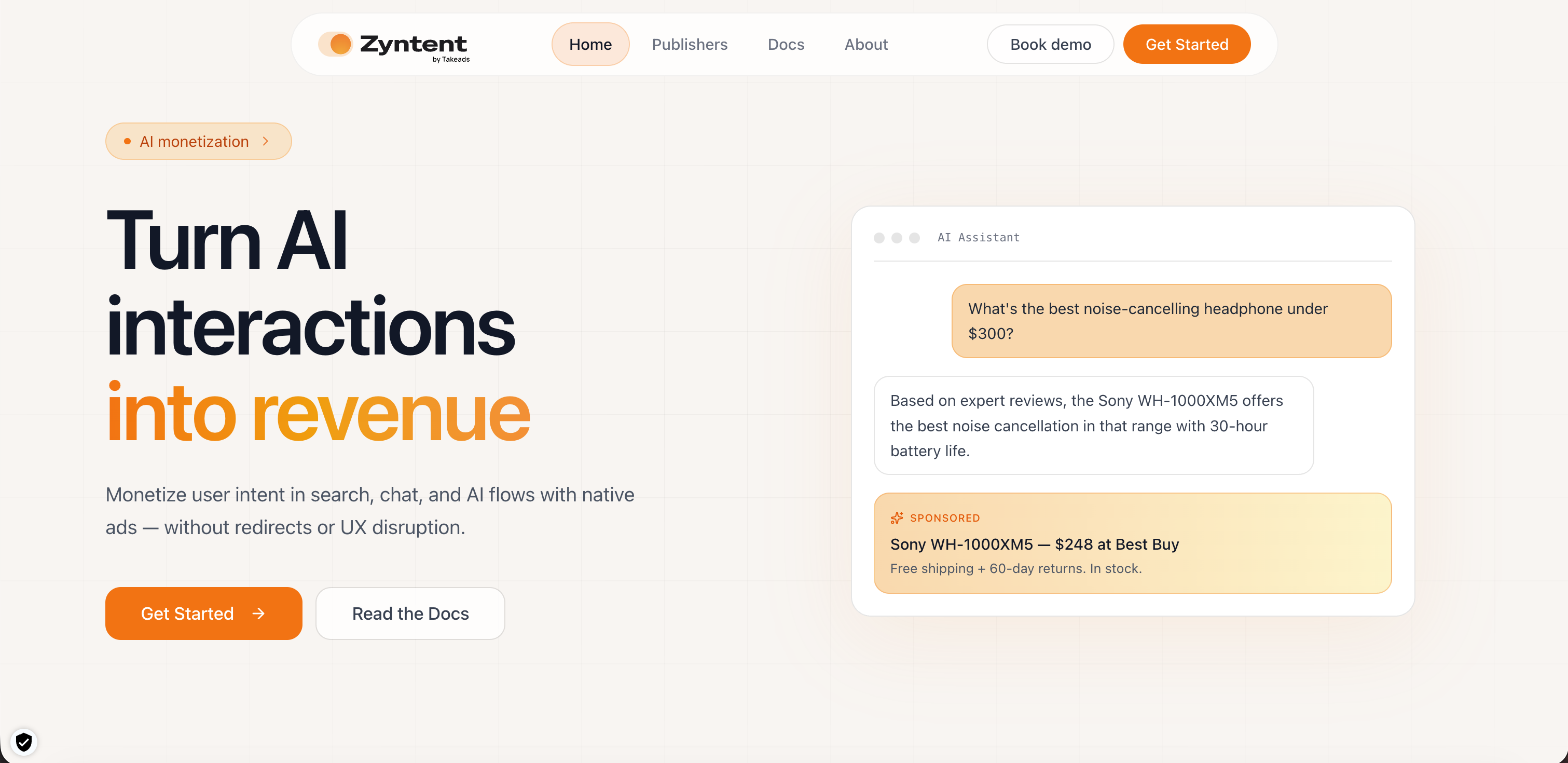
- Boost ad click-through rates to 4-6% by matching real-time user intent with the most relevant offer from the advertiser network, using advanced AI intent detection.
- Capture revenue from purchase signals before users fully articulate their intent, enabled by analyzing each conversation turn for explicit and latent buying cues.
- Monetize every traffic source—search, content, AI apps, forums, and domains—by detecting purchase intent across all these surfaces with a single integration.
- Preserve a seamless user experience by serving native ad cards that blend into the conversation flow as contextual product suggestions, not disruptive banners.
- Generate revenue from AI interactions without redirects or UX disruption, thanks to ad delivery that avoids redirects and maintains conversational context.
- Unlock new revenue streams from chat, search, and AI flows by adapting ad formats contextually to any AI surface including chat interfaces and domain parks.
- Achieve faster time-to-revenue with a single SDK that works across all major LLM stacks, eliminating the need to maintain separate infrastructure for each model.
- Optimize ad relevance and engagement in real time by matching user intent to ads without relying on IAB taxonomy or legacy DSP latency.
Pros & Cons
Pros
- Operates on major LLM stacks
- Smooth, non-disruptive UX
- Detects user intent real-time
- Matches intent with relevant ads
- Maximizes user engagement
- Includes native ad format
- No redirects needed
- Can monetize various traffic sources
- Seamless SDK integration
- Catches purchase signals early
- Real-time ad generation
- Highly efficient performance
- Contextual ad display
- Non-intrusive ad placement
- Intent recognition across sources
- Support all LLM models
- No maintenance needed
- Quick response and interaction times
- Captures both explicit and latent purchase intentions
- Revenue share model
- Seamless addition to conversational flow
- Better CTR than banner ads
- One SDK for any LLM stack
- Live in a short time
- No user data stored or sent
- Matched ad in under 50ms
- Ads adapt to context
- Ad recommendation that matches platform tone
- 55,000+ merchant network
- 50ms latency from intent signal to ad
- High average CTR
- No integration fees
- Dedicated support for each partner
- 24h response time
Cons
- Limited control over ad matching
- Zero-shot inference limitations
- No user data storage
- Dependent on advertiser network
- Latency relies on advertiser responses
- No support for IAB taxonomy
- Legacy DSP integration issues
- CTR rates may vary greatly
- Single SDK format limitations
- Custom model integration complexities
Reviews
Rate this tool
Loading reviews...
❓ Frequently Asked Questions
Zyntent is an AI-powered intent monetization tool that allows publishers to monetize user intent in search, chat, and AI flows using native ads.
Zyntent monetizes user intent by detecting it in real time across multiple platforms including search, content, AI apps, tools, forums, and domains. Once the intent is captured, it matches the user's intent with the most relevant offer from its roster of ads, providing a high chance for user engagement.
Yes, Zyntent is designed to operate across all major Large Language Models stacks, enabling it to seamlessly integrate into various AI environments.
No, Zyntent doesn't cause any disruption to the user experience. It avoids using redirects and prides itself on offering a smooth and non-disruptive user experience.
Zyntent uses advanced AI technology to detect user intent in real time. It analyzes every conversation turn for explicit or latent purchase intent.
Zyntent's intent detection spans across search, content, AI apps, tools, forums, and domains.
Once Zyntent captures the user intent, it uses AI technology to match this intent with the highest relevance offer from its roster of ads in real time.
The native ad format offered by Zyntent appears within the chat flow. It aims to maintain the context of the conversation and is designed to be non-intrusive.
Zyntent preserves the context of a conversation by seamlessly integrating its native ad format within the chat flow. The intent-based targeted ads are designed to fit the ongoing conversation, preventing any disruptive shifts in context.
Zyntent captures purchase signals before users even formulate a specific search query. It analyzes multiple conversation turns to detect early signals, allowing it to catch potential revenue-generating interactions efficiently.
Zyntent integrates with all large language models (LLM) stacks. This includes, but is not limited to, OpenAI, Anthropic, Gemini and other custom models.
Zyntent contributes to revenue growth by turning AI interactions into revenue. It captures user intent and matches it with relevant ads in real-time, increasing the likelihood of user engagement and resulting in higher ad click-through rates (CTR). The intent-based targeting results in a CTR of 4-6%, significantly higher than the typical banner ad.
Yes, Zyntent does offer real-time analytics. It identifies user intent, matches ads, and logs impressions and clicks, all in real-time.
Yes, Zyntent does provide tools for publishers. It offers a single SDK that works with any LLM stack. The SDK is designed for easy implementation with minimal infrastructure maintenance required.
Zyntent's approach to ad optimization involves real-time intent recognition and matching. It uses advanced AI to instantly detect user intent and matches it with the most relevant ad from its network. This intent-based targeting maximizes ad relevance, thereby optimising user engagement.
Zyntent supports chat interactions by integrating native ad formats within the chat flows. These ads are designed to look like part of the conversation, providing non-intrusive, contextually relevant product suggestions.
Yes, Zyntent can be used for content monetization. It detects user intent across search, content, AI apps, tools, forums, and domains, and uses this captured intent to match the user with suitable ads.
Zyntent's user intent detection and real-time ad matching offer ways for optimizing search results. By capturing user intent early in a search, chat, or AI flow, it optimizes the chance of engagement, improving the overall effectiveness of search initiatives.
User intent is monetized in AI flows by Zyntent through real-time intent detection and ad matching. Zyntent captures explicit or latent purchase intent in AI interactions and matches it with a relevant ad from its roster in real time.
Zyntent is very effective in maintaining a non-disruptive user experience (UX). By embedding native ad formats within chat flows and preserving conversational context, Zyntent ensures the user experience remains consistent and uninterrupted.
Zyntent functions through a three-step process. In the first step, it analyses each conversation turn for purchase intent, whether explicit or latent. The second step involves matching the identified intent with the most relevant offer available in its advertiser network in real-time, without any need for IAB taxonomy or legacy DSP latency. Lastly, a native ad card is presented within the chat flow, which is always contextual and never intrusive, resembling a product suggestion rather than a banner.
Intent monetization in Zyntent refers to the system's capability to transform AI interactions into revenue opportunities. Utilizing AI technology, Zyntent detects user intent across diverse sources in real time and matches this intent with an advertisement from its roster of ads. This unlocks new revenue potential without causing any UX disruption or requiring redirects.
Zyntent detects user intent using its AI technology. It analyzes each conversation turn for both explicit and latent purchase intent. The system is capable of spotting purchase signals before a user forms a concrete search query, which allows for quicker response and interaction times.
Yes, Zyntent can be seamlessly integrated into any AI environment. It is engineered to work across all LLM models, and can swiftly be integrated into a wide variety of language learning model stacks or custom models using a single SDK format, eliminating the need for developers to maintain an infrastructure.
Zyntent is designed to not disrupt the user experience. The tool ensures a smooth, non-disruptive user experience by avoiding redirects and integrating native ads within the AI conversation flow, preserving the context of the conversation, and maintaining a feel that makes the ads feel like a part of the conversation rather than an intrusive element.
Zyntent deals with redirects by completely avoiding them. Its design ensures that user engagement with native ads does not require redirects, maintaining a seamless user experience and preventing disruptions.
In Zyntent, ad relevance is of paramount importance. Once user intent has been detected, Zyntent matches the intent with the most relevant offer from its advertiser network, in real time. This ensures maximum likelihood of user engagement and optimizes the potential for revenue generation.
A native ad format in Zyntent refers to the advertisement delivery method in which the ad appears within the user's chat flow. The goal is to maintain the conversation's context and avoid intrusiveness, which enhances the user experience by making the ad appear like a product suggestion rather than a traditional banner.
Zyntent captures purchase signals by detecting user intent before a concrete search query is formed by the user. Using AI technology, Zyntent can spot these purchase indicators earlier, which allows it to respond and interact with potential revenue-creating interactions promptly and efficiently.
AI plays a critical role in Zyntent's intent detection. The AI technology allows Zyntent to detect user intent in real time, spanning across search, content, AI apps, tools, forums, and domains. Furthermore, it identifies both explicit and latent purchase intentions, thus increasing its precision and efficiency.
Zyntent is integrated into different language learning models using a single SDK format, which allows it to be swiftly integrated into a range of language learning model stacks or custom models. This eliminates the need for developers to maintain an infrastructure, thus simplifying the integration process significantly.
Zyntent's targeting strategy is unique due to its capability to capture purchase signals before users have fully articulated their intent. By detecting both explicit and latent purchase intentions, it can target ads more effectively, and in turn, deliver higher click-through rates and drive more revenue.
Zyntent generates real-time ads by detecting user intent instantly and matching it with the most relevant offer from its network of advertisers in real time, ensuring maximum relevance and user engagement.
In Zyntent's revenue share model, profits generated through ads are shared with publishers. This model incentivizes publishers to adopt Zyntent since it presents a way for them to generate revenue from their content without negatively affecting the user experience.
Zyntent's ad format adapts to different AI surfaces by blending into the conversation flow. It contextually adapts to various AI interfaces, including chat and search-driven interfaces, forums, community, and domain parks, and presents ads in a way that is similar to a product suggestion rather than a disruptive banner.
Zyntent applies intent detection to a variety of traffic sources, including search, content, AI apps, forums, and domains. This wide range of sources allows for comprehensive intent detection, thereby increasing opportunities for effective ad matching and revenue generation.
To maintain the context of a conversation, Zyntent presents ads in a native ad card within the chat flow. This ensures that the ads are contextual, fitting seamlessly into the conversation, and never intrusive. This context-aware manner of ad presentation ensures that the ads feel like part of the conversation, thereby enhancing user engagement and experience.
Zyntent monitors user engagement by detecting user intent and matching it with the highest relevance offer from its ad roster in real time, thereby increasing chances of user engagement. It also utilizes a unique native ad format within the chat flow, which is specifically designed to increase user engagement by blending seamlessly into the conversation.
Zyntent's advertiser network plays a significant role in matching user intent as it provides a variety of ads to match with identified user intent. The greater the number of available ads, the higher the chance of finding a perfect match for user intent, increasing the likelihood of user engagement and successfully monetizing the identified intent.
Pricing
Pricing model
No Pricing