

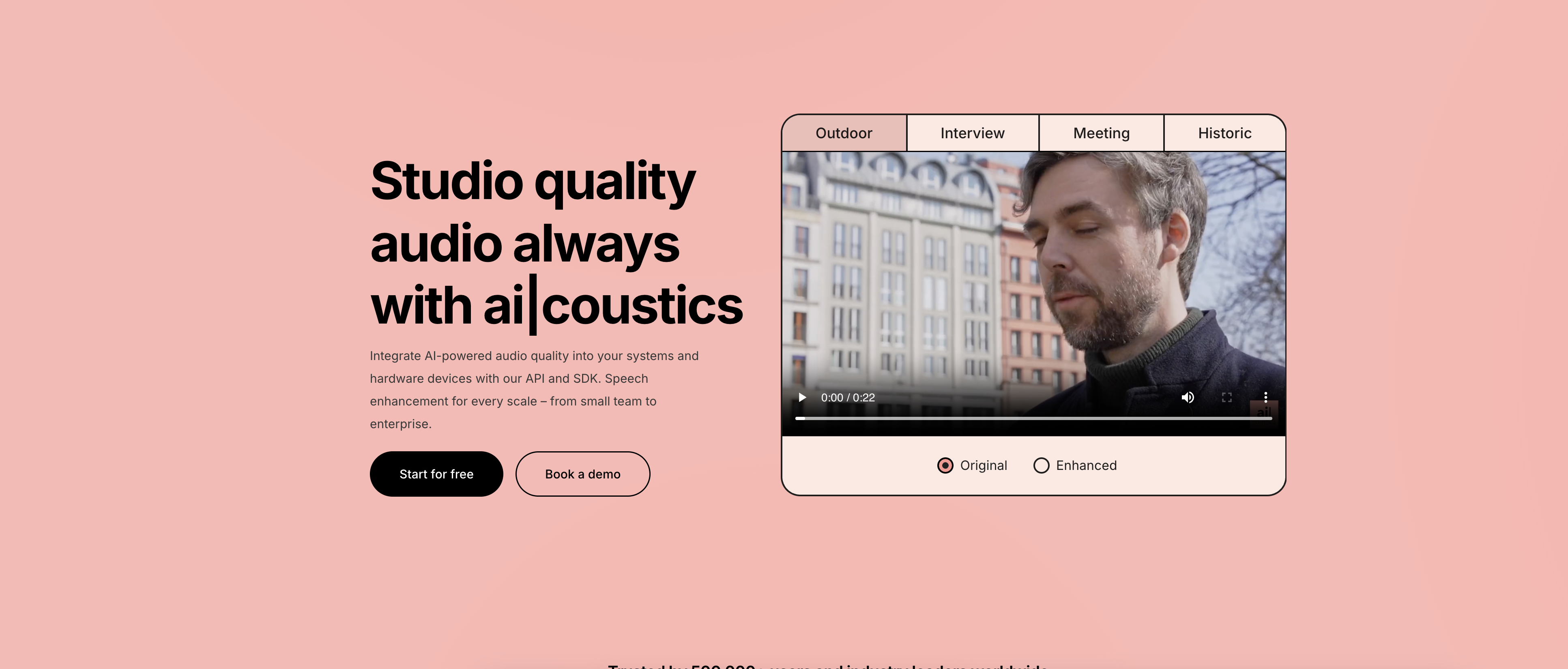
📝 Overview

- Achieve studio-quality audio from any recording device using Generative Speech AI that compensates for low-quality headsets and noisy environments
- Eliminate background noise and room resonances completely with advanced algorithms that preserve your natural voice identity while removing distractions
- Fix problematic recordings by repairing digital artifacts and restoring lost frequencies, transforming unusable audio into professional content
- Process audio in real-time with millisecond latency through the SDK for live applications like video conferencing and broadcasting
- Enhance audio directly on devices without internet connectivity using offline SDK processing for complete privacy and reliability
- Integrate seamlessly into existing workflows with cross-platform API compatibility for web, mobile, desktop, and embedded systems
- Improve speech intelligibility across multiple languages and accents using AI trained on diverse datasets to reduce misunderstandings
- Customize enhancement strength and parameters through adjustable controls to match your specific audio requirements
⚖️ Pros & Cons
Pros
- Studio-quality audio enhancement
- Background noise elimination
- Compensates for low-quality mics, headsets and other devices
- SDK or API integration
- Web app available
- Compatible with audio recording/transmission hardware
- Compatible with Mac, Windows, Linux, Android, iOS, Python, JS, Shell and more
- Easy integration
Cons
- Could remove desired background sounds
- Possible latency issues
❓ Frequently Asked Questions
Mila
🛠️ 1 tool
wrote:ai|coustics is an AI tool that enhances speech audio quality using advanced algorithms. Available in a range of different formats from individual audio enhancement in a wepb application to an API and SDK, ai|coustics is ideal for podcasters, broadcasters, educators, and more.
Mila
🛠️ 1 tool
wrote:Generative Speech AI technology provides users with studio-quality audio from any device in any situation, whether recording a podcast, video conferencing, or transmitting audio. The tool suppresses background noise, removes room resonances, compensates for low-quality headsets, and repairs digital artifacts to improve audio clarity and quality. It brings back lost components and frequencies with a robust and accurate platform which preserves speaker identity.
Mila
🛠️ 1 tool
wrote:Yes, ai|coustics is especially designed to be used with low-quality headsets. Even with a cheap headset in a noisy office room, you can still sound as if you were recorded in a music studio.
Mila
🛠️ 1 tool
wrote:ai|coustics ensures effective communication by improving speech intelligibility. It minimizes misunderstandings and augments audience focus by reducing background noise and amplifying speech clarity and quality.
Mila
🛠️ 1 tool
wrote:Lots! For example: you’ve recorded an interview and there’s too much background noise for it to be usable? Your travel vlog is difficult to understand? You teach students but don’t have a microphone to be able to provide clear, intelligble online lectures? You source audiobooks but not all your narrators have high quality audio set-ups? In all of these situations, and more, ai|coustics can solve your audio issues and provide studio-quality sound. This encompasses recording a podcast, video conferencing, transmitting audio, or any other speech product.
Mila
🛠️ 1 tool
wrote:Lots of podcasters use ai|coustics to ensure they can provide consistent, high-quality sound and keep audiences engaged regardless of their audio set-up. Podcasters using ai|coustics range from solo creators experimenting with the format to podcasting studios looking for easy integration into their existing CMS and platforms.
Mila
🛠️ 1 tool
wrote:Absolutely! ai|coustics offer a free trial period for you on both the web app and API products to experience the transformative power of audio enhancement technology firsthand. No credit card required—just sign up and start enhancing.
Mila
🛠️ 1 tool
wrote:Yes, ai|coustics supports video files and enhances the audio track within your video, ensuring your visuals are matched with equally high-quality sound.
Mila
🛠️ 1 tool
wrote:No special software or hardware is required. The ai|coustics web application is accessible from any standard web browser on computers, tablets, or smartphones.
Mila
🛠️ 1 tool
wrote:No, ai|coustics is designed to preserve the natural tone and timbre of the speaker’s voice. Thetechnology enhances the clarity and quality of the audio while maintaining the speaker’s unique vocal identity, ensuring that the essence of the speech remains untouched.
Mila
🛠️ 1 tool
wrote:Integration is straightforward. ai|coustics provide detailed documentation and support to help you embed their API into your platform, requiring only basic programming knowledge.
Mila
🛠️ 1 tool
wrote:Absolutely! The ai|coustics platform offers customizable controls, allowing you to adjust the enhancement strength and other parameters to suit your specific needs.
Mila
🛠️ 1 tool
wrote:There are no specific hardware requirements for the API itself, as it runs on ai|coustics’ servers. You just need an internet connection and the ability to make HTTP requests from your platform.
Mila
🛠️ 1 tool
wrote:Yes, ai|coustics offer a trial period with limited access to the API features so you can evaluate its capabilities and how it integrates with your systems.
Mila
🛠️ 1 tool
wrote:The SDK gives access to ai|coustics speech enhancement technology in real-time running offline directly on the device. You will receive it as a static library with a C/C++ header file.
Mila
🛠️ 1 tool
wrote:The SDK runs on Cortex-M/A chips and on all major mobile and desktop operating systems. For other architectures please reach out to ai|coustics.
Mila
🛠️ 1 tool
wrote:The ai|coustics SDK is engineered for minimal latency, enabling real-time audio enhancement. Thanks to optimized machine learning models and the efficient Rust programming language, the SDK processes audio with an exceptionally low latency, typically in the milliseconds range. This ensures that audio enhancement is virtually instantaneous, making it ideal for live applications and devices where real-time processing is critical, such as hearing aids, smartphones, and automotive infotainment systems.
Mila
🛠️ 1 tool
wrote:ai|coustics’ Generative Audio AI algorithms are trained on diverse datasets, enabling them to enhance speech clarity across a wide range of languages and accents.
Mila
🛠️ 1 tool
wrote:Comprehensive documentation, sample code, and dedicated support to assist with SDK integration and optimization.
Mila
🛠️ 1 tool
wrote:There are flexible licensing options tailored to the scale and scope of your project, from startups to large enterprises.
Mila
🛠️ 1 tool
wrote:No, the ai|coustics SDK is designed to operate independently on the device without the need for an internet connection. Once integrated, the SDK processes audio data locally, ensuring real-time enhancement with no reliance on external servers. This capability is particularly beneficial for applications where consistent internet access is not guaranteed or for user scenarios that demand privacy and data security.
Mila
🛠️ 1 tool
wrote:ai|coustics can be integrated with various platforms including Windows, Mac, Linux, Web, Android, and iOS, spanning across embedded, desktop, and cloud environments.
Mila
🛠️ 1 tool
wrote:No, the ai|coustics SDK is designed to operate independently on the device without the need for an internet connection. Once integrated, the SDK processes audio data locally, ensuring real-time enhancement with no reliance on external servers. This capability is particularly beneficial for applications where consistent internet access is not guaranteed or for user scenarios that demand privacy and data security.
Mila
🛠️ 1 tool
wrote:ai|coustics can be integrated with various platforms including Windows, Mac, Linux, Web, Android, and iOS, spanning across embedded, desktop, and cloud environments.
Mila
🛠️ 1 tool
wrote:No, the ai|coustics SDK is designed to operate independently on the device without the need for an internet connection. Once integrated, the SDK processes audio data locally, ensuring real-time enhancement with no reliance on external servers. This capability is particularly beneficial for applications where consistent internet access is not guaranteed or for user scenarios that demand privacy and data security.
Mila
🛠️ 1 tool
wrote:ai|coustics can be integrated with various platforms including Windows, Mac, Linux, Web, Android, and iOS, spanning across embedded, desktop, and cloud environments.
Mila
🛠️ 1 tool
wrote:No, the ai|coustics SDK is designed to operate independently on the device without the need for an internet connection. Once integrated, the SDK processes audio data locally, ensuring real-time enhancement with no reliance on external servers. This capability is particularly beneficial for applications where consistent internet access is not guaranteed or for user scenarios that demand privacy and data security.
Mila
🛠️ 1 tool
wrote:ai|coustics can be integrated with various platforms including Windows, Mac, Linux, Web, Android, and iOS, spanning across embedded, desktop, and cloud environments.
Mila
🛠️ 1 tool
wrote:No, the ai|coustics SDK is designed to operate independently on the device without the need for an internet connection. Once integrated, the SDK processes audio data locally, ensuring real-time enhancement with no reliance on external servers. This capability is particularly beneficial for applications where consistent internet access is not guaranteed or for user scenarios that demand privacy and data security.
Mila
🛠️ 1 tool
wrote:ai|coustics can be integrated with various platforms including Windows, Mac, Linux, Web, Android, and iOS, spanning across embedded, desktop, and cloud environments.
Mila
🛠️ 1 tool
wrote:No, the ai|coustics SDK is designed to operate independently on the device without the need for an internet connection. Once integrated, the SDK processes audio data locally, ensuring real-time enhancement with no reliance on external servers. This capability is particularly beneficial for applications where consistent internet access is not guaranteed or for user scenarios that demand privacy and data security.
Mila
🛠️ 1 tool
wrote:ai|coustics can be integrated with various platforms including Windows, Mac, Linux, Web, Android, and iOS, spanning across embedded, desktop, and cloud environments.
Mila
🛠️ 1 tool
wrote:No, the ai|coustics SDK is designed to operate independently on the device without the need for an internet connection. Once integrated, the SDK processes audio data locally, ensuring real-time enhancement with no reliance on external servers. This capability is particularly beneficial for applications where consistent internet access is not guaranteed or for user scenarios that demand privacy and data security.
Mila
🛠️ 1 tool
wrote:ai|coustics can be integrated with various platforms including Windows, Mac, Linux, Web, Android, and iOS, spanning across embedded, desktop, and cloud environments.
Mila
🛠️ 1 tool
wrote:No, the ai|coustics SDK is designed to operate independently on the device without the need for an internet connection. Once integrated, the SDK processes audio data locally, ensuring real-time enhancement with no reliance on external servers. This capability is particularly beneficial for applications where consistent internet access is not guaranteed or for user scenarios that demand privacy and data security.
Mila
🛠️ 1 tool
wrote:ai|coustics can be integrated with various platforms including Windows, Mac, Linux, Web, Android, and iOS, spanning across embedded, desktop, and cloud environments.
Mila
🛠️ 1 tool
wrote:No, the ai|coustics SDK is designed to operate independently on the device without the need for an internet connection. Once integrated, the SDK processes audio data locally, ensuring real-time enhancement with no reliance on external servers. This capability is particularly beneficial for applications where consistent internet access is not guaranteed or for user scenarios that demand privacy and data security.
Mila
🛠️ 1 tool
wrote:ai|coustics can be integrated with various platforms including Windows, Mac, Linux, Web, Android, and iOS, spanning across embedded, desktop, and cloud environments.
Mila
🛠️ 1 tool
wrote:Absolutely! ai|coustics offer a free trial period for you on both the web app and API products to experience the transformative power of audio enhancement technology firsthand. No credit card required—just sign up and start enhancing.
Mila
🛠️ 1 tool
wrote:Yes, ai|coustics supports video files and enhances the audio track within your video, ensuring your visuals are matched with equally high-quality sound.
Mila
🛠️ 1 tool
wrote:No special software or hardware is required. The ai|coustics web application is accessible from any standard web browser on computers, tablets, or smartphones.
Mila
🛠️ 1 tool
wrote:No, ai|coustics is designed to preserve the natural tone and timbre of the speaker’s voice. Thetechnology enhances the clarity and quality of the audio while maintaining the speaker’s unique vocal identity, ensuring that the essence of the speech remains untouched.
Mila
🛠️ 1 tool
wrote:Integration is straightforward. ai|coustics provide detailed documentation and support to help you embed their API into your platform, requiring only basic programming knowledge.
Mila
🛠️ 1 tool
wrote:Absolutely! The ai|coustics platform offers customizable controls, allowing you to adjust the enhancement strength and other parameters to suit your specific needs.
Mila
🛠️ 1 tool
wrote:There are no specific hardware requirements for the API itself, as it runs on ai|coustics’ servers. You just need an internet connection and the ability to make HTTP requests from your platform.
Mila
🛠️ 1 tool
wrote:Yes, ai|coustics offer a trial period with limited access to the API features so you can evaluate its capabilities and how it integrates with your systems.
Mila
🛠️ 1 tool
wrote:The SDK gives access to ai|coustics speech enhancement technology in real-time running offline directly on the device. You will receive it as a static library with a C/C++ header file.
Mila
🛠️ 1 tool
wrote:The SDK runs on Cortex-M/A chips and on all major mobile and desktop operating systems. For other architectures please reach out to ai|coustics.
Mila
🛠️ 1 tool
wrote:The ai|coustics SDK is engineered for minimal latency, enabling real-time audio enhancement. Thanks to optimized machine learning models and the efficient Rust programming language, the SDK processes audio with an exceptionally low latency, typically in the milliseconds range. This ensures that audio enhancement is virtually instantaneous, making it ideal for live applications and devices where real-time processing is critical, such as hearing aids, smartphones, and automotive infotainment systems.
Mila
🛠️ 1 tool
wrote:ai|coustics’ Generative Audio AI algorithms are trained on diverse datasets, enabling them to enhance speech clarity across a wide range of languages and accents.
Mila
🛠️ 1 tool
wrote:Comprehensive documentation, sample code, and dedicated support to assist with SDK integration and optimization.
Mila
🛠️ 1 tool
wrote:There are flexible licensing options tailored to the scale and scope of your project, from startups to large enterprises.
Mila
🛠️ 1 tool
wrote:No, the ai|coustics SDK is designed to operate independently on the device without the need for an internet connection. Once integrated, the SDK processes audio data locally, ensuring real-time enhancement with no reliance on external servers. This capability is particularly beneficial for applications where consistent internet access is not guaranteed or for user scenarios that demand privacy and data security.
Mila
🛠️ 1 tool
wrote:ai|coustics can be integrated with various platforms including Windows, Mac, Linux, Web, Android, and iOS, spanning across embedded, desktop, and cloud environments.
Mila
🛠️ 1 tool
wrote:No, the ai|coustics SDK is designed to operate independently on the device without the need for an internet connection. Once integrated, the SDK processes audio data locally, ensuring real-time enhancement with no reliance on external servers. This capability is particularly beneficial for applications where consistent internet access is not guaranteed or for user scenarios that demand privacy and data security.
Mila
🛠️ 1 tool
wrote:ai|coustics can be integrated with various platforms including Windows, Mac, Linux, Web, Android, and iOS, spanning across embedded, desktop, and cloud environments.
Mila
🛠️ 1 tool
wrote:No, the ai|coustics SDK is designed to operate independently on the device without the need for an internet connection. Once integrated, the SDK processes audio data locally, ensuring real-time enhancement with no reliance on external servers. This capability is particularly beneficial for applications where consistent internet access is not guaranteed or for user scenarios that demand privacy and data security.
Mila
🛠️ 1 tool
wrote:ai|coustics can be integrated with various platforms including Windows, Mac, Linux, Web, Android, and iOS, spanning across embedded, desktop, and cloud environments.
Mila
🛠️ 1 tool
wrote:No, the ai|coustics SDK is designed to operate independently on the device without the need for an internet connection. Once integrated, the SDK processes audio data locally, ensuring real-time enhancement with no reliance on external servers. This capability is particularly beneficial for applications where consistent internet access is not guaranteed or for user scenarios that demand privacy and data security.
Mila
🛠️ 1 tool
wrote:ai|coustics can be integrated with various platforms including Windows, Mac, Linux, Web, Android, and iOS, spanning across embedded, desktop, and cloud environments.
Mila
🛠️ 1 tool
wrote:No, the ai|coustics SDK is designed to operate independently on the device without the need for an internet connection. Once integrated, the SDK processes audio data locally, ensuring real-time enhancement with no reliance on external servers. This capability is particularly beneficial for applications where consistent internet access is not guaranteed or for user scenarios that demand privacy and data security.
Mila
🛠️ 1 tool
wrote:ai|coustics can be integrated with various platforms including Windows, Mac, Linux, Web, Android, and iOS, spanning across embedded, desktop, and cloud environments.
Mila
🛠️ 1 tool
wrote:No, the ai|coustics SDK is designed to operate independently on the device without the need for an internet connection. Once integrated, the SDK processes audio data locally, ensuring real-time enhancement with no reliance on external servers. This capability is particularly beneficial for applications where consistent internet access is not guaranteed or for user scenarios that demand privacy and data security.
Mila
🛠️ 1 tool
wrote:ai|coustics can be integrated with various platforms including Windows, Mac, Linux, Web, Android, and iOS, spanning across embedded, desktop, and cloud environments.
Mila
🛠️ 1 tool
wrote:No, the ai|coustics SDK is designed to operate independently on the device without the need for an internet connection. Once integrated, the SDK processes audio data locally, ensuring real-time enhancement with no reliance on external servers. This capability is particularly beneficial for applications where consistent internet access is not guaranteed or for user scenarios that demand privacy and data security.
Mila
🛠️ 1 tool
wrote:ai|coustics can be integrated with various platforms including Windows, Mac, Linux, Web, Android, and iOS, spanning across embedded, desktop, and cloud environments.
Mila
🛠️ 1 tool
wrote:No, the ai|coustics SDK is designed to operate independently on the device without the need for an internet connection. Once integrated, the SDK processes audio data locally, ensuring real-time enhancement with no reliance on external servers. This capability is particularly beneficial for applications where consistent internet access is not guaranteed or for user scenarios that demand privacy and data security.
Mila
🛠️ 1 tool
wrote:ai|coustics can be integrated with various platforms including Windows, Mac, Linux, Web, Android, and iOS, spanning across embedded, desktop, and cloud environments.
Mila
🛠️ 1 tool
wrote:No, the ai|coustics SDK is designed to operate independently on the device without the need for an internet connection. Once integrated, the SDK processes audio data locally, ensuring real-time enhancement with no reliance on external servers. This capability is particularly beneficial for applications where consistent internet access is not guaranteed or for user scenarios that demand privacy and data security.
Mila
🛠️ 1 tool
wrote:ai|coustics can be integrated with various platforms including Windows, Mac, Linux, Web, Android, and iOS, spanning across embedded, desktop, and cloud environments.
💰 Pricing
Pricing model
Freemium
Paid options from
$2.25/month
Billing frequency
Monthly
📺 Related Videos
Introducing the new ai-coustics developer platform
👤ai-coustics•2.2K views•Sep 16, 2025
AI Background Noise Remover Free Tool (ai-coustics.com) #shorts #technology #ai
👤AI Insider•732 views•Aug 12, 2023
ai-coustics has a new look
👤ai-coustics•519 views•Sep 16, 2025
Ai Coustics Review & Exclusive Discount 💥 Save Big in 2025!
👤Review N Discount•81 views•Oct 31, 2025
[IFA 2023 Berlin] Speech Enhancement with AI - ai | coustics
👤World Trade Show TV / Germany•1.3K views•Sep 15, 2023
Ai coustics: AI Voice Enhancement
👤AI Challenger•33 views•Jun 24, 2024
🎧 Best AI Voice Enhancer Tool 🔥One Click Clear Audio!
👤CL Creative Limon•1.9K views•Jun 27, 2025
ai-coustics live in Pipecat
👤ai-coustics•255 views•Sep 4, 2025
ai|coustics at IFA Berlin - enhanced DJI mic
👤ai-coustics•772 views•Sep 19, 2024