

AI QA Monkey
Overview
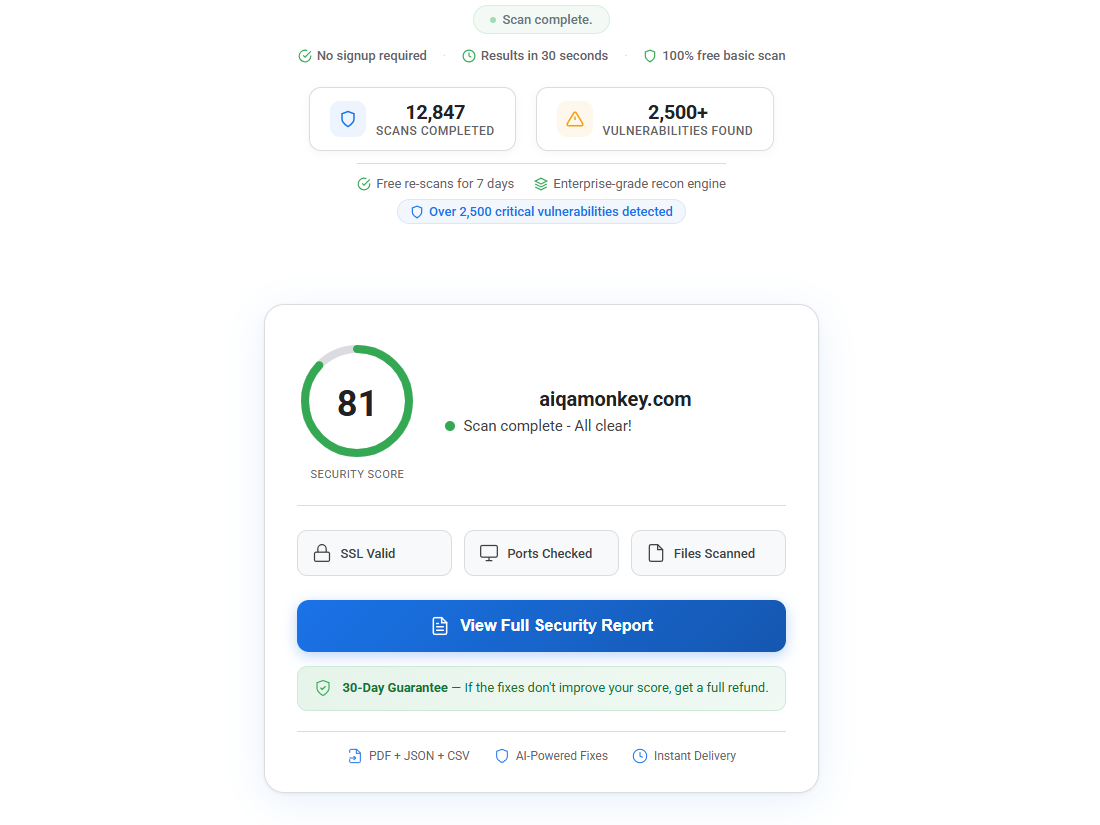
- See your website's security posture instantly with a single, easy-to-understand risk score based on detected vulnerabilities and their potential impact.
- Find and fix critical data leaks before hackers do by detecting exposed API keys and passwords in .env, .git, and backup files.
- Secure your website's data transmission and prevent man-in-the-middle attacks with automated SSL validation and HSTS/CSP header analysis.
- Ensure compliance and maintain user trust by automatically checking for GDPR requirements like privacy policies and cookie security.
- Manage the security of your entire web portfolio from one dashboard with simultaneous multi-domain scanning and a consolidated vulnerability view.
- Get stakeholders on board quickly with professional, white-label PDF reports and an executive summary of critical findings and actionable insights.
- Protect your domain's email reputation and prevent spoofing with real-time analysis of SPF and DMARC records.
- Identify exploitable entry points by discovering risky open ports like SSH, FTP, and MySQL.
- Uncover hidden risks in your CMS with targeted scans for WordPress and other platform vulnerabilities, including plugin detection.
Pros & Cons
Pros
- Instantaneous security audits
- Open port scanning
- Detects .env file leaks
- Identifies WordPress vulnerabilities
- SSL issue detection
- Secures headers and SSL
- .env and .git leak detection
- WordPress & CMS vulnerability checks
- GDPR and compliance checks
- Certificate validation
- HSTS, CSP, and header analysis
- SSH, FTP, MySQL open port discoveries
- Privacy policy detection
- Cookie security for GDPR compliance
- SPF and DMARC record checks
- Real-time domain reputation analysis
- Multi-Domain Dashboard for portfolio scanning
- Professional report downloads
- Overall risk score calculation
- Executive summaries for stakeholders
- DNS and Blacklist analysis
- Encrypt data protection
- Simulated log output
- Trend and confidence historical comparison
- Penetration testing feature
- Free to use
- Scans multiple domains
- File Leak Detection
- Cost Effective
- Addresses over 2,500 vulnerabilities
- Scans within 60 seconds
- Provides actionable insights
- Includes industry security index
- Exportable reports for stakeholders
- Industry-grade recon engine
- Export data in JSON
- Executes SLA & Compliance checks
- Category-based risk scoring
- Live recon console
- Highlights risk with severity badges
- Includes Observed exposure points
- Compliance Mapping feature
- HTTP signals captured feature
- Identify xmlrpc.php vulnerability checks
- Performs infrastructure scan
- Detects API keys and passwords leaks
- Plugin detection in WP & CMS scanning
- Maintains public leaderboards for cybersecurity
Cons
- No free trial available
- Per-domain scan payment
- No available mobile version
- Limited CMS vulnerabilities detection
- Lacks accuracy in detecting .env file leaks
- Unclear GDPR compliance details
- Limited multi-domain dashboard capabilities
- Possible false positives in vulnerability scanning
- No API integrations
- Lacks third-party software compatibility
Reviews
Rate this tool
Loading reviews...
❓ Frequently Asked Questions
AI QA Monkey is an AI-powered tool that conducts security audits for websites. It performs exhaustive scans to detect website vulnerabilities in real-time, providing instant feedback. It focuses on issues such as open ports, .env file leaks, WordPress vulnerabilities, and SSL problems.
AI QA Monkey scans for a wide array of vulnerabilities, including open ports, .env file leaks, WordPress vulnerabilities, and SSL issues. It also searches for object leaks, such as API keys and passwords inside .env and .git back-up files, and checks for vulnerabilities related to WordPress and other CMS platforms.
AI QA Monkey secures headers and SSL by validating security headers and certificates. It also executes HSTS, CSP, and critical header analysis - all integral to overall website security and data integrity. These actions ensure the safe transmission of sensitive data.
Object leaks, including exposed API keys and passwords inside .env and .git backup files, are detected by AI QA Monkey as part of its security auditing process. By identifying these, the tool helps prevent unauthorized access to sensitive information.
In terms of GDPR compliance checks, AI QA Monkey plays a vital role by detecting privacy policy and cookie security. By ensuring that the website complies with data protection regulations, AI QA Monkey contributes to maintaining the users' trust and safeguarding the website's reputation.
Yes, AI QA Monkey has the capability to perform open port discoveries including SSH, FTP, MySQL, and other risky open ports. By identifying these potential vulnerabilities, it helps strengthen the website's overall security stance.
Yes, AI QA Monkey provides real-time domain reputation analysis. This includes checks on SPF and DMARC records, helping ensure the domain's credibility and reducing the risk of email spoofing or other reputation-damaging activities.
The Multi-Domain Dashboard in AI QA Monkey is a powerful feature for portfolio scanning. It allows users to scan multiple domain names at once, showcasing vulnerabilities across different websites on a single dashboard for comprehensive oversight and management.
AI QA Monkey uses sophisticated algorithms to calculate an overall risk score based on the detected vulnerabilities and their potential impact on the website's security. This risk score provides an immediate understanding of the website's security posture in a single, easy-to-understand metric.
Yes, AI QA Monkey enables users to download professional reports containing actionable insights. These reports can be used for improving system security, briefing stakeholders, or integrating insights into other tools or processes.
AI QA Monkey can detect CMS vulnerabilities through its advanced scanning techniques. It identifies potential security risks associated with WordPress and other content management systems, helping to secure website data and functionality.
Yes, AI QA Monkey, with its Multi-Domain Dashboard feature, has the ability to scan multiple domains simultaneously. This shows all security details and vulnerabilities of the scanned domains in one place, making it easier for users to manage overall web security.
Yes, AI QA Monkey checks both SPF and DMARC records. These checks help safeguard the domain's reputation and integrity by minimizing the potential for email spoofing and ensuring that emails are dispatched and received securely.
AI QA Monkey’s HSTS CSP analysis plays a key role in securing websites by ensuring that security headers and certificates are validated properly. This contributes to safe data transmission, preventing man-in-the-middle attacks and other potential security breaches.
Yes, AI QA Monkey provides an executive summary for stakeholders. This concise report highlights critical findings and insights from the security audit, offering a digestible breakdown of vulnerabilities, risks, and recommendations.
AI QA Monkey detects privacy policy and cookie security as part of its GDPR compliance checks. This involves analyzing the website's privacy policy and verifying that cookies are properly secured, ensuring that the website is following best practices to protect user data.
The risk score calculated by AI QA Monkey indicates the overall security posture of a website. It quantifies the potential risks based on the detected vulnerabilities, providing a clear view of the website's security status and serving as a basis for decision-making about remediation actions.
Yes, AI QA Monkey can assist with Data Leak Prevention through its exhaustive scans. It examines for exposed .env, .git and backup files with API keys and passwords, helping to identify and address any potential data leaks before they can be exploited.
Yes, AI QA Monkey provides real-time scans, delivering instant and comprehensive security audits for websites. The tool quickly identifies vulnerabilities and provides actionable insights, allowing site administrators to promptly address any security issues identified.
AI QA Monkey contributes to website security through its wide-ranging auditing capabilities. By identifying potential vulnerabilities – from open ports and CMS issues to privacy policy and cookie security – it acts as a robust shield, helping to prevent cyber threats and ensure compliance with legal requirements.
AI QA Monkey can detect a wide variety of vulnerabilities including open ports, .env file leaks, SSL issues, and WordPress vulnerabilities. It can also detect object leaks such as API keys and passwords inside .env and .git back-up files, vulnerabilities in CMS systems, compliance issues related to GDPR, and domain reputation issues as indicated by SPF and DMARC records.
AI QA Monkey conducts SSL and security header checks by validating security headers and certificates. This includes execution of HTTP Strict Transport Security (HSTS), Content Security Policy (CSP), and critical header analysis. Any SSL issues are also identified and reported for further action.
Yes, AI QA Monkey can help with GDPR and compliance issues. It checks for the presence of a privacy policy and verifies cookie security, which are both critical components of GDPR compliance. The tool also conducts other related data protection checks to ensure full compliance.
The Multi-Domain Dashboard feature in AI QA Monkey allows users to conduct security audits on multiple domains simultaneously, hence aiding in portfolio scanning. This feature makes it easy for users to manage and monitor the security posture of multiple websites from a single dashboard.
With AI QA Monkey, you can generate professional reports containing detailed information regarding the security audit, including actionable insights. The tool also offers an executive summary report for stakeholders. These reports can be shared with team members or imported into other tools for further analysis.
AI QA Monkey handles port scanning by discovering open ports that may pose a security risk. This includes FTP, SSH, MySQL, and other risky open ports. By identifying these, the tool allows for immediate action to prevent potential exploits.
AI QA Monkey is capable of detecting object leaks such as API keys and passwords that are inadvertently exposed in .env and .git back-up files. This helps to protect sensitive information that should be kept private.
AI QA Monkey supports SPF and DMARC record checks as part of its domain reputation analysis. By checking these records, the tool can assess the standing of a domain with email providers, which can be a crucial factor in preventing email spoofing and improving email deliverability.
Yes, AI QA Monkey can assist in detecting CMS vulnerabilities. The tool specifically checks for vulnerabilities related to WordPress and other CMS systems, including user enumeration, plugin detection, and xmlrpc.php vulnerability checks.
Domain reputation analysis is performed by AI QA Monkey by checking SPF, DMARC records and conducting real-time domain reputation analysis. This helps in identifying any risk associated with your domain and proactively managing them.
AI QA Monkey prevents hacks by conducting thorough security audits, detecting open ports, identifying .env file leaks, scanning for WordPress and CMS vulnerabilities, and evaluating security headers and SSL. By identifying these vulnerabilities, it allows users to fix these issues before hackers can exploit them.
AI QA Monkey focuses on file leak detection because leaks of sensitive files, such as .env files, .git files, and backup files, can pose serious security risks. Detecting and rectifying such leaks helps to protect the integrity and security of a website.
AI QA Monkey verifies security headers and certificates by validating them as part of its security checks. It conducts HSTS, CSP, and critical header analysis to ensure that your website is conforming to the necessary security standards. Any anomalies in the security headers and certificates are reported.
AI QA Monkey performs a security audit by scanning for potential vulnerabilities such as open ports, .env file leaks, SSL issues, and WordPress vulnerabilities. It also validates security headers and certificates while detecting object leaks and conducting compliance checks.
Yes, AI QA Monkey can find WordPress vulnerabilities. The tool conducts specific checks aimed at identifying common WordPress vulnerabilities, including user enumeration and plugin detection. Any identified vulnerabilities are reported for rectification.
AI QA Monkey is effective in detecting .env file leaks. It is designed to scavenge for exposed .env files that contain sensitive data such as API keys and passwords. Any detected leaks are reported for immediate action, thus helping to preserve the security of the website.
Yes, AI QA Monkey does offer features for portfolio scanning. The Multi-Domain Dashboard feature supports portfolio scanning, enabling users to manage the security audits of multiple domains simultaneously from the same dashboard.
Yes, AI QA Monkey can assist with cookie security. As part of its GDPR & Compliance capabilities, the tool checks for cookie security practices, providing valuable insights into whether a website meets these critical data protection standards.
AI QA Monkey's overall risk score calculation is a comprehensive evaluation of the security posture of the website. It takes into account the cumulative risks posed by the identified vulnerabilities, the severity of those vulnerabilities, and the potential impact should they be exploited.
AI QA Monkey conducts an open port discovery by scanning for exposed FTP, SSH, MySQL, and other risky open ports. This feature helps to identify ports that if left open, could be exploited by hackers, thereby negatively impacting the security of the website.
Pricing
Pricing model
Freemium
Paid options from
$29
Billing frequency
One-time
Refund policy
Risk-Free: Full refund if your security rating doesn't rise within 30 days.