
AI4Docs.AI
Overview
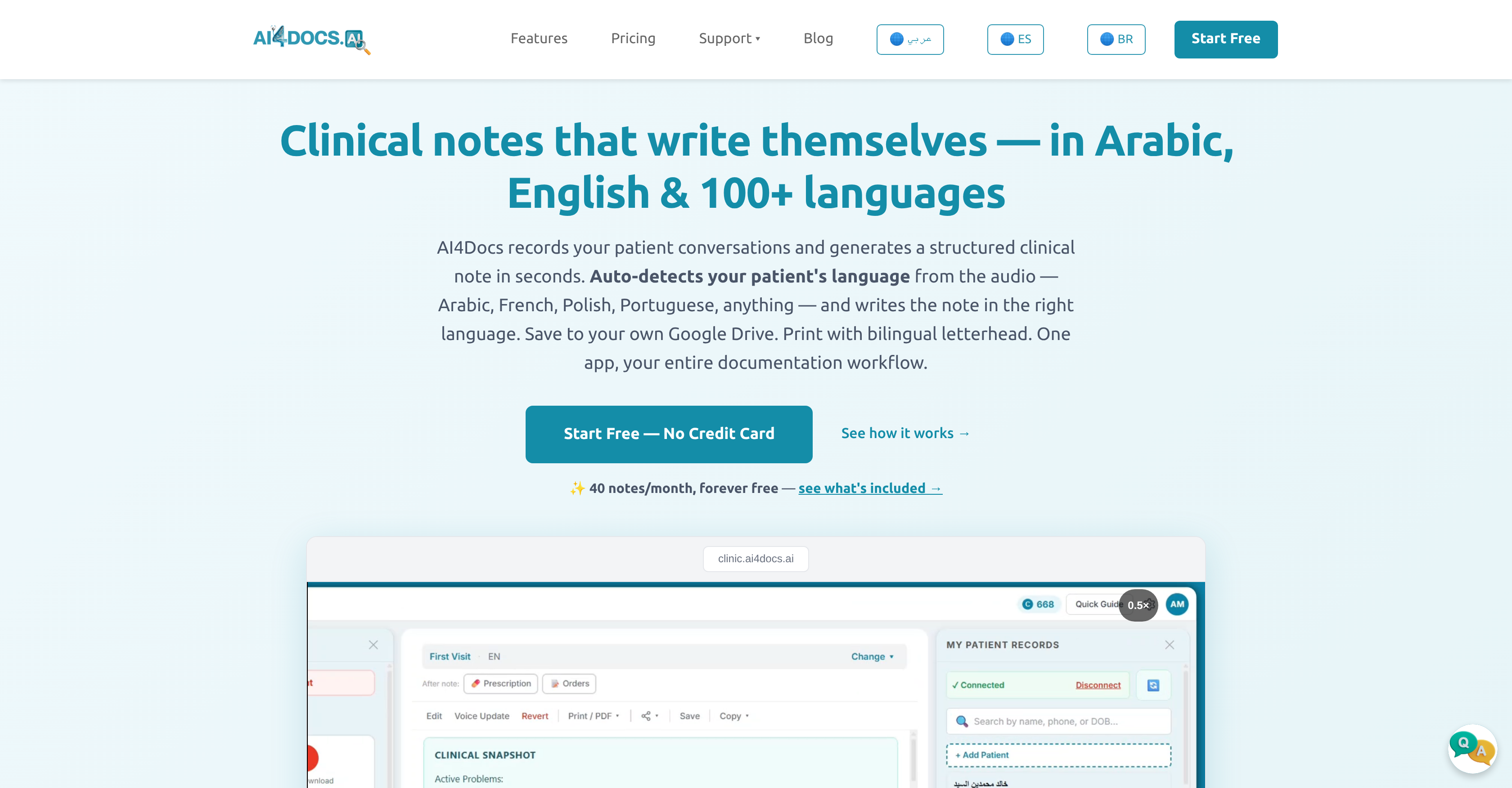
- Complete patient documentation in under 15 seconds by recording conversations and automatically generating structured clinical notes in the detected language.
- Eliminate language barriers with automatic language detection that identifies the patient's language from audio and produces notes in that language, including Arabic dialects.
- Reduce diagnostic uncertainty with an AI 2nd Opinion that combines conversation, dictation, and files to deliver a ranked differential diagnosis with evidence-based treatment recommendations and guideline citations.
- Maintain full data ownership and regulatory compliance by saving all clinical notes directly to your own Google Drive, with zero patient data stored on external servers.
- Capture complete clinical context in every note using a 4-input strategy that simultaneously processes patient conversation, doctor's input, supporting documents, and previous visits.
- Streamline multilingual patient communication by printing clinical notes, prescriptions, and referral letters with bilingual letterhead in Arabic and English on A4 or A5 paper.
- Digitize and organize handwritten patient records by uploading up to 400 images and converting them into a chronological timeline with problem lists and medication histories.
- Update notes hands-free using 30-second voice corrections that automatically place your edits in the correct section of the clinical note.
- Convert WhatsApp patient chats into structured clinical timelines by transcribing voice notes and analyzing lab images into a clean case summary.
- Adapt documentation to any clinical scenario with nine document types including first visit, follow-up, medical report, referral letter, and imaging reports.
Pros & Cons
Pros
- Supports 100+ languages
- Automatic language detection
- WhatsApp chat exports conversion
- Creates structured clinical notes
- Optimized for multiple languages
- Auto-identify patient's language
- Bilingual note printing
- Covers entire documentation workflow
- Supports various note types
- Handles multiple input data types
- Converts WhatsApp voice notes
- Transforms images into clinical timeline
- Generates differential diagnosis
- Provides treatment recommendations
- Patient data secure in Google Drive
- Editable notes with voice updates
- Zero-Storage Privacy policy
- GDPR compliant
- HIPAA eligibility
- Ability to print bilingually
- Minute timeline for handwritten notes
- Data saved to user's Google Drive
- Generates referral letter
- Method to combine four input sources
- Analyzed lab images from WhatsApp
- Free clinical notes per month
- Generates medical reports
- Google Drive integration
- Patient-doctor conversations recording
- Notes created in detected language
- Ranked differential diagnosis generation
- Upload photos of handwritten notes
- Supporting documents as input types
- Integrates previous visits into notes
- Implements voice updates or rich-text editor
- Arabic-aware smart search
- Transforms lab photos into clinical timeline
- Bilingual letterhead option for printing
- Clinical Guideline Citations
- Extracts prescriptions and orders
- Analyzes chat to notes
Cons
- Lacks EMR integration
- Limited output languages
- Dependency on Google Drive
- No support for offline usage
- Requires strong internet connection
- No feature to collaborate/share notes with other doctors
- Potential delays in note generation
- Relies heavily on voice clarity
- Limited to four input sources
Reviews
Rate this tool
Loading reviews...
❓ Frequently Asked Questions
AI4Docs.AI is an Artificial Intelligence-based tool catered to healthcare professionals. It aids in streamlining their documentation workflows by generating structured clinical notes from patient conversations automatically in over 100 different languages. It encompasses the entire documentation workflow, offering services like saving the notes to Google Drive, providing a bilingual print option and integrating with WhatsApp for transcription, among other features.
AI4Docs.AI contains a host of key features, including multilingual support, audio detection, note generation, data input management, voice notes transcription, lab images analysis, and clinical timeline creation. It also offers an AI 2nd opinion feature, differential diagnosis, treatment recommendations, and Google Drive integration. It ensures GDPR compliance and HIPAA eligibility too.
AI4Docs.AI utilises sophisticated audio detection algorithms to automatically identify a patient's language from the audio of their conversation. This makes it versatile and useful in a multi-lingual environment.
In AI4Docs.AI, audio detection is employed to ascertain the patient's language automatically. Based on this audio detection, relevant clinical notes are generated from the patient's conversation, streamlining the documentation process and limiting language barriers.
Yes, AI4Docs.AI can work with over 100 languages. This includes common languages such as English, Arabic, Portuguese and Polish, along with other languages too.
AI4Docs.AI integrates with Google Drive in a way that allows the user to save generated notes directly on their Google Drive. This ensures that patient records are safely maintained and can be further updated as needed, providing convenient access and security.
Yes, AI4Docs.AI offers the option to print generated notes bilingually. This allows healthcare professionals to print documents in two languages which can be useful in multilingual environments.
AI4Docs.AI can generate various note types such as first visit, follow-up, medical report, referral letter, dictation, extracting prescriptions, and orders. This wide range facilitates a comprehensive documentation process.
Yes, AI4Docs.AI has a robust system to analyse both patient conversations and doctor's inputs. It ensures that important information from both parties is included in the generated notes.
AI4Docs.AI can extract data from supporting documents by integrating them into the note-generating process. Whether these are lab reports, imaging, or previous visit records, AI4Docs.AI can read them and incorporate the information where necessary.
The AI 2nd opinion feature in AI4Docs.AI generates a ranked differential diagnosis and flags potential issues. It also recommends treatments based on established clinical guidelines. This can act as a tool for clinicians to cross-verify their diagnosis and treatment plan.
AI4Docs.AI creates a clinical timeline by transcribing voice notes, analysing lab images, and incorporating them into a comprehensive case summary. This timeline provides a clear and organised overview of the patient's medical journey.
The WhatsApp integration in AI4Docs.AI allows users to share patient chats directly to the tool. Voice notes are subsequently transcribed, lab images are analyzed, and the conversation is transformed into a clean clinical timeline complete with a case summary.
Yes, AI4Docs.AI is both GDPR compliant and HIPAA eligible. It maintains a 'Zero-Storage Privacy' policy, ensuring that patient data remains private and is not stored on its servers.
Yes, AI4Docs.AI can analyze lab images. It employs AI technologies to interpret lab results as part of its generation of clinical notes and timeline creation.
Users can update patient records with voice notes in AI4Docs.AI by using the Voice Update feature. This feature allows the user to speak for up to 30 seconds and integrates the update into the correct place in the generated note.
Zero-Storage Privacy in the context of AI4Docs.AI refers to the AI's design to ensure patient data safety. AI4Docs.AI processes notes in real time, stores them only on the user's Google Drive and keeps no copies on its servers, thus ensuring patient data privacy.
The differential diagnosis feature in AI4Docs.AI uses AI-assisted algorithms to weigh various possible diagnoses based on patient data. It generates a ranked list and alerts for red flags, assisting healthcare professionals in decision-making.
The evidence-based treatment recommendation feature in AI4Docs.AI uses AI to generate a range of recommended treatments based on the evidence available from clinical guidelines. This supports the decision-making process in the treatment plan.
AI4Docs.AI offers features that can take up to 400 images of handwritten patient notes and convert them into an organized chronological timeline with problem lists and medication histories – effectively digitizing and organizing handwritten notes.
AI4Docs.AI works by capturing audio from doctor-patient conversations, including the doctor's input and additional supporting documents. It then uses its AI to generate a comprehensive structured clinical note in less than 15 seconds, composed of the patient conversation, doctor's input, supporting documentation, and previous patient visits. Generated notes can then be saved on Google Drive or edited using voice commands or with a rich text editor. Users can print the clinical notes with a bilingual letterhead or share notes as a Word file or link.
AI4Docs.AI supports over 100 languages including English, Arabic, Polish, and Portuguese. It auto-detects the patient's language from the conversation audio.
Yes, AI4Docs.AI can generate various note types such as first visit, follow-up, medical report, referral letter, dictation, and also extracting prescriptions and orders. The physician can choose the desired note type, and the AI will generate it in the specified format.
AI4Docs.AI gives foremost priority to patient data privacy. The AI tool operates on a 'Zero-Storage Privacy' policy; it doesn't store any patient data on its servers. Instead, the system saves clinical notes directly to the user's own Google Drive. The application operates in real-time, processing notes and then returning them to the user's device to ensure maximum privacy.
The 'AI 2nd Opinion' feature in AI4Docs.AI is a feature that allows the AI system to provide a differential diagnosis, identify red flags, and generate evidence-based treatment recommendations, all in adherence with clinical guidelines. This feature is based on patient conversation, the doctor's dictation, and uploaded files such as lab results and imaging.
Yes, AI4Docs.AI allows for the editing of the generated clinical notes. Users can edit the clinical notes using voice commands or with a rich text editor. It provides 'Voice Update' where the users can tap to speak for up to 30 seconds, and the AI slots their correction to the correct place in the note.
Yes, AI4Docs.AI can transcribe voice notes from WhatsApp chat. It incorporates WhatsApp communication into its functionalities, meaning it can transcribe voice notes, analyze lab images, and transform them into a clean clinical timeline with a case summary.
AI4Docs.AI digitizes handwritten prescriptions by allowing users to upload photos of it. AI4Docs.AI then processes the uploaded picture and transforms it into an organized chronological timeline with problem list and medication history.
AI4Docs.AI ensures GDPR compliance and HIPAA eligibility through its 'Zero-Storage Privacy' policy: it doesn't store any patient data on its servers, and processing happens in real-time. After processing, the data is then sent back to the user's device to ensure maximum privacy.
Yes, AI4Docs.AI can handle patient conversation in Arabic dialects. It recognizes every major Arabic dialect, including Egyptian, Gulf (Saudi, UAE, Kuwait, Qatar), Levantine, Libyan, and Yemeni dialects.
The '4-input method' is a unique feature of AI4Docs.AI that combines four input sources into one generation: Patient Conversation, Doctor's Input (which includes typing, dictation, or use of templates), Supporting Documents (like images, PDFs, audio files), and Previous Visits. The AI processes all these inputs at once, ensuring no context is lost.
AI4Docs.AI is integrated with Google Drive. It saves clinical notes directly to the user's Google Drive in a Google Sheet format. This allows the notes to be searchable, organized, and under the user's control.
Yes, AI4Docs.AI has an automatic language detection feature. It auto-detects the patient's language from audio recordings of doctor-patient conversations and generates the clinical note in the autodetected language.
AI4Docs.AI offers a printing feature. Users can print clinical notes, prescriptions, investigation orders, medical reports, and referral letters with bilingual letterhead. The print format includes Arabic on the right and English on the left, with the logo centered, and can be printed either on A4 or A5 paper.
Yes, AI4Docs.AI generates differential diagnoses and evidence-based treatment recommendations. Its 'AI 2nd Opinion' feature combines patient conversation, the doctor's dictation, and uploaded files like lab results and imaging, to provide a ranked differential diagnosis, red flags, evidence-based treatment recommendations, and citations to clinical guidelines.
Yes, AI4Docs.AI can assist in creating referral letters. Users can choose 'referral letter' as the note type, and the AI would generate notes in this specified format.
Yes, AI4Docs.AI provides a feature named 'Voice Update' which lets users speak for up to 30 seconds to edit and correct the generated clinical note, ensuring the correction is slotted into the right place in the note.
Yes, AI4Docs.AI can generate notes for first visit and follow-ups. The tool offers note types like 'first visit' and 'follow-up', allowing users to select the appropriate type for their needs.
The 'Zero-Storage Privacy' policy of AI4Docs.AI ensures that no patient data is stored on their servers. AI4Docs.AI processes data in real-time and then sends it back to the user's device, ensuring maximum privacy. The notes are only saved in the user's Google Drive. Server logs filter out patient identifiers (names, diagnoses, medications) before any archival, supporting compliance with GDPR and HIPAA eligibility.
AI4Docs.AI uses audio detection technology to automatically identify the language used by the patient during the conversation. This feature facilitates the creation of clinical notes in the detected language.
AI4Docs.AI has a feature to transcribe WhatsApp voice notes by analyzing the audio content and converting it into structured clinical notes. It also processes lab images and other information from a WhatsApp communication to generate clinical timelines and case summaries.
AI4Docs.AI has been optimised to work with over 100 languages. Its auto-detect feature identifies the patient's language from the audio to serve its multilingual user base.
Yes, AI4Docs.AI supports the generation of various note types such as first visit, follow-up, medical report, referral letter, dictation, prescriptions, and orders.
AI4Docs.AI can compile input from four data types: Patient Conversation, Doctor's Input, Supporting Documents, and Previous Visits.
The AI 2nd Opinion feature of AI4Docs.AI combines patient conversation, physician's dictation, and uploaded files to generate a ranked differential diagnosis, evidence-based treatment recommendations, and citations to clinical guidelines.
Clinical notes created via AI4Docs.AI are saved directly to the user's Google Drive. The user retains full control over their data and patient information never touches AI4Docs.AI servers.
Yes, the generated clinical notes can be modified using rich text or using a 30-second voice update feature.
AI4Docs.AI's bilingual letterhead printing feature allows documents to be printed with dual-language headers, catering to multilingual communication needs.
Yes, AI4Docs.AI operates under a 'Zero-Storage Privacy' policy, ensuring compliance with GDPR and HIPAA protocols.
AI4Docs.AI supports the entire documentation workflow process by recording patient-doctor conversations, auto-detecting the patient's language, generating structured clinical notes, saving them to Google Drive, allowing bilingual printing, and providing an AI 2nd Opinion feature.
AI4Docs.AI incorporates WhatsApp communication into its input. It transcribes voice notes, analyses lab images, and transforms the complete conversation, along with all supplementary data, into a structured clinical timeline with a case summary.
AI4Docs.AI can generate structured clinical notes typically in less than 15 seconds.
AI plays a core role in the functioning of AI4Docs.AI. From language detection and transcription to creating structured clinical notes from varying input types, everything is powered by advanced AI technology.
AI4Docs.AI employs a strict data security policy. The notes are handled in real time and directly saved to the user's Google Drive. No patient data is stored on AI4Docs.AI servers.
Yes, AI4Docs.AI can generate referral letters as a part of its varied note generation capabilities.
AI4Docs.AI is designed to understand every major Arabic dialect, including Egyptian, Gulf, Levantine, Libyan, and Yemeni, thus accommodating a wide range of Arabic speaking users.
AI4Docs.AI offers bilingual letterhead printing, enabling users to print in A4 or A5 formats with Arabic on the right and English on the left.
AI4Docs.AI uses sophisticated AI algorithms to accurately transcribe spoken language, including the conversion of patient conversations and voice notes into structured, written, clinical notes.
Pricing
Pricing model
Freemium
Paid options from
$15/month
Billing frequency
Monthly
Refund policy
View Policy
Related Videos
My Patient Records — Save & Search Clinical Notes within AI4Docs | In Google Sheets in your drive
AI-Powered Medicine•24 views•Apr 1, 2026